Three days back saw a chart - A person came from Mumbai 65 years of age- everything he built gone due to leverage and options market.
Company worth from 30000 Cr to almost Zero- Debt ridden - My suggestion to young generation is - you can be in the game from last 40 years but one day - only one day it will come -when everything will go.
Never ever touch Options, leverages- The person had his own broker company and far better resources/knowledge and experience than you have, and still in old age everything gone.
I got so deeply impacted by consultation that i got sick from last three days- I wake up -eat food, medicines and sleep- Never ever do leverages
Compliant fuel should be available for all Cars
E10 for E10
E20 for E20
Logistics headache is not our headache. We have paid 40% GST on our car with 15 years registration cost. We need that fuel or ask brands to cover us for all repairs for 15 years.
Farmers & Sugar Mill income shouldn’t cost us repairs.
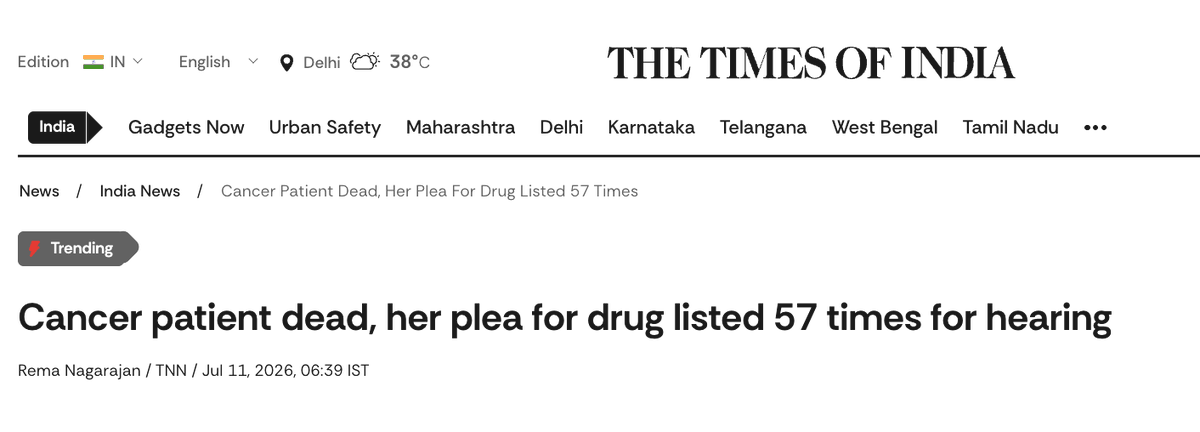
Cancer patient was about to die. She pleaded. Her plea has been listed 57 times. The court has still not heard it. Teesta Setalvad was about to be jailed. She pleaded. Her plea was listed out of turn. The court heard it at midnight.
Cancer patient is dead. Teesta is alive.
भाजपा के दो समर्थक, दोनों कट्टर दक्षिणपंथी, सनातनी और राष्ट्रवादी, 20% एथेनॉल नीति पर चर्चा कर रहे हैँ । इनका कहना है कि जितना पेट्रोल आप एथेनॉल मिलाकर बचाते हैं, उससे 10 गुना ज़्यादा ईंधन ट्रैफिक जाम और खराब सड़कों में बर्बाद हो जाता है। बाइक और कार मालिकों को एथेनॉल के कारण अपने इंजन की सुरक्षा के लिए अतिरिक्त किट लगवानी पड़ेगी, उसका खर्च कौन देगा? इथेनोल के उत्पादन में भारी मात्रा में पानी की खपत होती है और इसके पर्यावरणीय प्रभावों पर भी कहीं गंभीर चर्चा नहीं हो रही।
इन दोनों से अलग मेरा कहना है कि अकेले दिल्ली में प्रवेश करते समय सभी बॉर्डर पर टोल के कारण जो लंबा जाम लगता है, उसमें जितना पेट्रोल बर्बाद हो जाता है, उसे 100% एथेनॉल नीति भी नहीं बचा पाएगी।
@ARanganathan72@ajeetbharti
@volklub Rejected Slavia 1.0 tc for Honda city Cvt considering long term reliability, 1st time car buyer, sedate driving and mix of city and highway use . @volklub Your videos helped me take the decision.
U-turn or Right Turn?
What ET Money is doing now is not a U-turn — it is perhaps the most sensible and appropriate thing to do.
From the beginning, I have believed that in a country as diverse as India, the only advisory model that has survived, thrived, and will continue to scale sustainably is the MFD model.
Neither RIAs nor FinTech platforms have the ability, readiness, or bandwidth to offer personalised guidance and handholding the way individual MFDs can.
Finfluencers talk endlessly about direct plans and passive funds because that’s what grows their follower base and social media income. They too are making money off their audience — and there is nothing wrong with that. Nothing in this world sustains without a profit motive.
But here’s the reality everyone tiptoes around:
Indians do not pay for advice.
If you don’t offer it free, you’re called names. The steadily shrinking RIA space only reinforces this truth.
Few AMCs that initially avoided MFDs and ignored their power missed out on the massive AUM boom. Today, those same AMCs are recalibrating.
Some journalists, who often slip into activism in the guise of reporting, are now blaming policymakers — they have turned into the Yogendra Yadavs of personal finance.
Even the regulator has clearly acknowledged the critical role MFDs play in expanding financial inclusion and investor participation.
So the real question is:
Why tweak or break a system that has worked exceptionally well for decades?
Being Right or Doing the Right Things!
What is more important?
The recent SEBI investor survey raises more questions than answers — and perhaps poses new challenges for all of us in the financial ecosystem.
The survey says:
“63% of Indian households — that’s 213 million — know about at least one securities market product (Mutual Funds, ETFs, Shares, F&O, REITs/InvITs, Bonds, AIFs).”
That’s impressive. But does awareness automatically translate into participation?
Perhaps yes, perhaps no.
Being aware is not enough. Long-term investing demands patience — and patience is a scarce virtue. Some people show it in relationships, some in career or health, but very few in all aspects of life — especially in investing.
Many can take credit for spreading awareness.
But who will take responsibility for driving participation?
Another data point from the same survey is equally revealing — and ironic.
“Nearly 80% of households prefer capital preservation over higher returns, showing a strong aversion to risk. Even 79% of Gen-Z households display risk-averse behaviour.”
Now contrast this with the reality:
The same set of investors has lost ₹2.8 lakh crore in F&O, and large sums in gaming.
Isn’t it ironic?
On one hand, investors claim to prefer capital preservation; on the other, they speculate aggressively in derivatives and games of chance.
So what is really needed?
-More handholding.
-More in-person consulting.
-More one-on-one education.
But who will do this?
Only Mutual Fund Distributors (MFDs) can bridge this gap — yet, the ecosystem seems distracted.
The focus has shifted to Direct, Passive, Reducing TER, and at times, bad-mouthing MFDs — labeling them as “agents” or “conflicted”.
The media narrative often glorifies RIAs while downplaying the efficiency of the homegrown MFD model.
Are MFDs really conflicted, and RIAs truly conflict-free? The ground reality says otherwise.
If someone believes MFDs only sell higher-commission products — let’s see the data.
If that were true, the best-performing schemes wouldn’t have the largest AUMs.
AMFI has enough data to validate this. Regulators and AMFI can — and should — issue reasoned clarifications to allay these misconceptions.
Yes, action must be taken against errant MFDs. But let’s also recognize that the scope for mischief in MFD business is minimal.
No one with questionable practices has ever scaled up meaningfully in this space. Can the same be said about every other profession?
It’s time SEBI and AMFI openly support the MFD model — not short-change it.
Because being right is good —
but doing the right things for investors is what truly matters.
@lunarastro108@SsupritBhalla I listened both of them back to back. Pt. Bhimsen ji version made me couch on the sofa , the next one by Sanjeevji Abhyankar , I could not stop moving while listening to it.
This report and headlines are wrong at so many places. Here are my observations:
1. What is the point of comparing with TRI when no one can invest in TRI.
2. Better to compare with Index Funds. The numbers will change as IF underperform TRI by 1% plus point.
3. No consideration is given for RIA charges which can on an average be around 0.75% plus 18% GST = Total of 0.89%. Put these things together the gap is reduced by 2%.
4. Assets weighted returns are very different. My study shows that asset weighted AUM outperforms passive for 80-90% of AUM. Is this correct to compare Samco Fund with 40 cr of AUM and ICICI Fund with 40,000 crs of AUM. In this report both funds are given equal weights!
5. These reports are essentially prepared by SPIVA. It’s stands for Standard Poor Index Versus Active.
6. SPIVA makes money on the launches of passive funds. It’s in their interest to promote passive.
7. If it’s for DIY why then Direct Plans of active funds should be compared with Direct Plan of IF.
8. This report no where mention that 100% of passive funds underperform TRI at 100% of time.
The first step for us Indians to learn spirituality will be to learn how to drive with patience, to give way to others and be more sensible while driving.
This might sound like a small change, but every small change has behavioral effects which have snowball effects, the society without compassion is not going to reach any destination.
I have seen everytime you will do act of stopping your vehicle and give way to others, The amount of thankyou you get makes your day, You need to do this for your own mental health.
This is the first time I am asking everyone to retweet this- forget the government; we as a society need to change first. #driving #vehicles
Some basics
1) Have an emergency fund of not less than 1 year of your expenses.
2) Insure: Term, medical, personal accident and fire insurance for your house.
3) Don’t use revolving credit on your credit cards.
4) Simplify: have two bank accounts, two credit cards and two demat a/c.
5) Write a will.
6) Don’t borrow except for buying a house.
7) Ensure the value of the house is not more than 5 times your annual salary.
8) Create a corpus of not less than 30 times your annual expenses before considering retirement.
9) Spend less than you earn.
10) Try to save 30% of your salary.
11) Invest regularly.
12) Invest for long term; not less than 10 years, preferably 20 years or more.
13) Never stop your SIPs, especially in bear markets.
14) Never forget that all asset classes would always be cyclical.
15) Equity would provide the best return over long run than all other asset classes.
16) Follow portfolio diversification.
17) Follow asset allocation.
18) Have an advisor. The reward is worth the cost.
19) Check and review your portfolio only once a year.
20) More than your knowledge, it’s your behaviour which matters most for success in markets.
21) Come what may; always stay the course.
Bullish on stocks. Bullish on Indianness. And unreservedly bullish on his political choice.
Goodbye #RakeshJhunjhunwala, the Sensexational moneymaker with Nifty investment skills. Om Shanti.
Proud Moment for the MF Industry Honorable PM Shri Narendra Modi spoke about the robust growth of the Mutual Fund industry, at GIFT City today. He mentioned that MF industry grew by 250% from ₹10 lakh crores AUM in 2014 to over ₹35 lakh crores in Jun'22
https://t.co/2xYp4aYVex