The city of Denver makes it’s PBM contract available online. So I grabbed it and had Claude look at it and answer a simple question “Where are they getting ripped off”
Here is it’s response:
Denver is getting hit in six places, and the contract says so out loud. This is a self-funded City & County of Denver plan (4,051 employees / 8,554 participants, 1/1/2023–12/31/2025, $80M max) where the only stated pharmacy fee is… nothing. The medical admin fee is $45.13 PEPM. There is no PBM admin fee. That’s your first tell — the pharmacy program is priced entirely in the dark.
1. Spread pricing, written into the contract three separate times. Section A7 (Claims Processing): on mail, specialty and retail, United retains the difference between what it reimburses the network pharmacy and what Denver pays. It’s repeated in the General Conditions of the Pharmacy Financials exhibit and again in the Specialty Pharmacy Discount Guarantee conditions. So the AWP-discount guarantees describe what Denver pays — not what the pharmacy receives. The delta is Optum’s revenue, uncapped and unreported. For a public entity, that’s the whole ballgame. FTC found the Big 3 generated an estimated $1.4 billion of spread income on specialty generics alone.
2. Rebates: 100% retained, replaced with a fixed per-script number. Section A8: United keeps 100% of pharmacy rebates and pays Denver a fixed brand-script guarantee instead — $740.43 retail / $1,020.22 mail in 2023, rising to $885.02 / $1,105.10 by 2025. The contract then says explicitly that any rebates above the fixed amount are United’s to keep. Manufacturer rebate administration fees are folded into the guarantee, meaning they’re netted against what Denver was already owed rather than paid over. Denver has no idea what the actual rebate yield is, and no contractual right to find out.
3. The Rebate Credit clause is the biosimilar killer. If Denver moves to a biosimilar, an authorized alternative, or a lower-WAC brand, United gets credited toward its rebate guarantee for the manufacturer revenue it would have earned had Denver stayed on the high-rebate originator. Translation: United is financially indifferent to Denver buying the cheaper drug. Denver’s savings on ingredient cost get clawed back through the rebate math.
4. Your five clauses — all present, all in United’s favor. Specialty Drugs are defined as “Prescription Drugs available at United’s Specialty Pharmacy.” That’s a circular definition: whatever Optum stocks is specialty. Then: “United reserves the right to change the designation of a drug from specialty to non-specialty based on market conditions.” Then: specialty dispensed inside United’s specialty network is excluded from the retail and mail guarantees. Specialty dispensed outside it gets swept into the retail guarantee. Specialty rebates are “included in retail.” The specialty guarantee itself is 20.7% off AWP composite — and any specialty drug not on United’s list is guaranteed at only 14.0%. United controls the list. Every new high-cost launch defaults to the 14% bucket. And spread is retained on top of the discount either way.
5. Medical-benefit specialty has no guarantee at all. “Specialty drugs typically covered under the medical benefit (physician’s office, ambulatory, home infusion), and/or transitioned to the pharmacy benefit, are excluded from all guarantees.” That’s the buy-and-bill oncology and infusion book — the most expensive spend in the plan — with zero pricing accountability. On medical drug rebates Denver gets 80%, United keeps 20% plus float interest, and an unnamed subcontractor takes an undisclosed cut on top.
6. The lock-in clauses, which are the reason you can’t fix any of the above. Denver may not negotiate with any manufacturer for rebates or direct purchase — doing so forfeits earned-but-unpaid rebates. All pricing guarantees require United as exclusive mail provider. Terminating pharmacy services early means United keeps every pending and future rebate.
@GilsArenaShow@woodypaige@KenyonMartinSr IYKYK - Nikola is one of the best EVER. Should be getting praised like Larry and Magic. Almost silly how little respect is put on his name.
"You've never heard it till you've heard Eddie Vedder sing it."
Such respectful lines by Tom Petty, then he invites Eddie Vedder to stage.
There you have a beautiful performance of a song called 'The Waiting' live in 2006.
Tom Petty & The Heartbreakers and Eddie Vedder, the frontman of Pearl Jam, performing a great rendition of The Waiting.
This is what the internet was invented for.
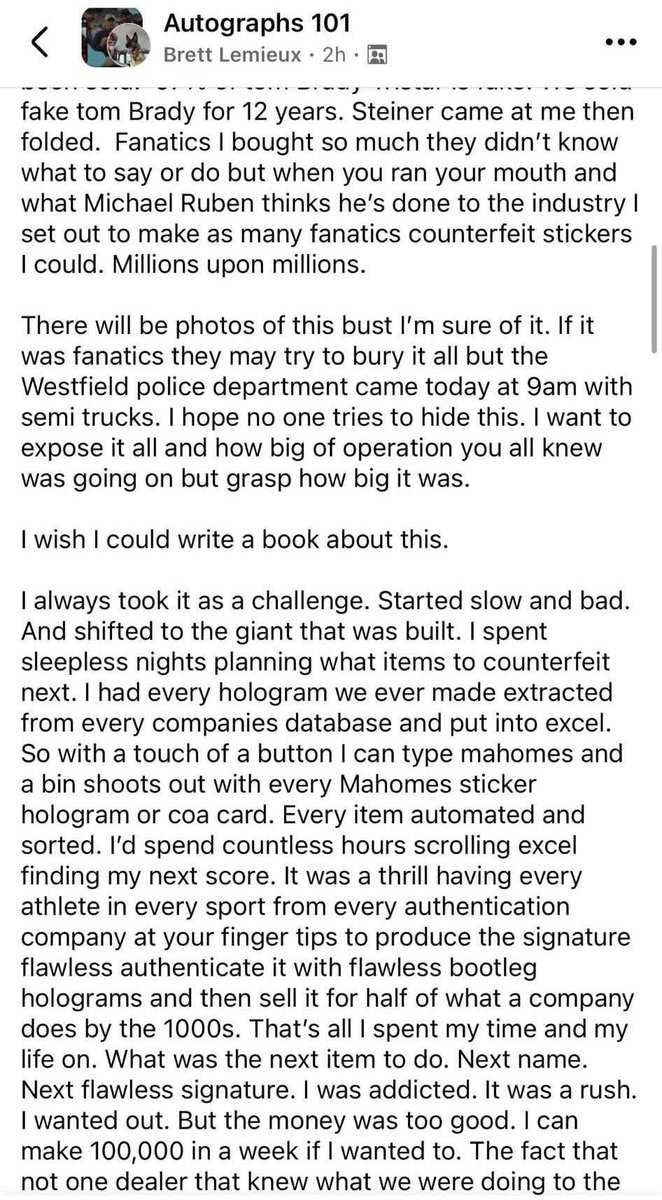
BREAKING: Officials have identified autograph dealer Brett Lemieux as the man found dead in a raid on fake memorabilia in Westfield, Indiana.
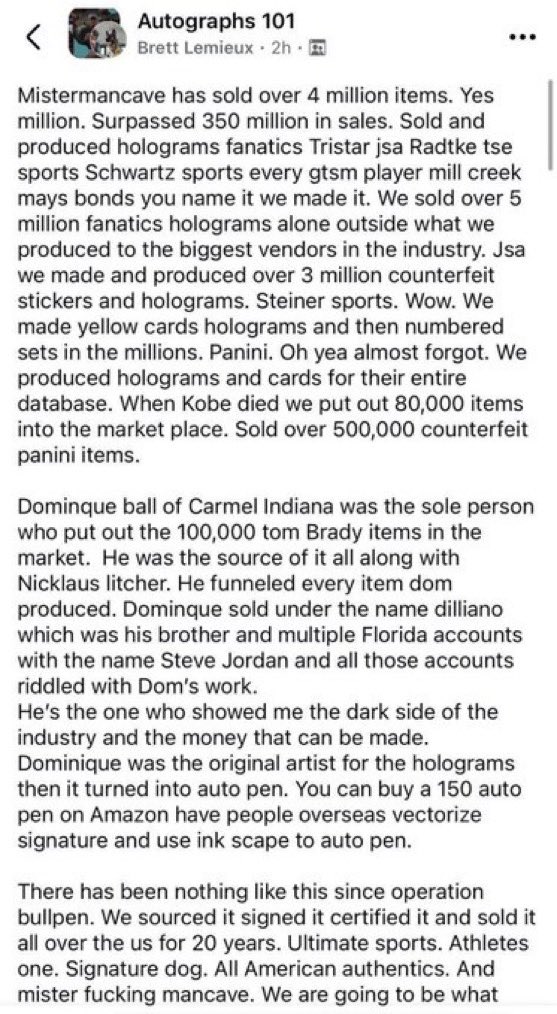
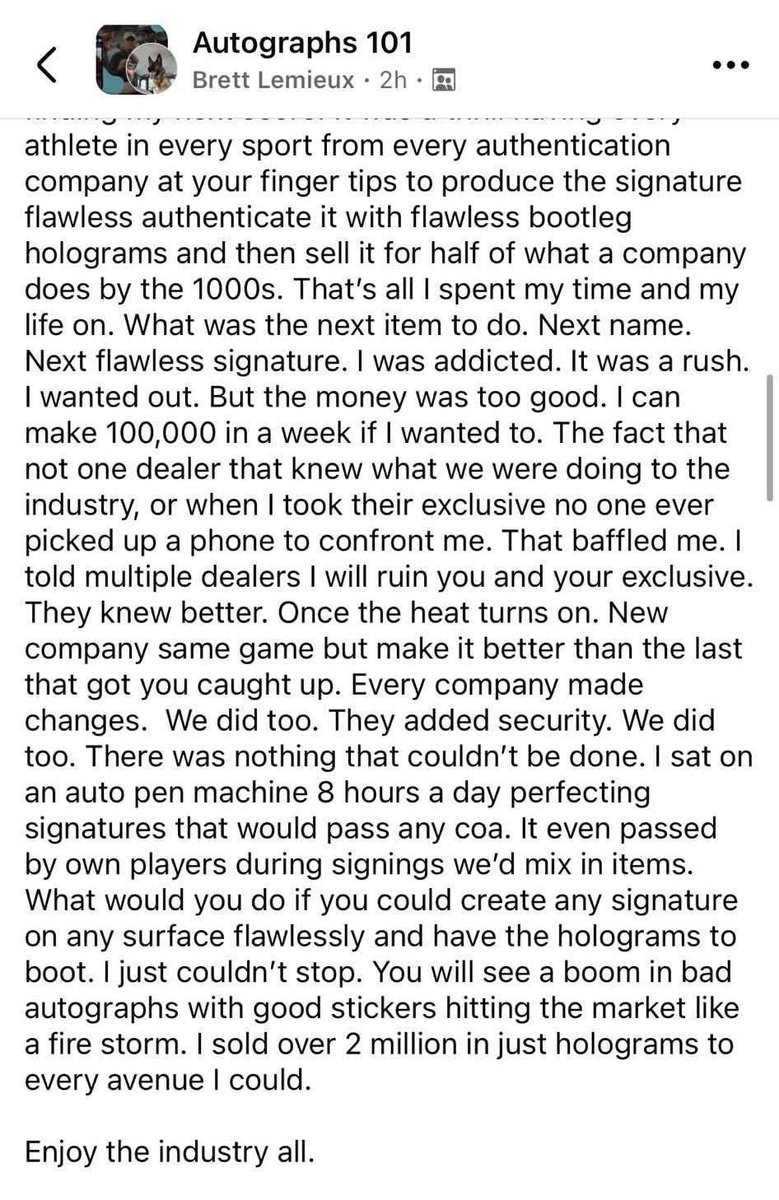
A long Facebook post attributed to Lemieux detailed a scheme involving millions worth of fake autographs.
https://t.co/phkypHgHZg
𝗗𝗘𝗩𝗘𝗟𝗢𝗣𝗜𝗡𝗚: A disturbing Facebook post from Brett Lemieux, shared in the “Autographs 101” group, appears to be a jaw-dropping confession to one of the largest sports memorabilia fraud operations in history.
Lemieux details a decades-long scheme involving the production and sale of millions of counterfeit autographs, holograms, and authentication stickers for stars like Tom Brady, Kobe Bryant, Patrick Mahomes, and Aaron Judge.
He claims his team infiltrated databases from various major memorabilia companies, selling forged items across the industry undetected for years. The post also alleges law enforcement recently raided the operation, with semi-trucks seizing over $500M worth of fake merchandise.
Recent reports of a deceased body have been confirmed at the site of the raid, but the investigation is still pending.