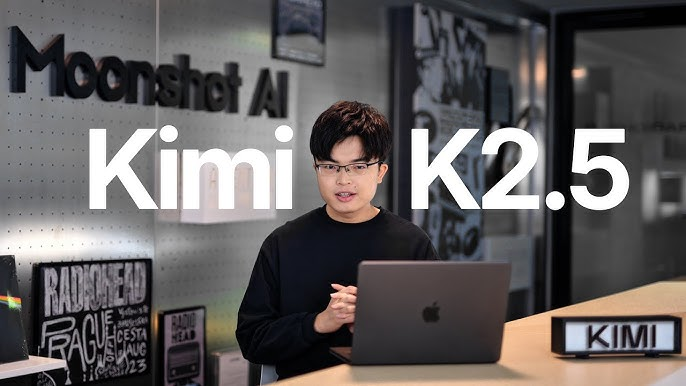
A kid from Shantou with no programming background got into Tsinghua University's computer science department by winning a high school informatics olympiad, then quit a job offer from Google Brain to start an AI company in Beijing with two of his college bandmates. Four years later that company released a 1 trillion parameter open-source AI model that outperformed every American closed model on coding benchmarks and became the fastest Chinese tech company in history to hit a $10 billion valuation.
His name is Yang Zhilin. The company is called Moonshot AI. The model is called Kimi K2.
Here is the story.
Yang was born in 1992 in Shantou, a small city in Guangdong province. In high school he had never written a line of code. He got selected for an informatics olympiad training program anyway. He won first prize at the Guangdong provincial level, which got him guaranteed admission to Tsinghua University.
He scored 667 on the gaokao, far above the Tsinghua cutoff. But the system placed him in Thermal Energy Engineering. He transferred to Computer Science in his sophomore year. He graduated in 2015 ranked first in his department class. During undergrad he was advised by Tang Jie, a Tsinghua professor who would later co-found another Chinese AI giant called Zhipu.
He went to Carnegie Mellon for his PhD under Ruslan Salakhutdinov and William Cohen. He finished in under four years. During that time he co-authored two of the most influential papers in modern AI, Transformer-XL and XLNet, which together shaped the long-context capabilities every modern LLM relies on. He worked at Facebook AI Research and Google Brain. He contributed to the original Google Gemini and Bard projects.
Then in November 2022 ChatGPT launched.
Yang flew back to the United States, looked at what OpenAI had done, and made up his mind. He told an interviewer later that he sensed two things were about to move at once, capital and talent, and when those two move together it is the rare moment when you can build a company from zero to one whose only purpose is AGI.
In March 2023 he founded Moonshot AI in Beijing with two Tsinghua classmates, Zhou Xinyu and Wu Yuxin. The three of them had been bandmates in a college rock group called Splay. The company name is a tribute to Pink Floyd's Dark Side of the Moon, Yang's favorite album. The company launched on the album's 50th anniversary.
He raised $60 million and built a 40-person team in three months. By 2024 he had raised over a billion dollars. The investors included Alibaba, Tencent, and Sequoia China. Moonshot AI became the fastest Chinese startup in history to reach a $10 billion valuation. ByteDance took four years. Pinduoduo took three. Moonshot did it in two.
In October 2023 they launched Kimi, a consumer chatbot with a 200,000 character context window, the longest in the world at the time. By 2024 it was running on Chinese hardware and had tens of millions of users.
Then on July 11, 2025 they released Kimi K2.
K2 is a 1 trillion parameter Mixture of Experts model that activates 32 billion parameters per inference. It is open weights. It beat GPT-4 and Claude on coding benchmarks. It outperformed DeepSeek V3 on agent tasks and tool use. Former OpenAI researcher Andrew Carr publicly said K2 communicates differently than other models, refusing to be sycophantic and pushing back on bad ideas the way few models do.
By early 2026 Moonshot had crossed $240 million in revenue. The Kimi K2.5 release exceeded the entire 2025 revenue total in under 20 days. K2.6 dropped in April 2026 with a SWE-Bench Pro score of 58.6, ahead of the leading closed-weight coding models at the time.
A kid from Shantou who had never coded a line in high school just released the open-source model that competes head-on with everything OpenAI, Google, and Anthropic have shipped.
He named it after the dark side of the moon.