Wife, mother, homeschool teacher. I love my land, I know what I know, and nothing more. An ever evolving version of self. TV show- Overlooked Critical Matters
Pterodactyls in Mexico.
Aliens are real.
Flying cars.
Quantum Computers.
Mass cyber-attacks.
Rocket Ships.
Drone wars.
Bombing of Iran.
This is just in 2026!
I was born in 1989 and below are just SOME of the events that have occurred in my 37 years of life.
1989: Fall of the Berlin Wall (November 9), triggering the Revolutions of 1989 across Eastern Europe and the collapse of communist regimes.
1990: Nelson Mandela released from prison after 27 years.
1991: Gulf War; formal dissolution of the Soviet Union, ending the Cold War and leaving the US as the sole superpower.
1990s: Rise of the public internet and World Wide Web
1999–2000: Y2K (ifykyk)
2001: September 11 attacks
2003: US-led invasion of Iraq
2004: tsunami killed 235k+
2005: Hurricane Katrina
2007–2008: Launch of the first iPhone; Global Financial Crisis / Great Recession begins
2008: Barack Obama elected (counts as a tragedy!)
2011: Osama bin Laden killed
2014: Russia annexes Crimea (rise of Isis). Live beheadings anyone?
2019–2023: COVID-19 pandemic (still not recovered!)
I am not even 40 yet and we are reliving the potential of y2k and 911 simultaneously at the same time, all the while seeming to never stop being sick from what is most likely lab grown illness. Let's not forget our lab grown meat, butter, and fruits that we now consume and are considered "real" food that I am sure has played no part in the growth of illnesses. 🙄 Then some of you wonder why millennials are tired?
So, I am genuinely curious, if you are older than me, what did your first 37 years of life look like (excluding what we already know above)? What dinosaur or "confirmed" alien sightings did you have? Lab grown illness? Are you just as tired as me?
Dear lord, I didn't even get into politics in this decade or our government itself. Epstein files? Pedophile Island? Demons? He/She?
Every day I wake up and wonder what new and improved chaos I will learn about today. At this point, the chaos is just comical. Why do you think millennials are so funny?
Also, how many people think that the recent shut off of CERN may be playing a part? I mean, dinosaurs and futuristic growth all at once? I am just saying, are we ruling out a clash of the multi-verses or is this just another Wednesday in the life of millennials? While we are at it, who remembers that Mandela was killed and not released?
I don't know, perhaps you can all shed some lite on this crazy life. For now, I am going to go drink my coffee, read my bible, say a little prayer, and then can me some goods.
Already over this month! Love you all. 🤝🫶
@Valliant4TX There is one about providing water at polling stations too.
One for making feb 4th muslim heritage day.
Two to change the state bird.
One to recognize English as the language of Texas.
I could keep going.
Saturday, I got caught up on reading all of the bills already filed for the 90th (R) session (more than 1,400 filings) and these are some of what I flagged of interest so far. There are other categories I flagged, including taxes, but I’ll share my thoughts on those later after I get clarification on a few things. For now I’m focusing on my personal work priorities. These are the bills I flagged:
Data Center Tax Breaks & Incentives:
HB 408, HB 750, SB 293, HB 1139, HB 732. These repeal or end sales-tax exemptions for data centers and large projects. Some stop new exemptions while letting already-certified facilities finish out; others cut existing ones sooner and block pending applications. HB 732 also bars data centers from state and local economic development incentives, tax abatements, and grants.
💪Why these matter to me: Taxpayers should not be subsidizing energy-hungry corporate facilities that strain rural land, water, and the grid.
Local Control, Siting Safeguards & Rural Protections:
HB 928, HB 529, HB 547, HB 561, SB 296, SB 338. These give counties (especially in unincorporated rural areas that lack zoning) a real say, including public hearings and approval processes, before data centers or large-load facilities can move forward. They require noise studies, site approvals, water-impact assessments, and notice. SB 296 adds a temporary moratorium, local-option elections, annual payments to county residents, and penalties. SB 338 adds rules on grid interconnection, water use, and limited incentives.
💪Why these matter to me: Rural Texas needs strong safeguards and local input before any of these projects proceed. People should come before unchecked corporate development.
Grid Security, Large-Load Costs & Transparency:
HB 589, HB 949, HB 1005, HB 1092, HB 1135, HB 1145, SB 280, SB 284, SB 287, SB 292. These require state permits for big computing sites before construction, shift transmission and infrastructure costs onto the data centers themselves instead of ordinary ratepayers, mandate public reporting on power and water use, and increase transparency around the deals. Some stop utilities from socializing the costs of plants built mainly for a single large user unless it clearly benefits everyone else.
💪Why these matter to me: We need a more secure Texas grid, but not at the expense of We the People. Costs and risks should not be shifted onto households so corporations can profit.
Other Transparency Measures:
HB 696, HB 734, HB 905, HB 906, HB 907, HB 908. These prohibit governments from signing deals that hide data-center project information, require public disclosure of economic-development agreements involving data centers, and strengthen open-records processes.
Other bills I flagged of interest that cover related topics such as cybersecurity for utilities, local energy options, or public process:
HB 307, HB 817, HB 871, HB 881, SB 73, SB 77, SB 120, SB 165, SB 168, SB 354, SB 359, SB 366, SB 391
Overall, the strongest bills I’m watching attack data-center subsidies, give rural counties and residents real say (votes, hearings, moratorium options, payments), force cost and impact transparency, and try to keep grid upgrades from landing on ordinary ratepayers. That lines up with what I want to see: people above corporations, full transparency, and real safeguards before any of these projects move forward in rural Texas.
If you would like to review these yourself, this is how to look up them up on Texas Legislature Online:
⚡Go to https://t.co/3gXT0kIuZZ
⚡In the search bar (or under “Bill Search”), enter the bill number.
⚡Make sure the session is set to 90(R) (90th Regular Session).
⚡Click the bill number in the results (Look for Text).
I’ll keep following these and share updates as they move.
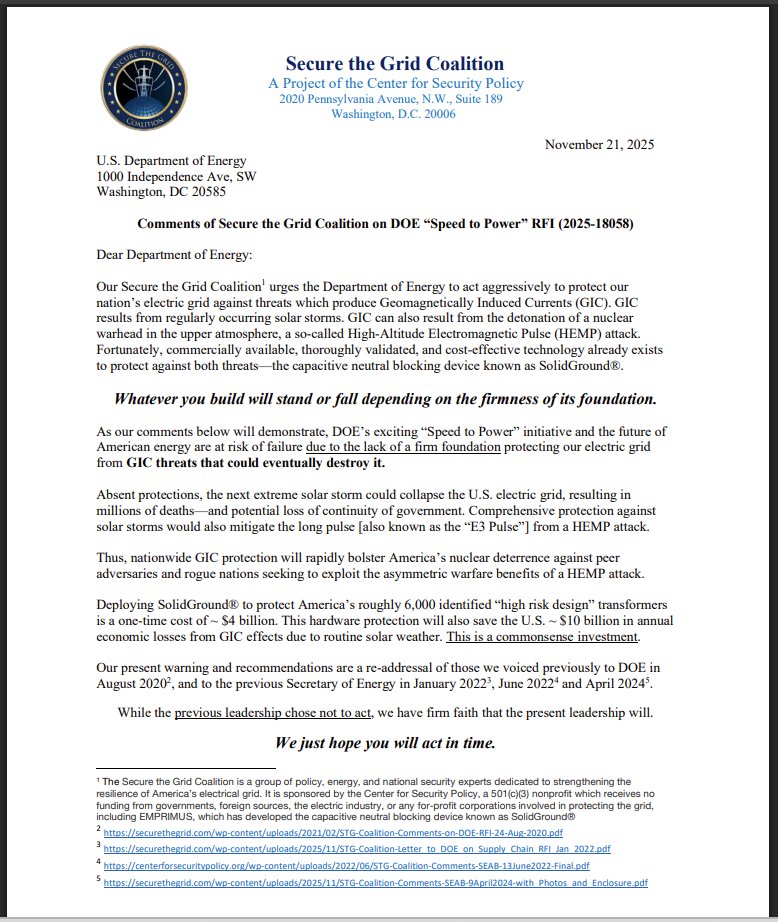
Our electric grid has an Achilles’ heel that most Americans have never heard of:
The large power transformers that keep the lights on. These transformers are vulnerable to Ground Induced Currents caused by solar storms and by a high-altitude nuclear EMP. A severe event could damage or destroy thousands of them. Because the lead time to build and deliver replacements is typically 4–6 years, the resulting blackout would not last hours or days. It could last years.
This is not a partisan issue. A long-term grid collapse would affect every American the same way, regardless of politics or location. It is a national-security and civilizational survival issue.
The technology to protect these transformers already exists, has been tested and validated, and has operated successfully on the grid for more than a decade. One-time costs for nationwide protection of the highest-risk units are estimated in the low billions, far less than the economic damage a single major solar storm can cause. Yet current NERC reliability standards remain far below the GIC levels seen in past storms and far below international recommendations for EMP protection. Years of comments to the Department of Energy and a formal complaint to FERC have not produced the necessary action.
At this point, only a presidential emergency order can direct the utility industry to install proven, cost-effective protection before the next major solar storm or a deliberate EMP attack.
Please sign the petition calling on the President to issue that emergency order and protect America’s transformers. The future of reliable electricity for the entire country depends on it.
Sign Here and Please share encouraging others to sign!
https://t.co/NBvdjmR5OH
PS- this petition does ask for a donation. Do NOT donate to the petition, your signature is enough. You can bypass the donation by sharing the petition instead. The goal is to get as many Americans as possible to help us hold the line and ensure the lights are not compromised by another vulnerability. There is enough going on in the world without another threat to our electricity. Let's try to work together to finally fix this vulnerability that has been known for too long to be real!
Learn more about the very REAL vulnerability here:
https://t.co/5GeovobFm7
I do have one more special note on a bill I really liked.
HB 817: Requires state officials and agencies to refer to public money as “the people’s money” (instead of “government funds,” etc.) in official documents, publications, and notices.
I think this one should be a no brainer but far too often I hear people talk about "free money from the government" or the "government is paying for it, not me". Too many people do not seem to know or understand that the only money the government has is "The People's Money". Nothing from the government is free, it came at your expense, and more people need to understand that.
This is another great reason why We the People should be following these bills, the legislative session, and going on record what our stance is on the proposed new statutes or amending of existing ones. We The People are who government serves and we have an important role that many of us have slacked on for too long. It is time we pay attention, stay alert, and hold them accountable to whom they serve.
Together is the only way to move forward with real change.
The 90th session is beginning, and I am asking for help.
Legislation is being filed. The next few months will be busy as I work to be a voice for the public in Austin. What will I be fighting for? Protecting farmland, protecting water, and pushing for a more secure Texas grid. That means more trips to the Capitol, more research, more packets, and more time on the road.
I am asking for help as we approach the new year and the session gets underway. Five dollars, ten, twenty, or twenty-five can make those trips easier. Donations help cover ordinary costs such as gas, meals, and car maintenance so the work can keep moving.
If you would rather hire the help directly, that is available too:
- A presentation for your county, club, or organization
- Attendance at commissioner's court or city council
- A consultation on the issue in your county
- Assistance with a public information request
It begins with a conversation either way.
Venmo: @Cinder89
Cash App: $LEAFconsulting
Zelle: 469-595-1691
[email protected] | 469-595-1691
https://t.co/UMEWCbrSg7
Send what fits today. Then share this with one person who wants a stronger voice for rural Texas in Austin.
No Government Should Sign a Contract That Hides Information From the People It Serves!
A new bill in the Texas Legislature would let cities, counties, and state agencies sign secrecy agreements with data center companies.
House Bill 374 does not ban these secrecy deals. It allows them. It sets a few rules: the agreement can last up to two years, the city council or county commissioners must vote on it in a public meeting, and there must be some public notice beforehand. If officials break the rules, the penalty is small.
That is not good enough.
Under no circumstances should any government sign a contract that hides information from the people it is supposed to serve. Period. When a project can raise your electric bill, strain the water supply, bring constant noise, or change your neighborhood, you have a right to know the details while decisions are still being made. Not after the deal is done. Not after the company has already locked in tax breaks or land deals.
Data center companies have used these secrecy agreements in Texas and across the country. Local officials sign them and then cannot answer basic questions from residents: Who is the company? How much power will it use? Where is the water coming from? How much tax money is being given away? People often find out only when it is too late to stop or change the project.
HB 374 would write this practice into state law. It would say, in effect, that hiding information is acceptable as long as you follow a few steps. That sends the wrong message. Government works for the public. It should not have secret side deals with private companies about projects that affect everyone around them.
Many communities have already said they want transparency, not secrecy. Other bills filed for the upcoming session would give counties more power to say yes or no to these projects and demand more information up front. HB 374 moves in the opposite direction.
The Texas Legislature starts its session in January 2027. This bill has already been filed. Now is the time to make it clear to your state representative and senator that you do not support any law that lets government hide information from the public.
No secrecy contracts. No exceptions. If a company wants public land, public water, public roads, or public tax breaks, the public gets the full story.
The bill can be found here:
https://t.co/1m8wnzKibv
Be ready to file opposition to this via public testimony in the 90th session!
The Secure the Texas Grid workbook is now live!
Texas counties can now access a practical guide for large-scale battery energy storage system (BESS) projects in unincorporated areas, plus a tool to see what projects are planned for their own county.
The workbook, “Getting Started with BESS Projects: A Guide for Texas Counties,” gives county judges, commissioners, fire marshals, and emergency managers concrete steps and requirements drawn from counties that have already handled these projects. Examples include:
- The county commissioners court is the authority having jurisdiction (AHJ) and they can choose to appoint a fire marshal or hire a third party to carry out reviews and enforcement.
- Under the state-adopted NFPA 1 Fire Code, developers MUST apply for and obtain a county fire permit before a battery project is built and energized.
- Counties can require complete, site-specific documents (hazard analyses, plume modeling, UL listings that match the actual equipment, Texas professional engineer seals) and can deny incomplete applications.
- Practical review steps, timelines, fee schedules that cover expert costs, questions to ask developers, emergency response planning, and how to address water supply, runoff, and responder training.
The goal is safety through existing codes and standards, not stopping projects. The guide is not legal advice.
Citizen health, safety, and welfare should be the number one goal, and these steps ensure that those issues are properly addressed.
Residents and officials can also look up planned projects for their county on the same page.
Access the workbook and county project information here:
https://t.co/NgE57tZpbK
Share this so more county leaders and residents know the resource is available. Informed counties are better equipped to protect public health, safety, infrastructure, and the Texas grid.
#SecureTheTexasGrid #TexasCounties #BESS #BatteryStorage
#LocalControl #TexasGrid
Edit: @brentmoney filed HB587 today and this will be a bill to follow and support that goes in line with this!
This is based on the legislation I helped write last year HB5454 and I knew they were going to re-file. Very thankful to see that it was done so quickly!
Read it here:
https://t.co/qKXmKqI4YZ
Today marks the start of pre-filing for the 90th Texas Legislature.
Weeks ago, I sent the Rural Texas Industrial Compatibility Act working draft to my own State Senator Bob Hall and State Representative Brent Money asking them to consider carrying it and it is my understanding that Hall's office may be carrying pieces if not the exact. I do feel this is important legislation and want to make sure that we get better protections in place for counties without growing government.
I have now broadened the request and sent it to additional House and Senate offices that represent rural districts or serve on relevant committees (Energy Resources, Environmental Regulation, Agriculture & Livestock, Natural Resources, Land & Resource Management, and others).
Sent to (among others):
- Sen @kevinsparkstx
- Sen. Charles Perry
- Sen. @LoisKolkhorst
- @SenBryanHughes
- @SenatorBobHall (earlier)
- Sen. @PeteFlores_TX
- Sen @TanParkerTX
- Sen. @SenPhilKingTX
- Senator Robert Nichols
- Rep. @DrewDarbyTX
- State Rep @BrooksLandgraf
- Rep. @RyanGuillen
- Rep. @CodyHarrisTX
- Rep. @GatesforTexas
- Rep. @KingForTexas
- Rep. @Burrows4TX
- State Rep @TrentAshbyTX
- Rep @StanGerdesforTX
- Rep. @AndyHopperTX
- State Rep @brentmoney (earlier)
- Rep. @wesvirdelltx
Why this matters for rural Texas:
Rural counties cannot zone. Utility-scale solar, wind, battery storage, and data centers are being sited on farm and ranch land next to homes and livestock with no statewide compatibility review. This draft creates that review. This is not creating new laws but amending existing.
It requires a TCEQ rural industrial compatibility permit, independent studies (not developer self-studies) of air, soil, water, wildlife, and effects on neighbors and livestock, numeric setbacks (waivable by the affected owner), and a sustainable water plan. It bars interconnection or large-load service until the permit is issued. Fees fund the program, not we the people!
It does not ban landowners from leasing or selling, does not give counties general zoning power, and does not regulate oil and gas or on-farm generation that is not a wholesale resource.
Rural Texans deserve a basic compatibility process so industrial projects do not land next to homes and livestock without independent review of impacts on water, soils, air, and neighbors.
How YOU can help:
1. Share this post with the attached draft, one-pager, and fiscal note. (Website link below)
2. Contact your own State Representative and State Senator and ask them to consider carrying or co-authoring a version of the Rural Texas Industrial Compatibility Act for the 90th session. Ask them to have Legislative Council review it.
3. Ask them why rural Texas still has no statewide process to review these projects for compatibility with homes, livestock, water, and farmland.
Attachments: working draft of the Rural Texas Industrial Compatibility Act, one-pager, and fiscal note. Give them my contact so I can answer any questions!
Phone: 469-595-1691
Email: [email protected]
Protect rural Texas. Let’s get a compatibility process in place!
#RuralTexas #TexasLegislature #PropertyRights #TCEQ
Read the Legislation Here:
https://t.co/h62IS4DodK