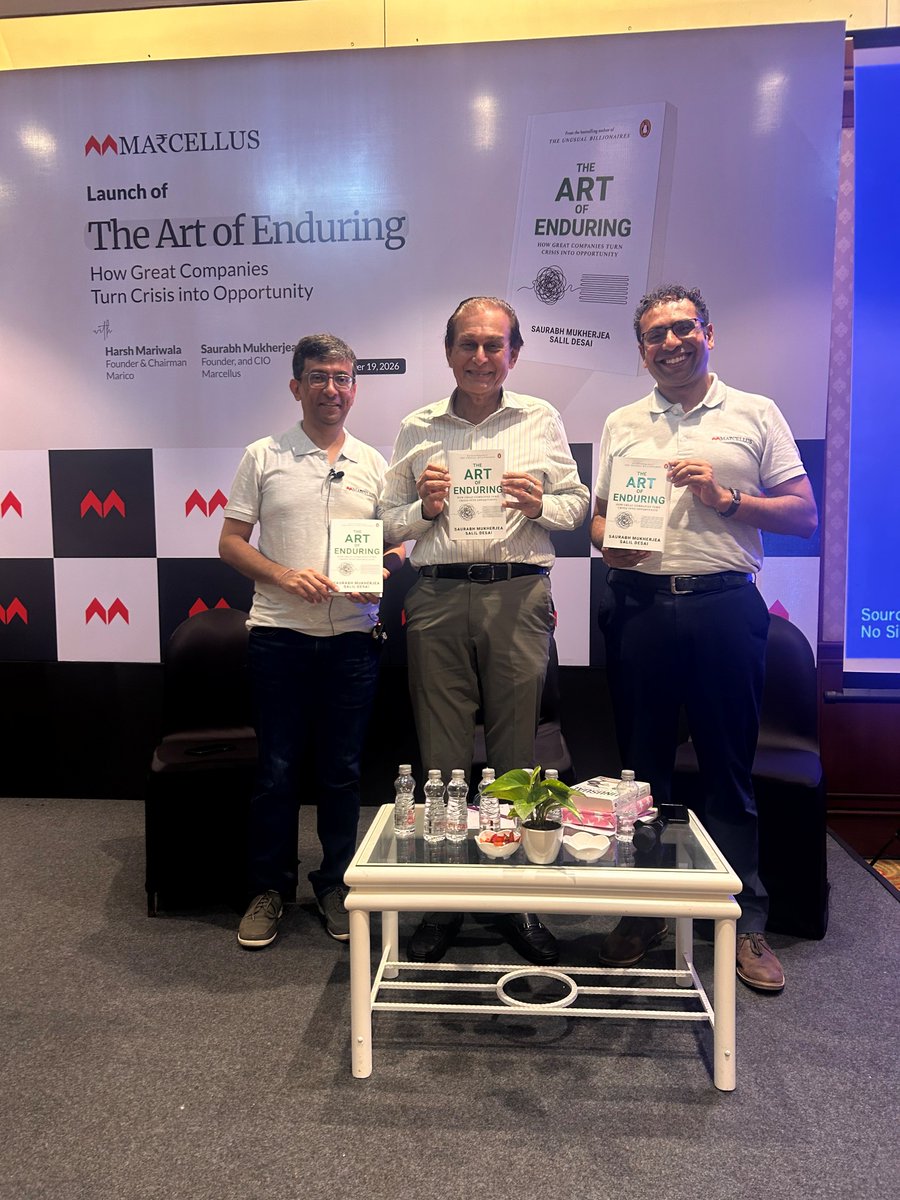
A special thank you to @hcmariwala for joining us and sharing his experiences and insights on what it takes to build and sustain a great business.
Today was a memorable day marking the launch of The Art of Enduring: How Great Companies Turn Crisis into Opportunity by Saurabh Mukherjea and Salil Desai. The book explores what enables great companies to endure through challenging times, navigate crises and turn adversity into opportunity.
The book is now available on Amazon. Pick up your copy: https://t.co/ekMmzfjoNL
The most expensive part of a hospital bill may never touch the hospital at all.
A patient admitted for care has no way of knowing whether the price on a medical consumable reflects its actual cost or a markup fixed long before it ever reached the ward. That gap in information is, at its core, a public health issue.
A survey of hospital consumables in Maharashtra found an IV infusion set with a trade price of ₹11.05 carrying a printed MRP of ₹325 ; a markup of 2,841%. A syringe procured at ₹6.75 carried an MRP of ₹57.20. A catheter procured at ₹29.41 carried an MRP of ₹310.
These are not elective purchases. Patients cannot compare prices, seek alternatives, or question a number printed on a box while receiving care and the MRP itself is often fixed upstream by manufacturers and distributors, disconnected from the trade price by a wide, unexplained margin. The result is a system where the party bearing the cost has the least information to evaluate it.
The regulatory gap is structural: scheduled medicines are capped under the Drugs (Prices Control) Order, 2013. Most medical devices and consumables are not leaving both the pricing and the information around it almost entirely unmonitored.
A review of these findings and clear guidelines on the permissible gap between trade procurement price and declared MRP have been recommended to the Department of Pharmaceuticals and the NPPA ; a step toward closing not just a pricing gap, but the information gap patients are left to bear alone.
#PublicHealth #GoodGovernance #Leadership #TukaramMundhe
https://t.co/Ye9CVzr8qU
If you want monthly passive income, then there are 5 investment options that offer monthly cash flow on investing of a corpus... and No. 5 is what young people should attempt to build for their retirement...
👉🏻 1/ POMIS - Post Office Monthly Income Scheme - this offers 7.4% interest p.a., paid out monthly with no TDS deduction...
An individual can invest up to Rs 9 Lakhs, and a joint account can take up to a maximum of Rs 15 lakhs...
Which means on a Rs 15 lakh balance, you can earn Rs 9250 per month
👉🏻 2/ SCSS - Senior Citizens Savings Scheme - this offers 8.2% p.a. interest paid out quarterly on a maximum investment of Rs 30 Lakhs per person... for people above the age of 60...
So one can earn Rs 20500 per month (paid quarterly) under this scheme...
👉🏻 3/ REITs and InvITs - which are Real Estate Investment Trusts by Embassy, Mindspace, Brookfield; and Infrastructure Investment Trusts like India Grid Trust - they invest your money (no less than 80%) in income generating commercial real estate properties, and are required under law to pay out 90% of the amount collected as rent to investors...
They typically pay out rentals quarterly - and can vary between 6.5% to 10% depending on the scheme and the risk
👉🏻 4/ RBI FRSB - RBI Floating Rate Savings Bond - this pays 8.05% p.a. interest paid out half yearly... there is no upper limit, and it has a seven year tenure...
So by investing Rs 50 Lakhs, you can get Rs 33541 per month (paid semi annually)
Similar products are Corporate FDs or Non Cumulative FDs - a number of NBFCs especially housing finance companies, as well as a few banks offer these options where interest between 7 to 8% p.a. is paid - and depending on which scheme you pick, you can opt for monthly, quarterly or half yearly payouts...
It’s best checked with your local bank...
👉🏻 5/ This is what most people should plan to build for their retirement... an SWP or a Systematic Withdrawal Plan...
Where you keep investing in Mutual Funds while you are young in the form of an SIP... and after years of compounding, you fix an amount that you have to withdraw monthly called an SWP...
#casarthakahuja See less
NO ONE SHOULD BE TREATED AS ACCUSED says Bombay high court in Disha Salian case while ordering a CBI inquiry . Will the ‘noise’ media heed the court order or follow its own media trial principle of GUILTY TILL PROVEN INNOCENT? Time to end the bizarre conspiracy theories!
Why did the family of Late Actor Sri #SushantSingRajput had dropped the murder case & are not going for further proceedings legally ( Who Had Motivated Whome ) ? Or there is a big hidden truth.
Statement by - #VikashSingh ( Lawyer #SSR )
FYI - All #SSRians Accross The Globe .
Call from @ICICIPruLife mam this a service for your policy no &₹&&₹ aur premium is due on May 25.. Me: Sure. Caller: I wanted to know will you pay the premium on the due date or before that ? Me: 🙄 (cuts the call)
This for a policy that I pay regular premiums for 18+plus yrs
I was returning the book within the policy but the attitude of senior staff at new Krishna curve wasn’t welcoming.. I chose to get the book back but not happy with the entire experience
@crossword_book teach your staff to make credit notes with a transaction with voucher .. they weren’t happy that I returned a book in like an hour of purchase ( since it was available on your website 30% cheaper). Well within the policy why ask reasons for returning the book
#OnETNOW | Salil Desai, Marcellus Investment Managers, unveils the driving force of Indian consumption: The 'Octopus Class' of nearly 10 lakh people
@SalilDe@MarcellusInvest@Ajaya_buddy
Who doesn’t love Legos?! Our Marcellus Book of the Month is the story of this toy that’s loved all around the world. “The LEGO Story: How a Little Toy Sparked the World's Imagination”, by Jens Andersen is a chronicle Lego’s origins and its evolution.
#MarcellusBOTM
1/