13/
The real lesson isn't whether CAS is good or bad.
It's this:
Markets reward those who adapt faster than they complain.
The rules will keep changing.
Your edge should be learning faster than everyone else.
What do you think?
Is CAS improving market integrity...
or making trading unnecessarily complicated?
1/
SEBI just changed how India's stock market decides the closing price.
Most investors ignored the news.
Many traders wish they hadn't.
Here's why this could change the last 15 minutes of every trading day. 🧵
12/
Every major market reform feels painful in the beginning.
T+2 settlement.
T+1 settlement.
Electronic trading.
Demat accounts.
Most were criticized before they became the norm.
CAS may follow the same path.
4 reasons I'm still bullish on Indian markets today:
1️⃣ FIIs are accumulating.
2️⃣ Crude oil is falling.
3️⃣ Global markets are strong.
4️⃣ RBI uncertainty is over.
📈 My bias: Buy the dips, don't chase the highs.
Agree or disagree? 👇 #Nifty#BankNifty#StockMarket
Today's market set up 05 Aug - The pre-market setup is constructive, thanks to positive global markets, lower crude oil prices, and a positive GIFT Nifty indication. The biggest event risk is the RBI policy decision, so while the opening bias is mildly bullish, expect elevated volatility once the policy and commentary are released.
What do you think may happen?
Will the policy stance to maintain a neutral stance?
#Nifty #Banknifty #sensex #nse
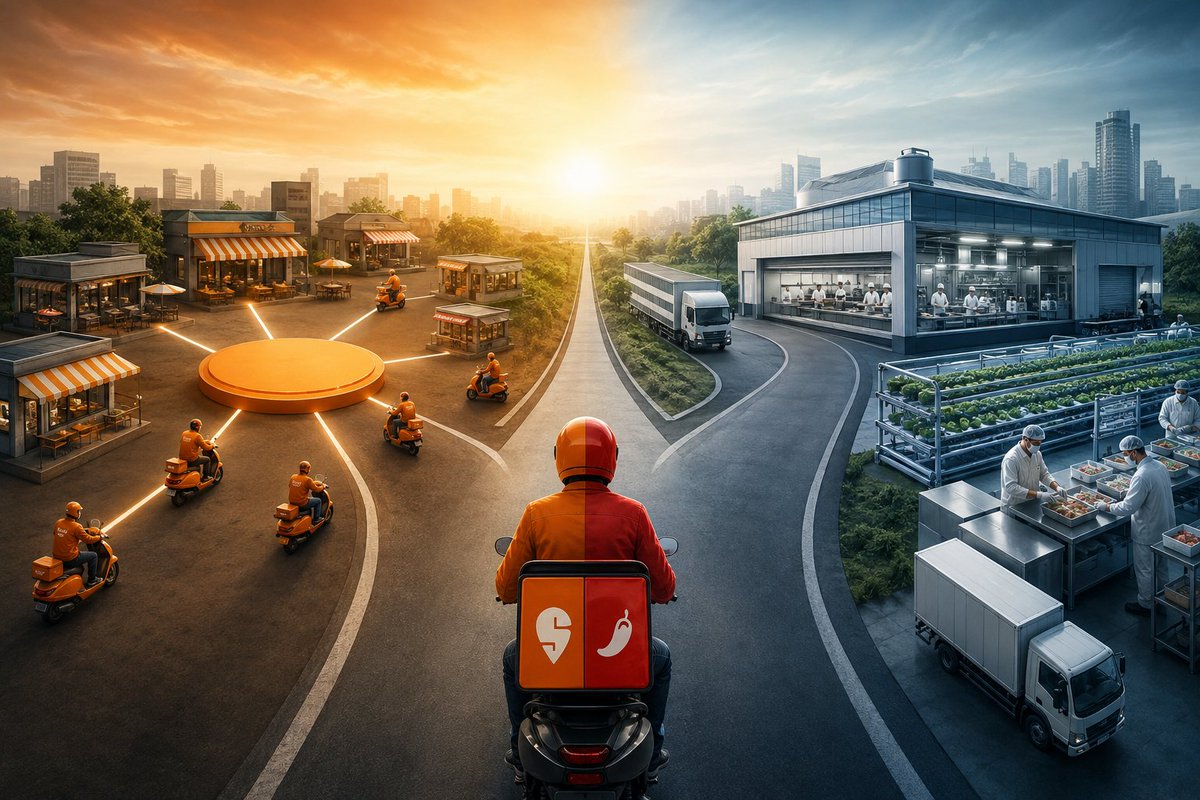
Everyone thinks #Swiggy and #Zomato are fighting the same battle.
They're not.
They're solving two completely different problems.
Here's what most people missed. 👇
For years, India's food delivery market has been obsessed with one question:
"How do we make food cheaper?"
Now the two biggest players have answered it...
In completely opposite ways.
Swiggy says:
Keep the existing restaurants.
Keep the existing delivery network.
Just create a separate platform for affordable meals.
That's exactly what #Toing is.
No new infrastructure.
No new kitchens.
No major capital expenditure.
It's a distribution play.
#Eternal (#Zomato) says:
"Cheap food isn't the problem."
The economics are.
Reducing commissions and delivery fees can only go so far.
Instead...
They're investing in #Blinkit's #Bistro—
A vertically integrated model where they control sourcing, kitchens, preparation and supply chain.
Instead of optimizing delivery...
They're redesigning food production itself.
Same destination.
Different roads.
One company is optimizing the marketplace.
The other is rebuilding the factory.
This is where the story gets interesting.
Many founders believe growth comes from improving what customers already use.
Sometimes it does.
But history tells us...
The biggest companies often create an entirely new business model when the old one reaches its limits.
Netflix didn't improve DVD rentals.
It built streaming.
Apple didn't make better MP3 players.
It created the iPhone.
Amazon didn't just improve retail.
It built AWS.
Now India's food delivery giants are asking the same question:
Do we optimize the existing system... or reinvent it?
The bigger lesson?
Every business eventually reaches a point where optimization gives diminishing returns.
At that moment...
You have two choices.
Optimize the engine.
Or...
Build a new one.
#Swiggy is betting on the first.
#Eternal is betting on the second.
Time will decide who was right.
But one thing is already clear:
The companies that survive the longest aren't always the ones with the best products.
They're the ones willing to rethink how the product itself gets created.
What's your bet?
👇 Which strategy has a better chance of winning over the next 5 years?
🟠 Swiggy's asset-light marketplace expansion
🔵 Eternal's vertically integrated food ecosystem
#BusinessStrategy #Startups #Swiggy #Zomato #Blinkit #ProductStrategy #Growth #Innovation #IndianStartups #Leadership
Market set up for today 04 Aug - The overnight setup remains constructive, with lower crude oil, stronger US equities and a firmer rupee providing support.
However, after Monday's sharp advance, the higher-probability outcome is a measured opening followed by consolidation, unless fresh buying pushes #Nifty decisively above 24,800. Keep an eye on banking stocks for confirmation of any sustained upside.
#Nifty #Banknifty #Sensex
Indian Companies Are Becoming Landlords of Capital, Not Builders of Businesses.
A decade ago...
If you wanted to become a ₹1 lakh crore company in India, there was only one way:
Build.
Manufacture.
Sell.
Hire.
Expand.
Today, there's another path.
Own financial assets.
Earn dividends.
Collect interest.
Make treasury gains.
And sometimes...
earn more from money than from making products.
That realization stopped me.
Because it changes how we should think about India's growth story.
The latest Income Tax and CMIE data tells a fascinating story.
While business income has steadily fallen as a share of total income...
Rentier income (dividends, interest, capital gains and treasury income) has risen significantly.
Not just for wealthy individuals.
Even for Indian corporates.
In fact:
• Industrial sales contribute less to total corporate income than they did 30 years ago.
• Rentier income has almost doubled as a share of corporate earnings.
• For companies with wealth above ₹100 crore, business income relative to capital income has fallen dramatically over the last decade.
In simple words:
Capital is starting to work harder than factories.
Now, before we jump to conclusions...
This isn't necessarily bad.
If companies invest wisely, treasury income can improve resilience, strengthen balance sheets and fund future growth.
The problem begins when...
Financial returns become more attractive than entrepreneurial risk.
Why build a new factory...
...if treasury investments generate better returns?
Why hire thousands...
...if capital markets reward financial engineering faster?
That's where the concern lies.
History shows us something interesting.
Countries create long-term prosperity when businesses focus on:
• Innovation
• Manufacturing
• Productivity
• Exports
• Job creation
Not merely on optimizing financial returns.
Financial income creates wealth.
Business income creates economies.
One enriches balance sheets.
The other enriches society.
This made me reflect on something bigger.
India now has 12 business families worth over ₹1 lakh crore.
Markets are at record highs.
Corporate profits are healthy.
But perhaps the next decade won't belong to the companies that simply allocate capital well.
It will belong to those who continue to build things that didn't exist yesterday.
Because...
Money can multiply money.
But only entrepreneurs multiply opportunities.
Capital compounds wealth.
Creation compounds nations.
What kind of companies do you think India needs more of over the next decade—financially efficient capital allocators, or businesses that keep building new products, factories, and jobs?
#India #Economy #Business #Entrepreneurship #CapitalMarkets #CorporateStrategy #Investing #Leadership #Manufacturing #Growth