Midterm years always feel really bad for crypto.
This time even more so since we topped on apathy.
While many cryptocurrencies will die out, I think Bitcoin will survive
LATEST: More than half of all $BTC in circulation is now held at an unrealized loss, a signal that has coincided with every major bear market bottom in history.
I DEMAND JUSTICE FOR @benjamincowen !!
NONE of the loudmouths that attacked his personality apologized publicly
INSTEAD they have NEW REASONS why Ben was wrong lmaooo
This shows you the lack of integrity of many people in this industry
Doing a very quick look at Full Year 2026 Net Income projection for $GME, with Q1 Actual being at $389.6M and projecting the following for the rest of the year (taking out derivative gains beyond Q2):
Q2: $250-400M
Q3: $170-250M
Q4: $250-350M
That puts total Net income between $1.06-$1.39B for the full year. And I think I am leaning a bit conservative, given where we are in the new console cycle, GTA 6 in Q4 and PowerPacks just coming out of beta.
On the revenue side, Q1 Actual was $835.3M, and projecting the following for the rest of the year:
Q2: $850-950M
Q3: $850-950M
Q4: $1.3-1.5B
Which puts the Total Revenue between $3.83-4.23B for the full year. These are really rough back-of-the-napkin estimates and I am looking forward to the 10-Q being released today to get more detailed info on Q1.
Gotten a lot of questions on why the early earnings release and what's next for the $GME offer. One read is that the timing may have been designed to get Ryan out of the GME earnings blackout period sooner, giving him more room to keep buying $EBAY with less friction or restriction. eBay is also seeing some pressure from dividend mechanics, which may be adding to the timing and price advantage. Other reasons could be to strengthen GME's credibility by showing a strong quarter and a much improved buyback program, to support the stock portion of the acquisition offer by helping GME's share price, or to improve financing and capital markets options if more funding is needed for the new bid.
So the short version is that early earnings could have been about timing, leverage, and optics all at once.
For what's next, I originally thought we would see a Schedule TO filing next, but I do not think that is correct any longer. eBay already rejected the initial proposal, so the more likely sequence of next steps is continued accumulation, further 13D/A updates, and pressure built through continued 425 filings rather than immediately jumping into a tender offer. In precedent situations, bidders often use that middle phase to strengthen leverage, line up financing, and test whether the target board softens before forcing the process into a shareholder-level battle. Importantly, the timing to escalate to a tender offer may also depend on whether Proposal 4 on eBay's shareholder vote passes first. If Proposal 4 passes, it could shift the governance dynamics and change the leverage balance for Cohen, making a formal tender offer more or less attractive depending on the outcome.
That order matters because a Schedule TO is the point where the campaign stops being just strategic pressure and becomes a formal tender offer with disclosure, timing, and execution obligations. If the board is already rejecting the bid, a bidder would usually want to assess whether there is still any path to a negotiated outcome or whether the right move is to keep building position and credibility before triggering the more rigid tender-offer machinery that goes straight to shareholders. In other activist and hostile situations, that sequencing is common. Signal interest, get rebuffed, keep pressure on, then escalate only when the bidder is ready to go directly to holders.
So, the precedent-based read on what's next is that a Schedule TO is still possible, but it is probably not the next step unless Ryan Cohen decides to escalate straight to shareholders. More likely, he keeps tightening the noose through additional ownership, disclosures, and market pressure until the cost of not launching a formal tender offer becomes higher than the cost and exposure of going public with one.
In a few months profits will temporarily flow out of TradFi (cool off phase after IPOs).
People will want to know where to put their money because everything already went up so much.
And there Bitcoin will be, ready to begin the next four year cycle.
RC is a genius
$GME board's approval of a $2B share buyback authorization gives RC the ability to deploy cash immediately at these current, suppressed price levels
By repurchasing shares in the low $20s, the company drastically reduces the float and boosts EPS
Once the buyback forces the price back up, RC can turn around and issue new shares at much higher prices. This assumes the July 7 vote passes and he has an additional 1.5B shares to sell when needed.
If executed well, he may even be able to obtain massive amounts of capital without even touching the new 1.5 billion in authorized shares.
If the shorts try to double down and drive the price lower, they can buy back shares again at the lower prices.
Rinse and repeat
It is an endless financial loop
Can’t stop. Won’t stop. GameStop.
Aging is arguably the root cause of most major diseases (loss of function in our cells). Four years ago, we made a bet that aging was treatable, and NewLimit was born.
NewLimit now has a prototype drug that reverses the age of some human cells (restores function they had when they were younger), and a clinical trial scheduled for next year (with more drug candidates in the pipeline).
Grateful to Founders Fund, Thrive, Greenoaks, and the rest of the investors for this latest round. @jacobkimmel and the team are just getting started.
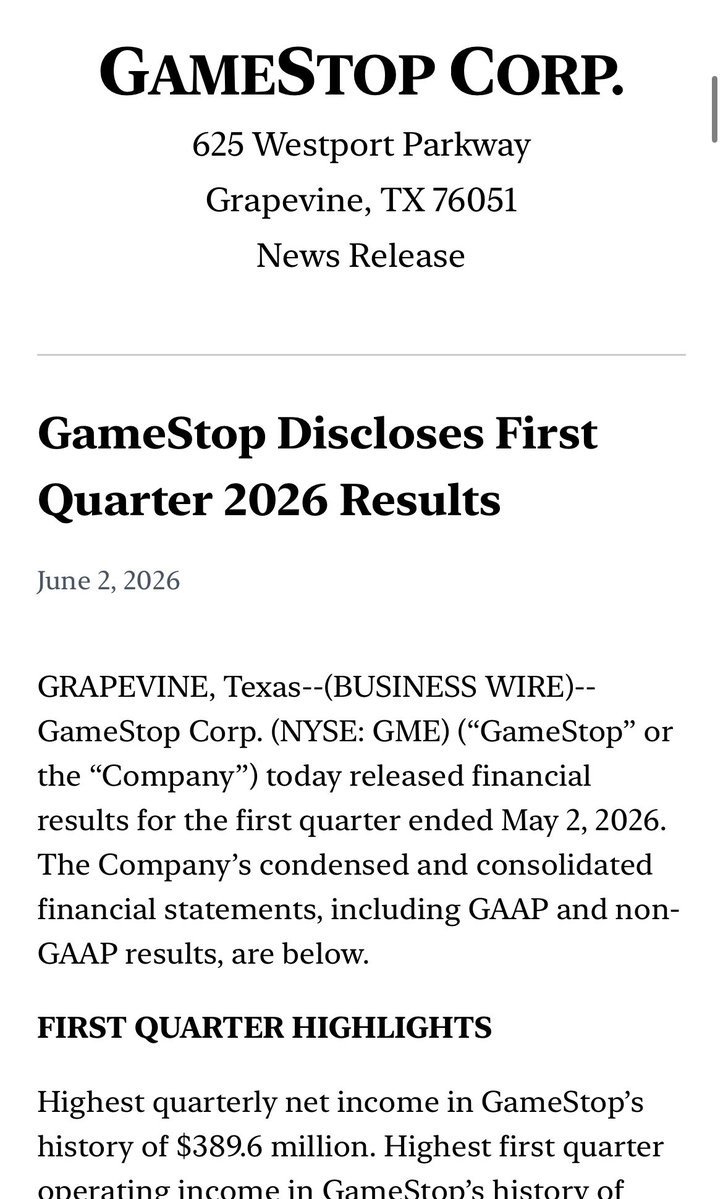
BREAKING: GameStop releases surprise Q1 2026 earnings with highest quarterly net income in GameStop history with $389.6M.
Also a strong beat 0.30 over expected 0.16 $GME 🚨🚨🚨
You used to sell stuff on eBay.
Maybe an old camera. Maybe Beanie Babies. Maybe a coat that didn't fit.
You paid a small fee. The buyer got the thing. Everyone went home.
That eBay is gone.
The website looks the same. The logo is the same. The 135 million buyers are still there.
But the company isn't really a marketplace anymore.
It is an advertising business with a marketplace attached for distribution.
Last year, sellers paid eBay $2 billion just to make sure their own listings showed up.
Read that again.
The board calls this growth.
A Canadian who runs a video game store called it something else.
Here is what actually happened.
In 2020 the board hired a new CEO. His name is Jamie Iannone. He arrived with a strategy called focused categories.
In plain English, that means leaning into the stuff people pay extra for. Sneakers. Watches. Trading cards. Auto parts.
The everyday seller, the person with the camera and the coat, was no longer the customer.
The customer was now the seller who would pay to be seen.
In 2025 eBay did $80 billion in transactions. They kept $11 billion of that as revenue. Of that $11 billion, $2 billion came from advertising.
Sellers paid them $2 billion to promote listings on a website those sellers already pay fees to use.
That is the growth story.
In the same year, the number of enthusiast buyers, eBay's own term for their best customers, was 16 million.
It was also 16 million the year before.
And the year before that.
And the year before that.
Four years. Zero growth. They mention this on every earnings call without mentioning it.
So what does a company do when growth stops?
It buys back its own stock.
In 2025, eBay returned over $3 billion to shareholders. Most of that was buybacks. In February the board authorized another $2 billion on top.
Buybacks shrink the share count. Earnings per share goes up even when earnings stay flat. The stock price follows.
The stock was $68 a year ago. It is $108 today.
The company did not improve. The denominator got smaller.
Then a man from Canada noticed.
His name is Ryan Cohen. He runs GameStop. He started his career selling pet food online and sold it to PetSmart for $3.35 billion.
He looked at eBay. 135 million buyers. $80 billion in transactions. Real margins. Real cash flow. A board harvesting the business instead of running it.
He bought 5% of the company through derivatives and stock.
Then on May 4, he offered to buy the rest. $125 per share. $56 billion total.
On May 12, the eBay board rejected the bid. They called it not credible.
The math is credible.
What the board means by not credible is we would have to explain why we sold.
Then Cohen went on Piers Morgan.
He said eBay is run by a bunch of losers with perverse financial incentives.
He pointed out that eBay's CEO has been paid $144 million over six years.
He pointed out that he personally takes no salary and has put $128 million of his own money into the company he runs.
You do not have to like Ryan Cohen to notice he is making a point that is hard to argue with.
eBay used to be a place where regular people sold things to other regular people.
Now it is a $48 billion company whose largest growth driver is charging its own sellers to advertise to a buyer base that stopped growing four years ago, while spending billions a year buying its own stock to make the chart go up.
The board calls this strategy.
A video game CEO from Canada called it what it is.
The market is now waiting to see who else agrees.
Plz fix. Thx.
Sent from my iPhone
A US Senator just casually explained how you can store BTC in your brain during a legislation markup:
"It provides people who are being tortured in foreign countries the opportunity to walk away with their money in their head. Because Bitcoin can be memorized."
Magic ✨