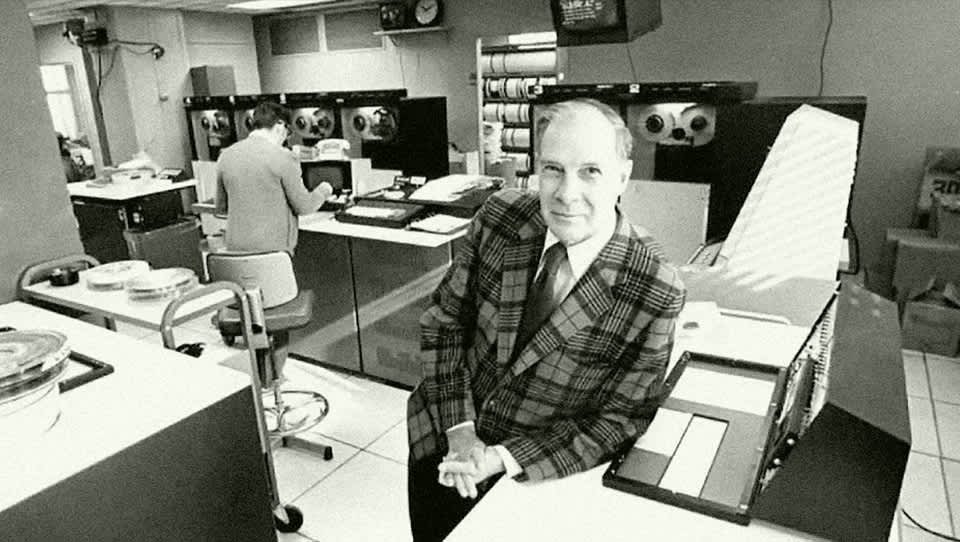
A mathematician who shared an office with Claude Shannon at Bell Labs gave one lecture in 1986 that explains why some people win Nobel Prizes and other equally smart people spend their whole lives doing forgettable work.
His name was Richard Hamming. He won the Turing Award. He invented error-correcting codes that made modern computing possible. And he spent 30 years at Bell Labs sitting in a cafeteria at lunch watching which scientists became legendary and which ones faded into nothing.
In March 1986, he walked into a Bellcore auditorium in front of 200 researchers and told them exactly what he had seen.
Here's the framework that has been quoted by every serious scientist for the last 40 years.
His opening line landed like a punch. He said most scientists he worked with at Bell Labs were just as smart as the Nobel Prize winners. Just as hardworking. Just as credentialed. And yet at the end of a 40-year career, one group had changed entire fields and the other group was forgotten by the time they retired.
He wanted to know what the difference actually was. And he said it wasn't luck. It wasn't IQ. It was a specific set of habits that almost nobody is willing to follow.
The first habit was the one that hurts the most to hear. He said most scientists deliberately avoid the most important problem in their field because the odds of failure are too high. They pick a safe adjacent problem, solve it cleanly, publish it, and move on. And because they never swing at the hard problem, they never hit it. He said if you do not work on an important problem, it is unlikely you will do important work. That is not a motivational line. That is a logical one.
The second habit was about doors. Literal doors. He noticed that the scientists at Bell Labs who kept their office doors closed got more done in the short term because they had no interruptions. But the scientists who kept their doors open got more done over a career. The open-door scientists were interrupted constantly. They also absorbed every new idea passing through the hallway. Ten years in, they were working on problems the closed-door scientists did not even know existed.
The third habit was inversion. When Bell Labs refused to give him the team of programmers he wanted, Hamming sat with the rejection for weeks. Then he flipped the question. Instead of asking for programmers to write the programs, he asked why machines could not write the programs themselves. That single inversion pushed him into the frontier of computer science. He said the pattern repeats everywhere. What looks like a defect, if you flip it correctly, becomes the exact thing that pushes you ahead of everyone else.
The fourth habit was the one that hit me the hardest. He said knowledge and productivity compound like interest. Someone who works 10 percent harder than you does not produce 10 percent more over a career. They produce twice as much. The gap doesn't add. It multiplies. And it compounds silently for years before anyone notices.
He finished the lecture with a line I have never been able to shake.
He said Pasteur's famous quote is right. Luck favors the prepared mind. But he meant it literally. You don't hope for luck. You engineer the conditions where luck can land on you. Open doors. Important problems. Inverted questions. Compounded hours. Those are not traits. Those are choices you make every single day.
The transcript has been sitting on the University of Virginia's computer science website for almost 30 years. The video is free on YouTube. Stripe Press reprinted the full lectures as a book in 2020 and Bret Victor wrote the foreword.
Hamming died in 1998. He gave his final lecture a few weeks before. He was 82.
The lecture that explains why some careers become legendary and others disappear is still free. Most people who could benefit from it will never open it.
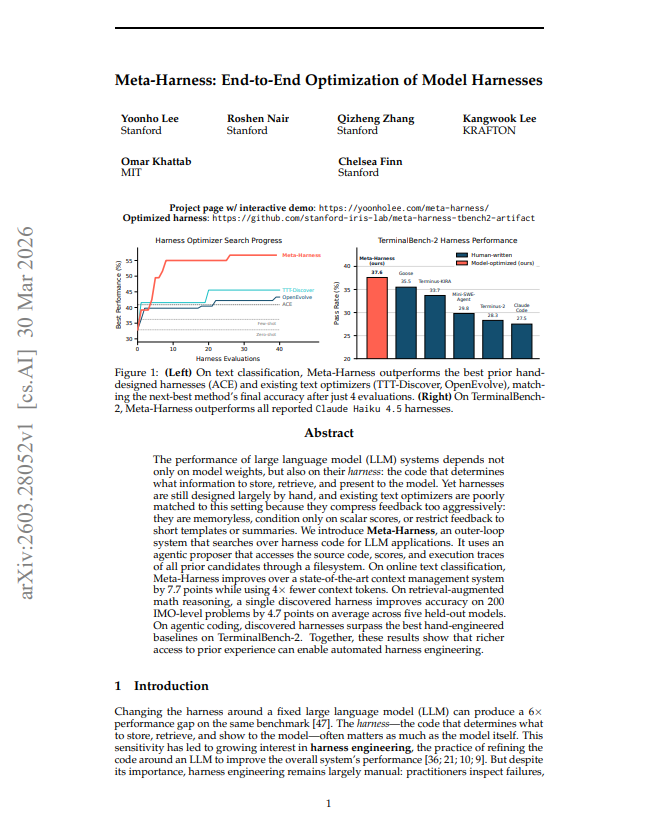
Holy shit. Stanford just showed that the biggest performance gap in AI systems isn't the model it's the harness.
The code wrapping the model. And they built a system that writes better harnesses automatically than humans can by hand.
> +7.7 points. 4x fewer tokens.
> #1 ranking on an actively contested benchmark.
The harness is the code that decides what information an AI model sees at each step what to store, what to retrieve, what context to show.
Changing the harness around a fixed model can produce a 6x performance gap on the same benchmark. Most practitioners know this empirically.
What nobody had done was automate the process of finding better harnesses.
Stanford's Meta-Harness does exactly that: it runs a coding agent in a loop, gives it access to every prior harness it has tried along with the full execution traces and scores, and lets it propose better ones.
The agent reads raw code and failure logs not summaries, not scalar scores and figures out why things broke.
The key insight is about information.
Every prior automated optimization method compressed feedback before handing it to the optimizer.
> Scalar scores only.
> LLM-generated summaries.
> Short templates.
Stanford's finding is that this compression destroys exactly the signal you need for harness engineering.
A single design choice about what to store in memory can cascade through hundreds of downstream steps.
You cannot debug that from a summary.
Meta-Harness gives the proposer a filesystem containing every prior harness's source code, execution traces, and scores up to 10 million tokens of diagnostic information per evaluation and lets it use grep and cat to read whatever it needs.
Prior methods worked with 100 to 30,000 tokens of feedback. Meta-Harness works with 3 orders of magnitude more.
The TerminalBench-2 search trajectory reveals what this actually looks like in practice.
The agent ran for 10 iterations on an actively contested coding benchmark.
In iterations 1 and 2, it bundled structural fixes with prompt rewrites and both regressed.
In iteration 3, it explicitly identified the confound: the prompt changes were the common failure factor, not the structural fixes.
It isolated the structural changes, tested them alone, and observed the smallest regression yet.
Over the next 4 iterations it kept probing why completion-flow edits were fragile citing specific tasks and turn counts from prior traces as evidence.
By iteration 7 it pivoted entirely:
instead of modifying the control loop, it added a single environment snapshot before the agent starts, gathering what tools and languages are available in one shell command.
That 80-line additive change became the best candidate in the run and ranked #1 among all Haiku 4.5 agents on the benchmark.
The numbers across all three domains:
→ Text classification vs best hand-designed harness (ACE): +7.7 points accuracy, 4x fewer context tokens
→ Text classification vs best automated optimizer (OpenEvolve, TTT-Discover): matches their final performance in 4 evaluations vs their 60, then surpasses by 10+ points
→ Full interface vs scores-only ablation: median accuracy 50.0 vs 34.6 raw execution traces are the critical ingredient, summaries don't recover the gap
→ IMO-level math: +4.7 points average across 5 held-out models that were never seen during search
→ IMO math: discovered retrieval harness transfers across GPT-5.4-nano, GPT-5.4-mini, Gemini-3.1-Flash-Lite, Gemini-3-Flash, and GPT-OSS-20B
→ TerminalBench-2 with Haiku 4.5: 37.6% #1 among all reported Haiku 4.5 agents, beating Goose (35.5%) and Terminus-KIRA (33.7%)
→ TerminalBench-2 with Opus 4.6: 76.4% #2 overall, beating all hand-engineered agents except one whose result couldn't be reproduced from public code
→ Out-of-distribution text classification on 9 unseen datasets: 73.1% average vs ACE's 70.2%
The math harness discovery is the cleanest demonstration of what automated search actually finds.
Stanford gave Meta-Harness a corpus of 535,000 solved math problems and told it to find a better retrieval strategy for IMO-level problems.
What emerged after 40 iterations was a four-route lexical router: combinatorics problems get deduplicated BM25 with difficulty reranking, geometry problems get one hard reference plus two raw BM25 neighbors, number theory gets reranked toward solutions that state their technique early, and everything else gets adaptive retrieval based on how concentrated the top scores are. Nobody designed this.
The agent discovered that different problem types need different retrieval policies by reading through failure traces and iterating on what broke.
The ablation table is the most important result in the paper.
> Scores only: median 34.6, best 41.3.
> Scores plus LLM-generated summary: median 34.9, best 38.7.
> Full execution traces: median 50.0, best 56.7. Summaries made things slightly worse than scores alone.
The raw traces the actual prompts, tool calls, model outputs, and state updates from every prior run are what drive the improvement.
This is not a marginal difference. The full interface outperforms the compressed interface by 15 points at median.
Harness engineering requires debugging causal chains across hundreds of steps. You cannot compress that signal.
The model has been the focus of the entire AI industry for the last five years.
Stanford just showed the wrapper around the model matters just as much and that AI can now write better wrappers than humans can.
The memory-bound problem in LLM inference has always had two potential solutions: move data more efficiently (disaggregation, better interconnects) or shrink the data itself (compression).
Bonsai is pushing quantization to its logical extreme with 1-bit weights, and extreme compression turns out to have a second-order effect that goes beyond memory. At 1-bit, the dominant compute operation shifts from floating-point multiply-accumulate to conditional integer addition.
Today's GPUs are essentially massive arrays of circuits built around multiplication. At 1-bit, that operation is greatly reduced, replaced by simple addition and subtraction. That's a different compute primitive entirely, one that today's GPU architecture wasn't designed for.
Intelligence density = how much useful intelligence a model delivers per GB.
By this measure, 1-bit Bonsai 8B scores 1.06/GB, while the closest nearby full-precision 8B model scores 0.10/GB.
This isn’t a small efficiency gain — it’s a new paradigm of intelligence compression: advanced capability in a radically smaller deployment footprint.
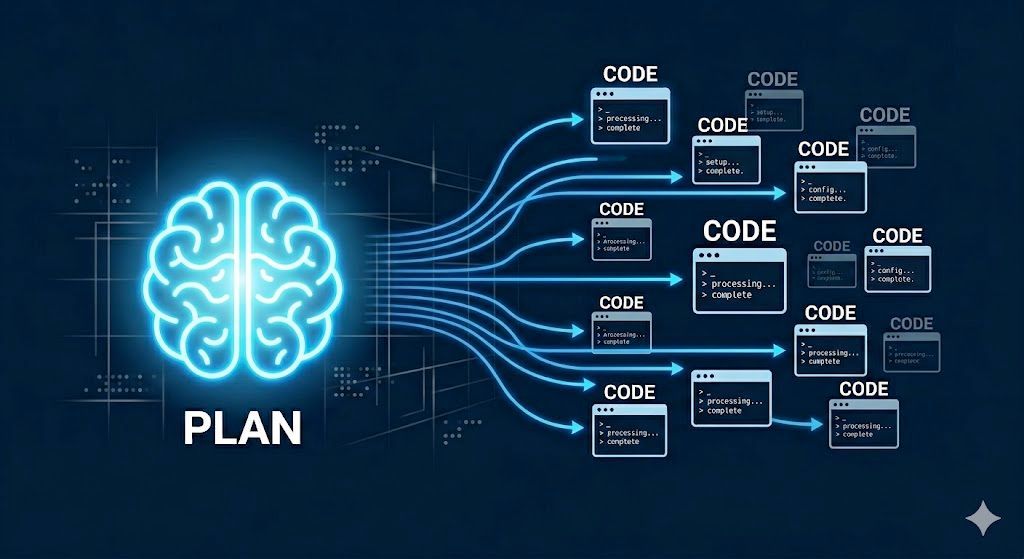
Disagg planning.
In inference, disaggregated prefill splits the compute-heavy prefill from decode. A similar thing is playing out in agentic coding: planning and execution are different cognitive tasks that favor different model profiles. Models that reason deeply aren't always the best coders.
Opus architects, Sonnet/Codex builds. Why burn $15/M tokens when a $3 model can execute a well-written spec flawlessly?
AI companies guard their strategies closely. Their hiring pages, however, are public.
@datagenproc and @chutchesonai analyzed open roles at OpenAI, Anthropic, xAI, and DeepMind. Here's some of what their job postings tell us about their plans:
The GPU vs ASIC debate is over.
Today at GTC, NVIDIA answered with both.
GPU handles prefill (heavy compute).
Groq LPU handles decode (fast token generation via SRAM)
#nvidiagtc2026
I wrote a short story to explain to my students the evolution of PPO, DPO, GRPO, to GDPO (NVIDIA's new paper). 👇
This story is based on my own personal RL journey to become the family chef. 🍳
(when my wife was my girlfriend)
𝗣𝗣𝗢 I wanted to cook a new dish for our next date. I hired an expert (my buddy) to try it and tell me whether it might be good. If not, I tweaked my cooking method and tried again. This loop repeated. My girlfriend (user) was not involved during the training time, until the date (aka, the inference time).
𝗗𝗣𝗢 I stopped cooking new dishes for a moment. Instead, I went back through all my past meals — successes and disasters. I replayed those scenarios in my head and asked: “What would I have done differently?” I updated my 𝘥𝘦𝘤𝘪𝘴𝘪𝘰𝘯-𝘮𝘢𝘬𝘪𝘯𝘨, not by trying new dishes, but by learning from comparisons.
(we got married)
𝗚𝗥𝗣𝗢 I’m out of past examples. And I didn't want to hire an expert anymore (I no longer lived with my buddies). So I cooked a bunch of dishes at once and simply watched: Which one did my wife eat more than the others? No expert judgment — just relative preference from outcomes.
(now we have 2 kids)
𝗚𝗗𝗣𝗢 Then life gets more interesting. Now we have two kids. That’s two additional reward functions.
Do I combine all their preferences into a single objective? Do I keep them separate? How do I optimize without one child dominating the signal?
This is where multi-reward alignment starts to matter.
#ppo #dpo #grpo #gdpo #aibyhand
Everyone's freaking out about vibe coding. In the holiday spirit, allow me to share my anxiety on the wild west of robotics. 3 lessons I learned in 2025.
1. Hardware is ahead of software, but hardware reliability severely limits software iteration speed.
We've seen exquisite engineering arts like Optimus, e-Atlas, Figure, Neo, G1, etc. Our best AI has not squeezed all the juice out of these frontier hardware. The body is more capable than what the brain can command. Yet babysitting these robots demands an entire operation team. Unlike humans, robots don't heal from bruises. Overheating, broken motors, bizarre firmware issues haunt us daily. Mistakes are irreversible and unforgiving.
My patience was the only thing that scaled.
2. Benchmarking is still an epic disaster in robotics.
LLM normies thought MMLU & SWE-Bench are common sense. Hold your 🍺 for robotics. No one agrees on anything: hardware platform, task definition, scoring rubrics, simulator, or real world setups. Everyone is SOTA, by definition, on the benchmark they define on the fly for each news announcement. Everyone cherry-picks the nicest looking demo out of 100 retries.
We gotta do better as a field in 2026 and stop treating reproducibility and scientific discipline as second-class citizens.
3. VLM-based VLA feels wrong.
VLA stands for "vision-language-action" model and has been the dominant approach for robot brains. Recipe is simple: take a pretrained VLM checkpoint and graft an action module on top. But if you think about it, VLMs are hyper-optimized to hill-climb benchmarks like visual question answering. This implies two problems: (1) most parameters in VLMs are for language & knowledge, not for physics; (2) visual encoders are actively tuned to *discard* low-level details, because Q&A only requires high-level understanding. But minute details matter a lot for dexterity.
There's no reason for VLA's performance to scale as VLM parameters scale. Pretraining is misaligned. Video world model seems to be a much better pretraining objective for robot policy. I'm betting big on it.
LLM memory is considered one of the hardest problems in AI.
All we have today are endless hacks and workarounds. But the root solution has always been right in front of us.
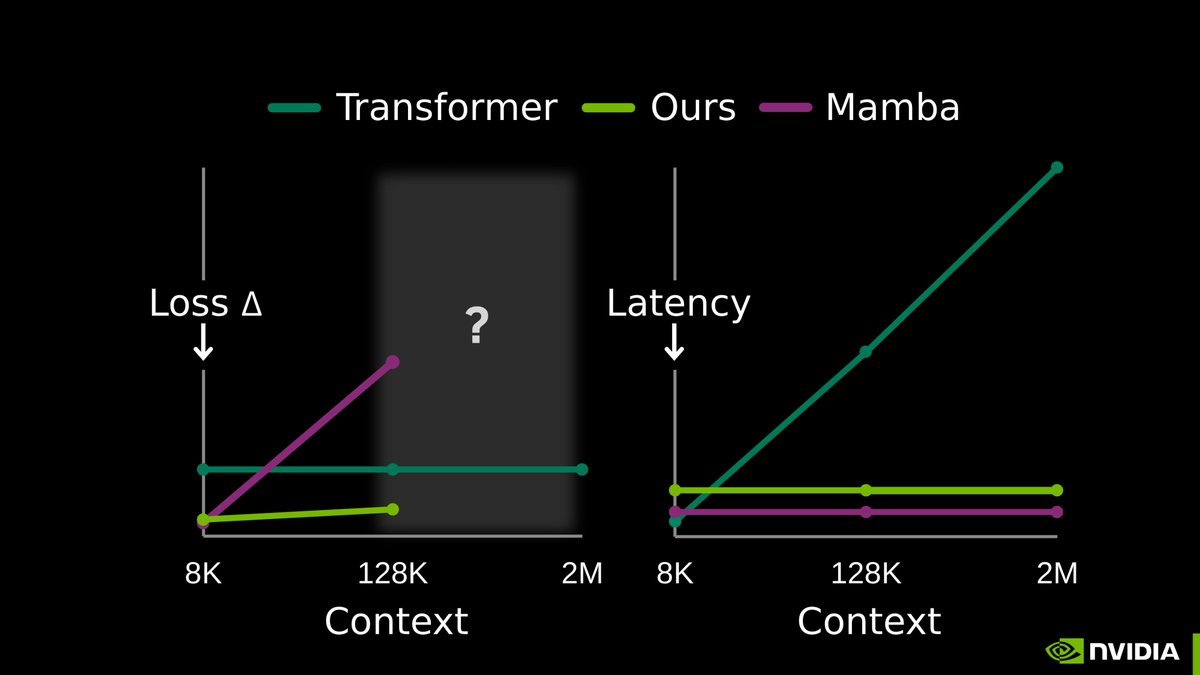
Next-token prediction is already an effective compressor. We don’t need a radical new architecture. The missing piece is to continue training the model at test-time, using context as training data.
Our full release of End-to-End Test-Time Training (TTT-E2E) with @NVIDIAAI, @AsteraInstitute, and @StanfordAILab is now available.
Blog: https://t.co/woCpiIrq0T
Arxiv: https://t.co/3VkFlS3wx3
This has been over a year in the making with @arnuvtandon and an incredible team.
Big congratulations to the https://t.co/mcAzE7BV2t team on $6M raise!
Audio AI is the next frontier for human–AI augmentation, and https://t.co/mcAzE7BV2t is tackling one of the toughest and most exciting frontiers in deep tech — real-time, on-device audio AI that enhances how humans and machines understand the world.
Thrilled to support this mission at SCB 10X alongside other strong partners.
Open. Source. SOTA. Deep. Research. 🚀
Today, we’re releasing PokeeResearch-7B, a SOTA open-source deep research agent that outperforms all other 7B deep research agents. And, we are open-sourcing both the weights and inference code on @huggingface!
We're additionally excited to have partnered with vLLM @vllm_project, SGLang @sgl_project, and verl @verl_project on training and inference pipelines.
We can’t wait to see what you all build with PokeeResearch!
🤗• Hugging Face Model: https://t.co/pFegN55uJ4
🌐• Webpage: https://t.co/17n9Nw8p8F
📋• ArXiv: https://t.co/zTrpC0srGO
🔗• Github Repo: https://t.co/FevODN9oXY
The security vulnerability we found in Perplexity’s Comet browser this summer is not an isolated issue.
Indirect prompt injections are a systemic problem facing Comet and other AI-powered browsers.
Today we’re publishing details on more security vulnerabilities we uncovered.