Code is the right action interface for spatial reasoning agents.
New from NVIDIA Research: SpatialClaw, a training-free agent that uses code as its action interface for complex visual tasks.
Instead of calling a fixed set of pre-defined tools, the agent writes Python inside a persistent kernel, so it can compose perception modules, inspect intermediate results, and revise its strategy across steps. Perception outputs become ordinary variables it can reuse and combine with libraries like NumPy and SciPy.
With no benchmark-specific or model-specific tuning, it beats a recent prior agent by 11.2 points across 20 benchmarks and holds up consistently across six different model backbones.
You can check out SpatialClaw here: https://t.co/xfZBw5il0i
Proud to collaborate on the next frontier of private AI. 🔒
Apple is expanding Private Cloud Compute to @GoogleCloud using NVIDIA GPUs.
https://t.co/6R6MP1SkVm
From Taiwan to Kentucky to Silicon Valley, our CEO Jensen Huang’s story is one of resilience, reinvention, and a belief that accelerated computing could change the world.
Watch Jensen join @CondoleezzaRice for the first episode of @HooverInst’s Only in America series.
Lambda Bare Metal Instances combine the key characteristics of direct access to hardware, no third-party hypervisor, and an API-driven lifecycle.
NVIDIA's full-stack AI factory platform delivers the highest compute per watt, lowest token cost, and longest useful life — and bare metal unlocks every bit of it.
Read the blog 👇
Today, @NVIDIA is widely recognized as the most consequential technology company in the world. But when Founder and CEO Jensen Huang hatched the idea more than three decades ago, it was viewed as little more than an incredibly risky bet on a new approach to computing.
How did Huang, an immigrant from working class roots in Taiwan, build this company into what it is today? In the first installment of the Hoover Institution's Only in America series, @CondoleezzaRice sits down with Huang to explore why his rise—and that of NVIDIA—couldn't have happened anywhere else.
04:42 Jensen Huang's journey to the US
07:54 Jensen's experience at boarding school in Kentucky
14:23 How Jensen came to Silicon Valley
17:23 Founding NVIDIA
23:40 The evolution and growth of NVIDIA
27:08 Sustaining motivation amid challenges
29:01 America's exceptional tech sector
32:28 Why Huang is a "cautious optimist" on AI
35:10 Jensen Huang's Only in America story
Albert Einstein referred to her as the most important woman in the history of mathematics.
Einstein was known for being selective with his praise. However, in 1935, he wrote a letter to the New York Times in which he stated that, according to experts, a particular mathematician was "the most significant creative mathematical genius thus far produced since women's higher education became accessible."
He was talking about Emmy Noether.
It’s unbelievable how a song can turn your mood from bottom to the top in 3 minutes. What a singer this guy is, thank you Bruce.
Dancing In the Dark - Bruce Springsteen
“I learned this, at least, by my experiment; that if one advances confidently in the direction of his dreams, and endeavors to live the life which he has imagined, he will meet with a success unexpected in common hours.”
― Henry David Thoreau
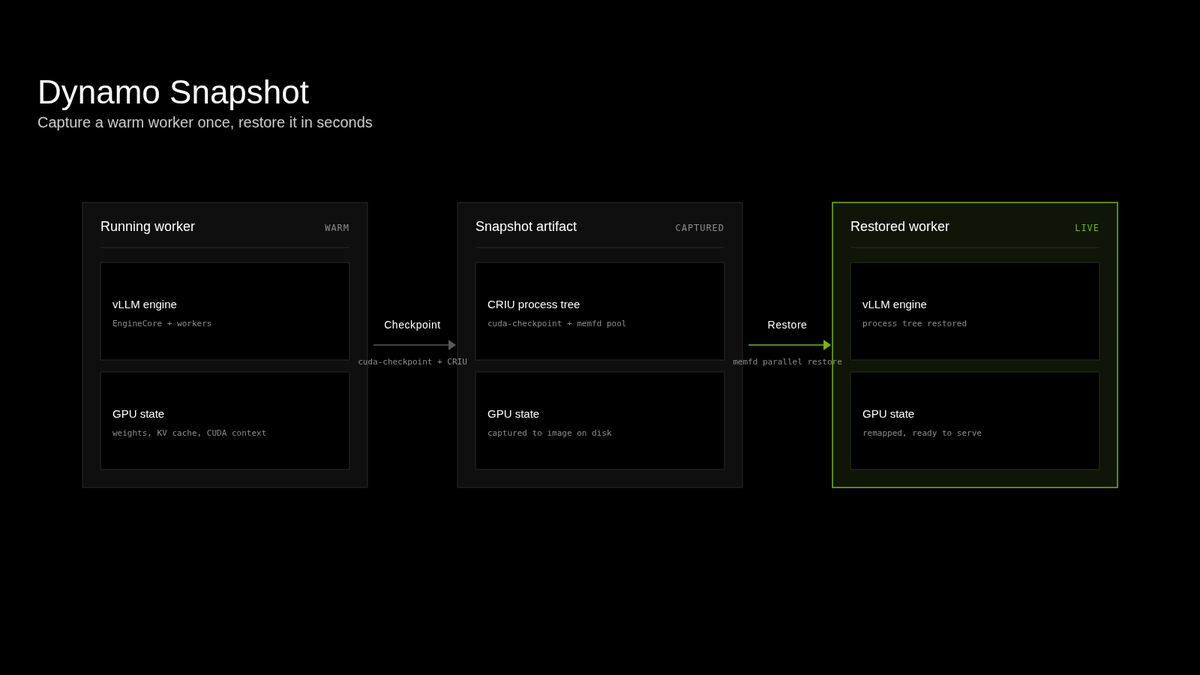
Introducing Dynamo Snapshot, our approach for fast startup for inference workloads on Kubernetes, which reduces startup time from minutes to under 5 seconds.
In production inference deployments demand fluctuates over time. Cold-starting inference workloads can take minutes, leaving idle GPUs that generate no tokens and serve no requests.
Snapshot leverages GMS to enable concurrent weight restoration over a high-speed interconnect, while using Linux native AIO and parallel memfd restoration to accelerate CRIU restore performance.
You should read this thread.
It used to take about 25 seconds to generate a 5-second video on 8 Blackwell GPUs. The legends at @haoailab brought that down to just 4.2 seconds on a single Blackwell GPU… and then open sourced the tech behind it.
Token economics determine whether your AI scales or stalls.
The key to optimizing AI tokenomics? Start with the customer use case. Then work backwards. 🧵
Shruti Koparkar from our Accelerated Computing team breaks down each tokenomics pillar on the NVIDIA AI podcast:
Industrial AI is reshaping how the world designs, simulates, and manufactures. 🏭
At #NVIDIAGTC at #COMPUTEX2026, explore sessions covering the latest in accelerated computing, semiconductor design, AI physics, and more.
➡️ Engineering Simulation, Reimagined: AI Physics for CAE and Semiconductor Design | https://t.co/MeibpUFW3K
➡️ From Weeks to Hours: GPU-Native Semiconductor Simulation in Practice | https://t.co/cGAnmBxb5X
➡️ Accelerating Industrial Engineering: From Product Design to Manufacturing in the AI Supercomputing Era | https://t.co/FBJtWICkxB
NEWS: NVIDIA announces financial results for first quarter fiscal 2027.
➡️ Record revenue of $81.6 billion and up 85% from a year ago
➡️ Record Data Center revenue of $75.2 billion and up 92% from a year ago
Read more: https://t.co/E3rEzpaRMe
NVIDIA’s Ian Buck hand-delivered the first-ever NVIDIA Vera CPUs to our partners @AnthropicAI, @OpenAI, @SpaceX, and @OracleCloud. 🎉
Vera is NVIDIA's first custom CPU, purpose-built for the age of agentic AI. This is just the beginning. The road to Vera-powered systems starts here.
Thank you to our partners for being on this journey with us. The best is yet to come. 💚