POV: You’re a pararescuer jumping out of a C-17 🪂✈️
Watch this point-of-view footage from @NASAArtemis rescue demonstrations earlier this month, where teams rehearsed operations in the event of a pad abort or in-flight abort scenario. Part of this operation includes a C-17 aircraft carrying @usairforce pararescuers near a simulated splashdown location to retrieve the mannequin crew and transport them for medical care.
Using mannequin crew and the @NASA_Orion mockup Crew Module Test Article (CMTA), Exploration Ground Systems and @DeptofDefense teams in the sky and sea rehearsed procedures to rescue the @NASAArtemis II crew during an abort from Launch Complex 39B or during ascent to space. Teams in a C-17 aircraft dropped inflatable boats and support gear, jet skis, and survival equipment to aid rescue forces below.
Learn more here: https://t.co/4ttCSmVpiX
Firing rooms 1 and 2 were bustling last week!
Exploration Ground Systems teams completed cryogenic and term count simulations, along with gaseous oxygen loading onto @NASA_Orion. Teams also completed a two-part safety abort demonstration to practice recovery operations in the unlikely event of a pad or in-flight abort scenario.
Learn more about the safety abort demonstration here: https://t.co/4ttCSmVpiX
Reminder: NASA's Exploration Ground Systems X account will be archived in one week. This account will remain available for your viewing. We will soon post updates about building, launching, and recovering Artemis missions via @NASAKennedy and @NASAArtemis.
This week, Exploration Ground Systems and @DeptofDefense teams completed a two-part safety abort demonstration from the Launch Control Center at @NASAKennedy and in the waters near Cape Canaveral. This test prepares rescue personnel to recover crew and @NASA_Orion in the event of a pad abort or in-flight abort scenario.
Learn more here: https://t.co/XNareozU6S
Over time, NASA’s social media portfolio grew to more than 400 accounts across dozens of platforms. While each account has served an important purpose in telling our story, our focus is to improve the user experience through more cohesive messaging. We are reducing the overall number of accounts for a simplified presence that continues to inform, educate, and inspire the public.
Important update: In the coming weeks, NASA's Exploration Ground Systems X account will be archived. To consolidate our social media presence, we will soon post updates about building, launching, and recovering Artemis missions via @NASAKennedy and @NASAArtemis.
Power up complete!
Teams powered up the @NASAArtemis SLS rocket core stage and solid rocket boosters inside the iconic Vehicle Assembly Building for the first time last week. The test verified the interfaces across the core stage, boosters and ground systems function properly.
Read more about our integrated testing here: https://t.co/d9ChHbA7aQ
In 2007, Liliana Villarreal joined @NASA. Now, she's the Artemis Landing and Recovery Director.
“I think it’s an amazing thing what we’re doing for humanity. It’s going to better humanity, and it’s a steppingstone to eventually us living in other worlds. And I get to be part of that. You get to be part of that. How cool is that?” - Lili
Learn about her journey here: https://t.co/XOsTrUDXSC
Pumped up! ⛽
Teams with Exploration Ground Systems ready @NASA_Orion for stacking atop the Artemis II @NASA_SLS rocket by fueling the service module, provided by @esa. To complete this operation, teams stationed in the Launch Control Center oversee and direct fueling operations, while teams in the Multi-Payload Processing Facility respond to manipulate valves and load the flight hardware’s bipropellant system.
The service module is the powerhouse of the Orion spacecraft. It will provide in-space maneuvering capability, power, and life support commodities such as water, oxygen, and nitrogen for @NASAArtemis missions.
Teams with @NASAGroundSys are preparing Artemis II with a series of integrated testing on the @NASA_SLS rocket. Engineers have started the test campaign to confirm rocket and ground systems are working and communicating as planned.
Follow along: https://t.co/NXLd7it7vB
Power up 🔋✅
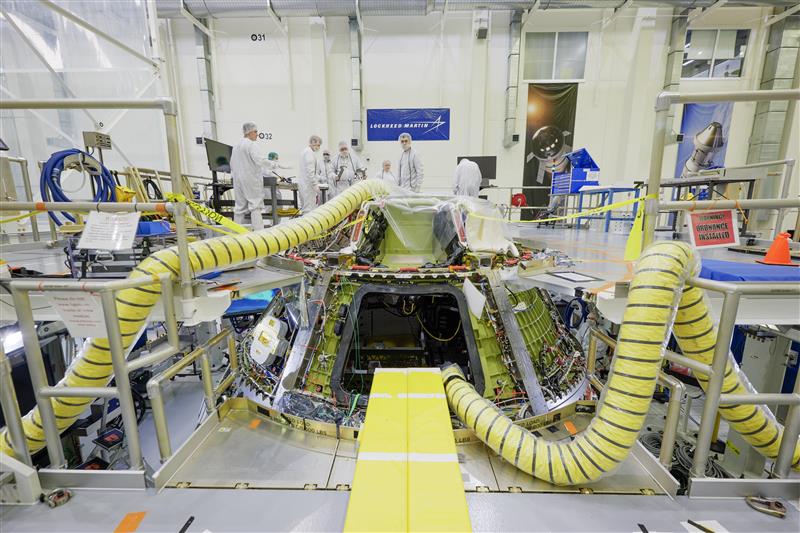
Technicians recently powered on the @NASAArtemis III Orion crew module. This initial power on marked the startup of the crew module’s computers, power and data units, which are responsible for commanding vehicle subsystems.
Learn more: https://t.co/XPTvD1JgWU
����Powered up!⚡
Last week, Exploration Ground Systems teams powered up the @NASAArtemis II @NASA_SLS core stage and solid rocket boosters for the first time. Teams in @NASAKennedy’s Launch Control Center verified the systems and interfaces function between the flight hardware and ground systems, including the engine and booster thrust control systems.
If you can’t stand the heat, get out of the flame trench 🔥
The flame deflector at @NASAKennedy’s Launch Complex 39B will redirect the exhaust and intense heat of @NASA_SLS northward at liftoff, experiencing a peak heat of 2,200 degrees Fahrenheit. Teams with Exploration Ground Systems recently replaced the deflector’s metal plates, which range in size and weight from 1,100 to 5,500 pounds each.
A jam-packed week for the Artemis II crew — paying homage to the Apollo 1 crew, going through emergency egress exercises, and checking out the @NASA_Orion spacecraft ahead of fueling in the Multi-Payload Processing Facility at @NASAKennedy.
The @NASAArtemis II crew visited @NASAKennedy this week!
With teams from NASA’s Exploration Ground Systems, they participated in Emergency Egress System training at Launch Complex 39B and the Vehicle Assembly Building, walked through the crew access arm of mobile launcher 1, and joined a launch simulation in Firing Room 1 of the Launch Control Center.