What Non-Law Students Miss About Law Modules
We can dismantle the superiority complex of any profession without trivialising its qualifying process. Those of you citing your A grades in law modules taken as electives, or in law-related modules taken from another faculty, to prove that Law is an easier discipline are probably doing so out of blissful ignorance. The law modules taken as electives, or as service courses outside the Faculty of Law, are watered-down versions of what is taught to Law students. I know this because I have experienced both.
When I applied to study Law as a direct-entry student, I tendered a transcript containing modules such as Nigerian Legal System, which are mandatory for the study of Law, and sought waivers because I had A grades in all the law modules I had taken as a Political Science student. That application was rejected. The reason given was that the content of the law modules I took in my non-law degree was an intentionally diluted version, and that I could not have been assessed as I would have been if I were a Law student.
It took me just one semester to understand the difference. The same modules I had taken were not of similar academic demand, even though, for instance, my Nigerian Legal System lecturer was a retired High Court judge who had recently served as Attorney-General and Commissioner for Justice. He was uncompromisingly strict, to the point of boasting that none of us would secure an A grade in his module. I think only two of us in a class of over 60 achieved it.
Yes, he was strict in teaching non-law students, but the requirement to master specific cases, statutes and various legal principles in a non-law degree was not of the same measure as what I would later experience in the Faculty of Law. It then made sense that the Law Faculty had rejected my application. If I had not gone back for an LL.B. programme, I would probably have subscribed to the mindset that, having secured A grades in law modules as a Political Science student, I possessed the same mastery of those modules as Law students.
So, these Commercial Law, Taxation Law, Company Law, and Law of Contract modules you took as non-law students, and now cite as proof that law modules were easy, are not of the same intensity as what is taught in the Faculty of Law. The academic demands are not similar either, and I say this with experiential authority.
Law is demanding, academically and professionally. But I also think it is ridiculous to persist in bragging that a particular discipline is tougher than others when you have not functioned in that other discipline. No degree should be measured by the scale of suffering it took to achieve it. Most of the comparisons trending on social media are projections of professional bias and arrogance, and they are largely baseless.
If you judge a devoted medical doctor by his knowledge of astronomy, you are going to be disappointed, just as you would be if you judge an economist by his understanding of applied law. Every discipline is relevant in its own way, and outside it, its practitioners are bound to falter or stutter.
A lawyer may develop expertise in health law, but that does not confer deeper knowledge of medical procedures than a medical doctor possesses. By the same token, accountants cannot claim greater mastery of taxation law, with its attendant cases, statutes, and interlocking principles, than lawyers, who bring a broader, more nuanced, and more rigorously tested understanding of law and its overlapping doctrines, extending well beyond any single sub-field.
And I am not yet saying one is more difficult than the other, Sir. I know about 10 ACAs and those still struggling to become. I know one CFA candidate in level 3. I fairly know the hell they go through. The difficulty b/w ICAN and Bar Finals is only relative. CFA is different.😂
Below 50% is a conditional pass in Bar Finals, which calls for a resit. And I believe you may know, one failure in a course means one has failed the entire exams and will have to restart. BTW, I am not yet in Law School, so I don't have the full picture of what it's like.
The difference is that in the NBA and ANAN(another accounting professional examinations), candidates can still earn a pass classification with scores below 50%.
In ICAN, however, there is no “Pass” grade as a classification. You either meet the pass mark of 50% for the paper or you fail it.
That is why an ICAN candidate scoring 49% goes home empty-handed, while in some other professional programmes, a lower score may still earn a pass classification.
So when someone boasts about passing with 40%, accountants are usually wondering whether that score would even keep the exam script out of the failure pile in ICAN. 😂
@senatorbash What I believe makes the difference is how ICAN allows candidates to sit for the exams. The only reason this comparison is made is I think because of how flexible ICAN has been made. While Bar Finals people get locked in and do it within a certain time.
This is plainly false. Roughly 80% of students who sat for the bar finals this year passed, and historical data aren’t far off that mark. Compare this with professional exams where only about 40% of candidates pass.
Some of the smartest people I know are still struggling to clear the CFA, and even those who have passed often did so only after multiple attempts. The CFA has a pass rate below 50%, and you could practically count the number of charter holders in Nigeria on your hands, despite the national obsession with the qualification.
It’s understandable to be so traumatised by our own professional experience that we use it as the default measuring stick, but the data doesn’t bend to our sentiments. We’ve all seen the calibre of minds who’ve entered law school and passed on their first attempt. people whose intelligence, with all due respect, is nothing extraordinary.
@SarkinMota_AMF And all this while he has not seen what Sarkin Mota was building that would provide jobs to some youths as a business man, it's his video in a bouncing car he has chosen to see. Our people!
I have been liking all tweets about passing the bar finals. I am just happy as if I were the one that's passed. A big congratulations to everyone out there.
There’s a comment made by a young female lawyer on my previous post about the recent Court of Appeal, Lagos Division remark on a young lawyer. She said it's better to follow seniors to court than going to embarrass yourself.
I’m not against pupillage. Not at all. But let’s be honest, learning in this profession is not by mere physical proximity to a senior. It is by preparation, diligence, paying attention to details, and hard work.
If you want to avoid embarrassment in court, start with the basics: study your case file thoroughly before stepping into court. Understand the facts, anticipate the twists, research the law, and be ready for questions. If you understand the basic things, every other thing can be excused.
Even the best make mistakes. Seniors. SANs. Everyone. But you are expected to know the elementary things.
Lord Denning knew what he saw in law practice before he exclaimed, "God forbid for a lawyer to know all the laws."
I once had a Chief Magistrate tell me in open court that I could not obtain a CTC of HER record book, “Who are you to request it?” she asked.
I respectfully corrected her. It is not HER record book. It is a public document. I cited the law. It was a subtle embarrassing moment for her, as a law student who was present started cheering me in silent.
Learning in legal practice also comes from observation. Attend court regularly. Pay attention, even when your matter is not being called. There’s a lot to pick from how others argue, make submissions, succeed, and even fail.
But let’s not romanticize unnecessary suffering. Running around court carrying files for a N50k monthly allowance under someone stuck in outdated practice is not the only path to competence. This is a different era.
As a Gen Z lawyer, you have tools, technology, resources, and access to materials; that many before you didn’t. Use them. Build legal communities, follow accounts that post law practice contents; leave VDM, BLord, King Mitchy, and Blessing CEO page you're following.
And yes, mistakes are part of the process. Personally, I learned a lot by handling my own matters, where the consequences were mine to bear. That forces growth. I have shared about 5 different cases i instituted in my personal capacity and won 90% of them. Take pro bono matters from the correction center, and learn with them.
Stop running around with jotters and pens during proceedings, tearing papers, and submitting to lead counsel; then, at the end of the day, you're giving 3k appearance. That’s not learning. Practice makes perfect. Do them yourself.
Truth is, many excellent lawyers never did pupillage, and they are doing exceptionally well today. If it’s not a structured, high-quality firm/ A-list law firm, Don't Do!
At the end of the day, I’d rather do charge and bail than find myself in that bondage.
------ Wisdom Chude Esq
Falana v. Meta: When Jurisprudence Cooks Concoction Rice
The first time I heard the phrase concoction rice was as a taunt — the meal of a child who had not yet acquired the refined skill required to produce a proper pot of jollof.
In my defence, I was trying. I would enter the kitchen with confidence, pour rice, pepper, seasoning, salt and every other ingredient I could lay my hands on (sometimes all at once). The food would come out, yes, but it would not come out right and it was definitely not healthy.
Reading Falana v. Meta took me back to that kitchen because what I saw looked and more importantly, tasted like jurisprudential concoction rice: a mixture of different legal principles, combined in a way that suggests a fundamental misunderstanding of how those principles work together, producing a precedent that is difficult for the legal palate to digest.
The Case in Brief:
The Applicant alleged that a page known as “Africare Health Centre” published a video using his name, image and a purported voice, falsely stating that he suffered from prostatitis, and that this amounted to (y) a breach of his constitutional right to privacy, and (z) a violation of the NDPA.
He sought declaratory reliefs, an order for takedown, and $5,000,000 in damages.
The Court granted the declarations, refused the takedown (because the video had already been removed), and awarded $25,000,000 in damages.
And that is where the real questions begin because every page of that 18-page judgment made me ask: Why? How? On what doctrinal pathway?
Who actually made the publication?
It was not in dispute that the content was posted by a third party on a page. The Respondent said so. The Applicant did not controvert it. The Court itself acknowledged it. Yet, liability moved, not to the publisher but to the platform.
Even more interesting, the Court restated the settled principle that liability for a publication lies with the maker of the statement and still proceeded in the opposite direction. That is the first spoon of the concoction.
The Agency Leap:
The Court held that the platform could be treated as a disclosed principal, and the unknown user as an undisclosed agent, thereby grounding vicarious liability.
Yes! Agency in a data protection / fundamental rights action. Pause and think about the implications.
If providing a platform automatically creates a principal–agent relationship, then: media houses are principals of every guest, event organisers are principals of every speaker, telecom providers are principals of every caller.
That is not an incremental development of law. That is a doctrinal earthquake.
The Impossibility Standard:
The judgment says platforms owe a duty to ensure integrity of publications, fair, but how is that achieved globally?
This is achieved through notice-and-takedown mechanisms; reporting systems and remedial frameworks. We have seen it in the EU by the provisions of the Digital Services Act. It is not by requiring pre-publication verification of every user post.
From the record, the platform had a notice mechanism, and removed the content once notified. Yet that responsible conduct received no real doctrinal weight and the court moved straight to liability and an imposition of an impossibility.
Joint Data Controller — Without the “why”:
Then came the final ingredient: Meta as a joint data controller. The Court held that in the circumstance, Meta was a joint data controller without a clear analytical pathway. No structured controller-determination test. No engagement with “means and purposes” in the NDPA sense.
The Court just made a declaration. Honestly, this is not how such a far-reaching concept should enter our jurisprudence.
Damages and the Father Christmas Problem:
The Applicant asked for $5M special damages and the Court awarded $25M.
The Court is not Father Christmas. Even in general damages, the award must remain tied to the claim before the court, and established principles.
Unfortunately,...
Was just randomly thinking about the things we take for granted. We wake up and plan the day - places we’d go, things we’d do, people we’d call etc. For the majority, we took for granted that we’d need to be able to walk, speak and see to do those things.
So much of what we call “planning” quietly assumes a whole architecture of functioning that we rarely acknowledge. The ability to walk to the kitchen. To see the morning light. To form words and be understood. To remember where we put our phone. To dial someone we love. None of that feels extraordinary until it’s interrupted.
What’s striking is that most of our ambitions, even the big ones, are built on very small biological miracles. Muscles firing. Nerves transmitting. Lungs expanding. Eyes focusing. A brain translating intention into movement without us consciously directing any of it.
We don’t usually wake up grateful for our spinal cord. Or our vocal cords. Or the way our optic nerve carries light into meaning. We just assume access.
And that assumption shapes how we move through the world. It creates an illusion of control. “I’ll go here.” “I’ll do that.” “I’ll call them.” As if the machinery underneath is guaranteed.
There’s something humbling about remembering that it isn’t, and that life itself is fickle.
The Reality of Migrating to the UK as a Lawyer: [Part 1] What You Need to Know
Before making the decision, there are two critical questions you must answer honestly:
• Do you intend to return to Nigeria to practise?
• Or are you planning to stay and build a long-term career in the UK?
These questions matter because a UK Master’s degree (LLM ) does not qualify you to practise law in the UK.
To become a solicitor, you must pass the Solicitors Qualifying Examination (SQE). This route typically takes an additional 1–2 years and currently costs just under £5,000, excluding preparation courses and living expenses. The fees are payable regardless of the outcome.
Qualification, however, is only part of the challenge.
Securing legal employment in the UK has proven difficult for many foreign-trained lawyers including those who graduated with first-class honours from Nigeria and earned distinctions in their UK Master’s programmes.
Visa sponsorship, limited UK work experience, and a highly competitive legal market mean that many end up taking non-legal roles or pivoting into adjacent fields to remain financially stable.
There is also the ongoing uncertainty around immigration policies, which adds another layer of risk that must be carefully considered.
The point of this post is not to discourage anyone, but to encourage informed decision-making. If you are serious about this path, pursuing it with a scholarship can significantly reduce the financial pressure.
Migration is a major life and career decision. Go into it with clarity, strategy, and realistic expectations.
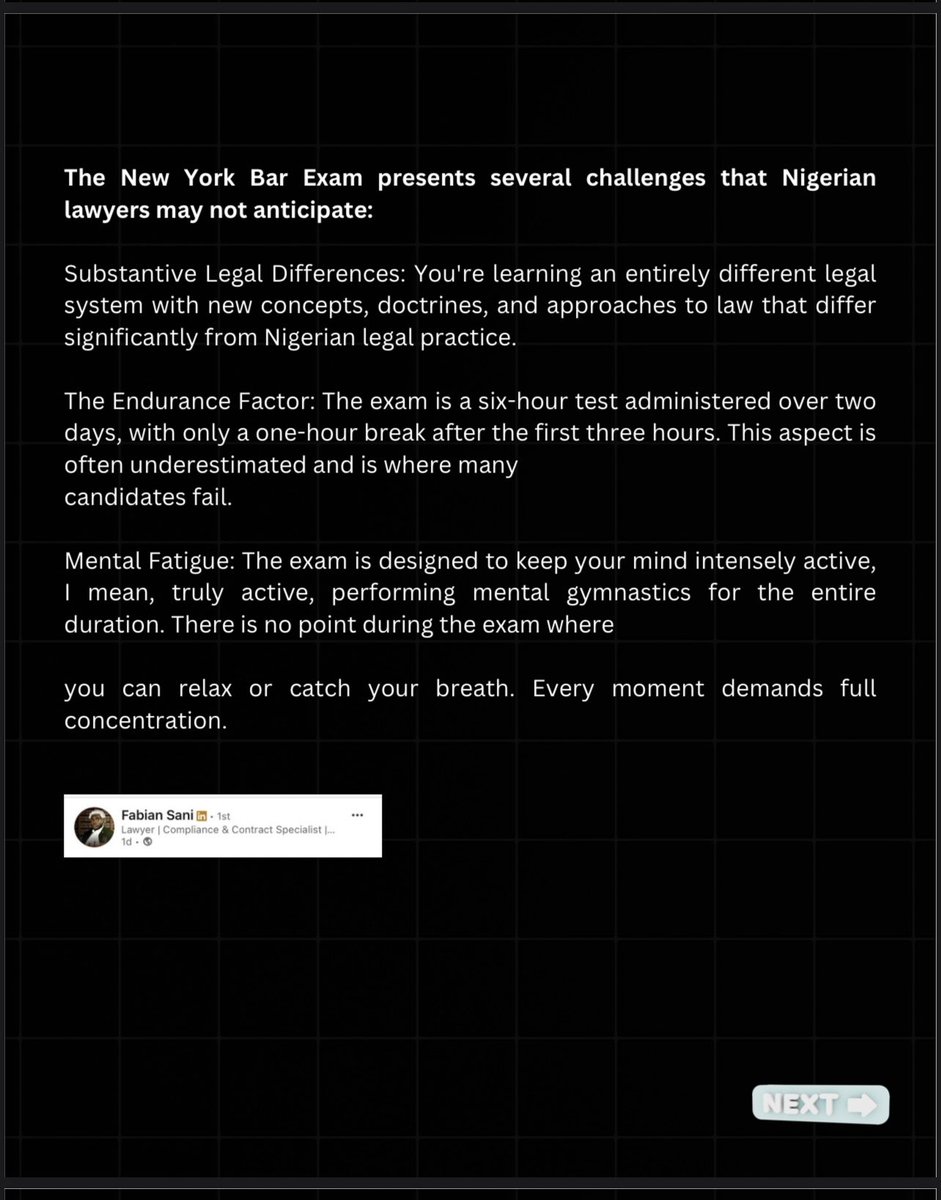
I passed the New York Bar! 🇺🇸
We see these posts all the time. We celebrate, we congratulate, and then we scroll on.
Recently, I facilitated a session with Igwekamma Obiorah a lawyer who didn’t just share his success he broke down EVERYTHING. The complete roadmap to studying law and navigating the US legal system, resulting in passing the New York Bar exam.
His story was so valuable that I’ve converted it into a comprehensive PowerPoint presentation because this information needs to reach more people.
If you’re considering law school in the US, preparing for the New York Bar.
Let’s change the narrative from just celebrating success to actually sharing the path to get there.
Like, share, and repost to help aspiring lawyers find their way.