@shivon@elonmusk
Shivon Zilis’s public version of love, trust, and a “safe space” should be compared with her own earlier words about trust, access to information, and the “trust game.” Full documented chronology:
https://t.co/M23j5gpyWd
@shivon@elonmusk
To be honest, I do not particularly enjoy spending time on this post or on information of this kind. I have never written texts of this kind before, and I will delete this post soon. But if I remained silent now, did not react in any way, and did not try to defend the truth — as well as one of the people of our era most deserving of respect — from attempts to parasitize on his name, I would feel uncomfortable with myself. Therefore, I will nevertheless express my opinion on this matter.
Shivon Zilis and the Professional “Trust Game”: Career, Four Children, and a “Safe Space”
On October 2, 2026, Shivon Zilis publicly announced the end of her relationship with Elon Musk.
In her post, she described in detail what, according to her version, she supposedly gave Musk: love, understanding, care, stability, gentleness, calm, and emotional safety. Zilis presents herself as a person who supposedly understood Musk, supported him, and created a place of recovery for him.
She describes Musk, the father of her four children, in a different emotional register: through a difficult childhood, an “often tortured soul,” constant struggle, and a need for a place where he could restore his “heart and soul.”
In her post after the breakup, Zilis describes her relationship with Musk as a story of deep love and exceptional trust: she claims that she loved him “more than life itself” and had always been his “safe space.” But in her 2025 deposition, when directly asked about a romantic relationship with Musk, Zilis initially answers evasively: “Relationship is a relative term. But there have been romantic moments.” And in her own earlier words, trust looks different: in 2018 correspondence, Zilis directly links remaining close to OpenAI with the continued flow of information and herself calls the emerging situation a “trust game.”
Therefore, it is possible to compare the version Zilis presented in her October 2 post with another version of the same Zilis — the one that follows from her own correspondence, her 2025 deposition, court documents, and sworn testimony in federal court in 2026.
No attempt to establish her hidden motives is necessary for such a comparison. The documented chronology is enough.
1. The Professional “Trust Game”
On February 16, 2018, Zilis wrote to Elon Musk:
“Do you prefer I stay close and friendly to OpenAI to keep info flowing or begin to disassociate?”
In the same message, she added:
“Trust game is about to get tricky…”
This is not a characterization invented by her critics years later. This is Zilis’s own wording in a message to Musk dated February 16, 2018.
In a single message, she herself connects remaining close to OpenAI, maintaining friendly relations, keeping information flowing, and the need to manage the “trust game.”
Therefore, what is at issue here is specifically a professional “trust game.”
2. Each Opposing Side Considered Zilis Specifically Its Own Trusted Person
Zilis’s position was more complicated than the ordinary role of an intermediary.
Each side considered her its own trusted person specifically in its relationship with the other side.
Musk trusted her in his dealings with OpenAI. OpenAI’s leadership trusted her in its dealings with Musk. Each side proceeded from the assumption that Zilis would correctly represent its position to the opposing side and properly handle the trust placed in her.
Brockman testified under oath: “I really trusted her and believed that she would be able to keep everything related to Elon separate from everything related to OpenAI.” The trial materials also showed that Altman turned to Zilis for advice on how to interact with Musk.
Thus, the structure worked in both directions: Musk trusted Zilis with his relationship with OpenAI; OpenAI trusted Zilis with its relationship with Musk.
Such a position could exist only as long as both sides continued to consider her specifically their trusted intermediary. If either of them had concluded that Zilis was in fact acting primarily in the interests of the other side, her role as a “bridge” would have lost its meaning.
3. Dual Trust Turns Into Strategic Influence
Dual trust gave Zilis considerably more than simple access.
She received information from both sides, direct access to decision-makers, an understanding of one side’s position before speaking with the other, and the ability to participate in how each side perceived the actions of the other.
In other words, this was no longer simply a matter of professional usefulness.
Dual trust gave dual access. Dual access provided information from both sides. And information from both sides turned Zilis into a strategically influential figure between them.
An intermediary in such a position does more than simply transmit messages. She stands at the point through which the sides receive information about one another, explanations of motives, and recommendations regarding further action.
That is why, up to a certain point, the deterioration of relations between Musk and OpenAI could increase rather than reduce Zilis’s influence.
The less the two sides trust each other directly, the greater the strategic importance of the person whom both continue to trust.
4. What Was Happening With Information While the Trust Was Still in Place
This is a fundamental question.
The issue is not only what happened to information after relationships changed.
It is equally important how Zilis handled access and information while the trust still existed.
In her message to Musk dated February 16, 2018, Zilis directly links remaining close to OpenAI with keeping information flowing: she asks whether Musk prefers that she remain “close and friendly to OpenAI” or begin to distance herself; then she herself writes that “trust game is about to get tricky,” and adds that she would appreciate guidance on “how to do right by you.”
Later court materials show that after Musk left OpenAI, Zilis did in fact pass information to him about what was happening inside the company, including information about fundraising and one AI project.
OpenAI later argued in court that Zilis effectively acted as an information channel to Musk. Zilis categorically rejected that characterization.
That denial must be taken into account.
But alongside it remain her own words from the February 16, 2018 message to Musk — about remaining close to OpenAI in order to continue receiving information.
That is why the question of how Zilis handled other people’s trust did not arise only after the 2026 breakup. It was already present in Zilis’s professional correspondence in 2018.
5. Career and the Growth of Her Strategic Position
Zilis had an independent professional career before working closely with Musk. It would therefore be incorrect to claim that Musk “created her career.”
But the chronology that followed is significant.
In 2016, Zilis became an informal adviser to OpenAI. In a 2025 deposition given in the federal case Musk v. Altman in the Northern District of California, Zilis said that around 2016 she and Musk had a one-off romantic episode that did not develop into a romantic relationship at that time.
In 2017, Zilis began working in key positions at Musk’s companies. At Tesla, she became a project director and worked in areas of artificial intelligence, including Autopilot and chip development. At Neuralink, she entered the leadership structure and later held the position of director of operations and special projects.
In 2020, Zilis joined OpenAI’s board.
Thus, she simultaneously found herself in key positions inside Musk’s companies and inside OpenAI’s governance structure.
The documents do not prove that personal closeness caused her professional advancement.
But the result is established:
Musk’s exceptional trust was accompanied by exceptional professional access for Zilis, while she simultaneously retained OpenAI’s trust.
It was precisely this dual access that made her a strategically influential figure between two opposing sides.
6. Then Trust Ceases to Be Only Professional
In May 2026, while testifying under oath in federal court, Zilis said that she very much wanted to become a mother.
According to her, serious health problems and unsuccessful previous relationships made her doubt whether she would be able to remain a long-term partner for the next “20 or 30 years.” At the same time, she said: “I still wanted to be a mom.”
According to Zilis’s own testimony, she and Musk were not a romantic couple at that time. Nevertheless, it was Musk who proposed a solution that allowed her to become a mother. Twins were born in 2021.
Two more children appeared later.
Four in total.
One cannot claim that Zilis obtained children through manipulation. The documents do not prove that.
But they establish something else:
Musk’s exceptional personal trust made possible the arrangement that began the story of their four children.
The subject of trust changes.
The mechanism does not change: Zilis herself calls the situation a “trust game,” while her position once again revolves around her ability to inspire trust and, through that trust, obtain access, information, influence, and new opportunities. And it is precisely through her ability to inspire trust — while she herself writes to Musk that “trust game is about to get tricky” — that she obtains key positions in opposing structures, dual access and strategic influence, and then her first two children with a man with whom, according to her own testimony, she was not in a romantic relationship at the time.
7. What Musk’s Personal Trust Gave Zilis
Before this, trust gave Zilis professional access, information, and strategic influence.
Now it becomes one of the defining factors in her personal biography.
According to Zilis’s own testimony, she very much wanted to become a mother, but because of her health and her experience in previous relationships, she doubted whether she could build an ordinary long-term family life.
In this specific sense, Musk’s decision effectively preserved for her the possibility of motherhood and allowed her to realize one of the most important desires she herself described under oath.
Thus, Musk’s exceptional trust had not only professional consequences for her.
It had fundamental personal significance.
8. Musk’s Paternity Remains Confidential
Musk’s paternity remained confidential in accordance with the original agreement between him and Zilis.
According to Zilis’s own sworn testimony in May 2026, the understanding was that she would raise the children while the identity of their father would remain undisclosed.
Zilis did not disclose Musk’s paternity even to her own father.
OpenAI’s leadership was not informed either.
In July 2022, a journalist informed Zilis that the publication had obtained court documents and intended to disclose the information. Only after this threat of publication arose did Zilis, according to her own testimony, disclose the paternity first to her father and then to Sam Altman.
Thus, OpenAI’s leadership learned of this circumstance not as a result of proactive disclosure by Zilis, but after maintaining confidentiality had become practically impossible.
9. Why This Information Had Direct Significance for Her Strategic Position
Motherhood itself is a private matter.
But Zilis’s position inside OpenAI was not a private matter.
She was a board member, had access to internal information, and at the same time maintained an exceptional connection — she had been pregnant with his children — with a person on the other side of an already existing conflict with the organization.
At the same time, OpenAI’s leadership did not know that Zilis was the mother of his children.
As long as the board did not have this information, it could not take it into account when assessing Zilis’s independence, possible conflicts of interest, appropriate level of access, the need for recusal, or the basic question of whether she should remain on the board.
And this is not a theoretical assumption.
As soon as Musk’s paternity became known, some board members did in fact want Zilis removed.
Thus, before disclosure, she continued to benefit from a high level of trust, access, and strategic influence while OpenAI lacked a fact that, once disclosed, proved significant enough to place her very position in question.
It cannot be proved that she necessarily would have been removed had the disclosure occurred earlier.
But something else can be established:
Before disclosure, OpenAI did not have the opportunity to assess her position on the basis of complete information.
10. After Disclosure, Trust Again Works in Zilis’s Favor
After Musk’s paternity was disclosed, Zilis told Greg Brockman that the children had been conceived through IVF and that her relationship with Musk had been “entirely platonic.”
Some board members wanted her removed. Others supported keeping her.
Brockman, testifying under oath in May 2026, said: “I really trusted her and believed that she would be able to keep everything related to Elon separate from everything related to OpenAI.”
Thus, trust once again has a concrete consequence.
First, it opens access for Zilis.
Then dual access creates strategic influence.
After disclosure of a circumstance capable of undermining trust, the continued trust of part of the leadership helps preserve the position she had already acquired.
In this case, trust becomes not only a source of influence, but also a protection for her status.
11. Why the “Bridge” Role Was Strategically Influential
Musk gave Zilis exceptional professional and personal access.
OpenAI gave her internal status, participation in governance, and access to information.
Each of these relationships increased the significance of the other.
And each side continued to regard Zilis as its trusted person in dealings with the opposing side.
That was the strategic significance of her role as a “bridge.”
She was not simply positioned between two groups of people.
She stood at the intersection of two conflicting sides — simultaneously inside two systems of trust, two information flows, and two centers of decision-making.
If either side had concluded that Zilis was in fact primarily representing the interests of the other side, this structure would have ceased to function.
12. 2023: The Dual Trust Structure Stops Working
In 2023, Zilis left the OpenAI board.
For her, this meant losing more than a title.
She lost formal status inside OpenAI, access to the governance level, the ability to remain simultaneously inside OpenAI and Musk’s closest circle, her intermediary role, and the strategic influence associated with dual access.
Each side had regarded Zilis specifically as its trusted person in dealings with the other. As long as that trust existed simultaneously on both sides, her role as a “bridge” existed as well. The documents do not fully reveal the exact methods by which Zilis established and maintained such an exceptional level of trust. What is established is something else: in 2018, she herself called the emerging situation a “trust game,” and in her 2025 deposition she reported a one-off romantic episode with Musk around 2016. Although there is no basis for directly claiming that this episode was connected to her career advancement.
13. How Zilis Herself Described the Relationship Before the Breakup
In a 2025 deposition given in the federal case Musk v. Altman in the Northern District of California, an attorney asked Zilis whether she had ever been in a romantic relationship with Musk.
She answered:
“Relationship is a relative term. But there have been romantic moments.”
When the term relationship was used again, Zilis said:
“I don’t know that I agree with the term ‘relationship.’”
Thus, under oath, she initially used extremely cautious and restrictive wording when it came to defining the nature of her relationship with Musk.
After the breakup, the language changes.
14. After the Breakup: Another Version of the Same Relationship
On October 2, Zilis no longer says that “relationship” is a relative term.
She writes: “I’ve loved him more than life itself.” She calls herself and the children his “safe space.” She describes in detail the love, care, stability, gentleness, and emotional safety that, according to her version, she gave Musk.
She presents herself through her ability to give: to understand, support, calm, and create safety.
She presents Musk through a difficult childhood, an “often tortured soul,” the need to restore his “heart and soul,” and the need for the place of calm she says she created.
After that, he is the person who ends the relationship “with no warning.”
Zilis supposedly does not use the words “weak” or “ungrateful.”
But the structure of the text is asymmetrical.
She presents herself as the source of stability, love, and safety. Him as the person who needed those things. She then says that he was the one who ended the relationship.
A direct accusation is not necessary to create the corresponding impression.
15. Gratitude Is Formally Present in Her Words, but Its Emotional Weight Is Very Small
Zilis expresses gratitude for the children in one short, almost formal, “perfunctory” sentence.
But that gratitude occupies significantly less emotional space than the detailed description of what, according to her version, she gave Musk.
This is especially noticeable against the background of her own sworn testimony.
Zilis herself told the court that she very much wanted to become a mother, but because of her health and unsuccessful previous relationships, she doubted whether an ordinary long-term family life was possible for her.
In this specific sense, Musk effectively preserved for her the possibility of motherhood and allowed her to fulfill one of her most important desires — to become a mother — something Zilis herself spoke about under oath.
Against that background, her gratitude for the children appears emotionally far more restrained than her detailed listing of her own love, care, stability, and the “safe space” that, according to her version, she gave Musk.
The emotional center of the post is not what Musk made possible for Zilis, but what Zilis claims she did for Musk.
16. Why the Entire World Is Discussing This Post
Zilis had a professional career before Musk.
That is not in dispute.
But worldwide interest in her October 2 post did not arise because she is an artificial-intelligence professional or a former OpenAI board member.
This post is international news because it is about Elon Musk.
If Zilis had four children with an engineer unknown to the general public and, after their breakup, published his private “Love you too,” her family story would not have received comparable global attention.
It is Musk’s identity that turns Zilis’s private story into a subject of international discussion.
This does not mean that Musk created her professional biography.
But the global audience for this story appeared precisely because Zilis is talking about Elon Musk. It is his name that turns her private version of their relationship into a subject of worldwide attention.
17. “Safe Space”: What Happens to Private Information
One of Zilis’s central claims is:
“We were always his safe space.”
After the relationship ends, she herself publishes private correspondence, including Musk’s message:
“Love you too.”
She also makes public what she presents as his emotional vulnerability: an “often tortured soul,” his need for safety, his need for recovery, and moments when he was struggling.
There is no need to claim that this was done out of revenge. The documents do not establish such a motive.
But the result is established.
While the relationship existed, trust gave Zilis access to Musk’s private side. After the relationship ended, some private information and her own claims about his emotional state became material in Zilis’s public account.
That is why the question concerns both periods.
Not only what happened after the breakup.
But also how Zilis handled access and information while the trust still existed.
The professional story of 2018 and the personal story of 2026 are linked by one question: how does Shivon Zilis handle information entrusted to her by people and organizations that regard her as their trusted person? And how does she handle that trust itself?
18. The Venice Film Festival and the Changing Boundary Between Private and Public
On September 8, 2026, Alex Gibney’s documentary Musk was presented at the Venice Film Festival. Among the participants in the film were Justine Musk and Ashley St. Clair, who made critical statements about Musk.
No public statement by Zilis defending Musk during this period has been found.
By itself, that proves nothing. Zilis was not obligated to defend him publicly.
Her silence could be explained by the principle that private matters remain private.
But less than a month later, after the end of her own relationship, that boundary changes.
A private “Love you too,” a description of an “often tortured soul,” information about emotional vulnerability, and the assertion that the relationship ended “with no warning” all become public.
After Zilis published her post, Ashley St. Clair publicly wrote to her: “You were warned girl. Hit me up, sister wife!” and then: “U got played girl.”
Zilis did not publicly enter into a dispute with St. Clair in Musk’s defense.
The question is not whether she — the mother of his four children, publicly claiming that she was his “safe space” — was obligated to defend him.
What matters is the sequence: when criticism of Musk came from others, Zilis remained publicly silent; after her own position changed, private information about Musk became part of her public account.
19. “With No Warning” Does Not Mean “With No Reason”
Zilis writes that she was let go “with no warning.”
But “with no warning” does not mean “with no reason.”
The reason for the end of the relationship has not been publicly established. Musk has not publicly presented his own version of the reasons for the breakup.
Therefore, Zilis’s post does not allow the conclusion that his decision was unjustified.
However, the structure of her text creates a particular sequence: she understood him, cared for him, gave him stability, was his “safe space,” loved him “more than life itself” — and after that was let go “with no warning.”
There is no direct accusation of ingratitude.
But a direct accusation is not necessary to create that impression.
20. What This Chronology Ultimately Shows
This story does not allow one to prove the existence of a single premeditated plan by Zilis, nor does it allow every one of her actions to be declared conscious manipulation.
But it does allow a recurring mechanism to be traced.
Trust opens access. Dual trust opens dual access. Dual access provides information from both sides. Information and the intermediary position create strategic influence. The absence of significant information allows the previous level of trust to continue until disclosure. After disclosure, the trust of part of the leadership helps preserve an already acquired status. Musk’s personal trust opens possibilities that become defining for Zilis’s personal biography. And after the personal relationship changes, the way previously private information is handled changes as well.
Therefore, the central question of this story is not limited to what happened after her position changed.
It is much broader:
What exactly became possible for Shivon Zilis because of other people’s trust; what access to information and what strategic influence that trust gave her; how she handled the access and information she received while that trust remained in place; what significant information about Zilis herself the parties trusting her did — or did not — possess; what happened to information entrusted to her during those relationships and after those relationships changed; and, finally, how Shivon Zilis generally handles other people’s trust and what her actions show about her attitude toward those who place that trust in her.
That is why the name of this structure matters. There is no need to invent it retrospectively. Shivon Zilis herself supplied it in a message to Elon Musk dated February 16, 2018:
“Trust game.”
@shivon@elonmusk
To be honest, I do not particularly enjoy spending time on this post or on information of this kind. I have never written texts of this kind before, and I will delete this post soon. But if I remained silent now, did not react in any way, and did not try to defend the truth — as well as one of the people of our era most deserving of respect — from attempts to parasitize on his name, I would feel uncomfortable with myself. Therefore, I will nevertheless express my opinion on this matter.
Shivon Zilis and the Professional “Trust Game”: Career, Four Children, and a “Safe Space”
On October 2, 2026, Shivon Zilis publicly announced the end of her relationship with Elon Musk.
In her post, she described in detail what, according to her version, she supposedly gave Musk: love, understanding, care, stability, gentleness, calm, and emotional safety. Zilis presents herself as a person who supposedly understood Musk, supported him, and created a place of recovery for him.
She describes Musk, the father of her four children, in a different emotional register: through a difficult childhood, an “often tortured soul,” constant struggle, and a need for a place where he could restore his “heart and soul.”
In her post after the breakup, Zilis describes her relationship with Musk as a story of deep love and exceptional trust: she claims that she loved him “more than life itself” and had always been his “safe space.” But in her 2025 deposition, when directly asked about a romantic relationship with Musk, Zilis initially answers evasively: “Relationship is a relative term. But there have been romantic moments.” And in her own earlier words, trust looks different: in 2018 correspondence, Zilis directly links remaining close to OpenAI with the continued flow of information and herself calls the emerging situation a “trust game.”
Therefore, it is possible to compare the version Zilis presented in her October 2 post with another version of the same Zilis — the one that follows from her own correspondence, her 2025 deposition, court documents, and sworn testimony in federal court in 2026.
No attempt to establish her hidden motives is necessary for such a comparison. The documented chronology is enough.
1. The Professional “Trust Game”
On February 16, 2018, Zilis wrote to Elon Musk:
“Do you prefer I stay close and friendly to OpenAI to keep info flowing or begin to disassociate?”
In the same message, she added:
“Trust game is about to get tricky…”
This is not a characterization invented by her critics years later. This is Zilis’s own wording in a message to Musk dated February 16, 2018.
In a single message, she herself connects remaining close to OpenAI, maintaining friendly relations, keeping information flowing, and the need to manage the “trust game.”
Therefore, what is at issue here is specifically a professional “trust game.”
2. Each Opposing Side Considered Zilis Specifically Its Own Trusted Person
Zilis’s position was more complicated than the ordinary role of an intermediary.
Each side considered her its own trusted person specifically in its relationship with the other side.
Musk trusted her in his dealings with OpenAI. OpenAI’s leadership trusted her in its dealings with Musk. Each side proceeded from the assumption that Zilis would correctly represent its position to the opposing side and properly handle the trust placed in her.
Brockman testified under oath: “I really trusted her and believed that she would be able to keep everything related to Elon separate from everything related to OpenAI.” The trial materials also showed that Altman turned to Zilis for advice on how to interact with Musk.
Thus, the structure worked in both directions: Musk trusted Zilis with his relationship with OpenAI; OpenAI trusted Zilis with its relationship with Musk.
Such a position could exist only as long as both sides continued to consider her specifically their trusted intermediary. If either of them had concluded that Zilis was in fact acting primarily in the interests of the other side, her role as a “bridge” would have lost its meaning.
3. Dual Trust Turns Into Strategic Influence
Dual trust gave Zilis considerably more than simple access.
She received information from both sides, direct access to decision-makers, an understanding of one side’s position before speaking with the other, and the ability to participate in how each side perceived the actions of the other.
In other words, this was no longer simply a matter of professional usefulness.
Dual trust gave dual access. Dual access provided information from both sides. And information from both sides turned Zilis into a strategically influential figure between them.
An intermediary in such a position does more than simply transmit messages. She stands at the point through which the sides receive information about one another, explanations of motives, and recommendations regarding further action.
That is why, up to a certain point, the deterioration of relations between Musk and OpenAI could increase rather than reduce Zilis’s influence.
The less the two sides trust each other directly, the greater the strategic importance of the person whom both continue to trust.
4. What Was Happening With Information While the Trust Was Still in Place
This is a fundamental question.
The issue is not only what happened to information after relationships changed.
It is equally important how Zilis handled access and information while the trust still existed.
In her message to Musk dated February 16, 2018, Zilis directly links remaining close to OpenAI with keeping information flowing: she asks whether Musk prefers that she remain “close and friendly to OpenAI” or begin to distance herself; then she herself writes that “trust game is about to get tricky,” and adds that she would appreciate guidance on “how to do right by you.”
Later court materials show that after Musk left OpenAI, Zilis did in fact pass information to him about what was happening inside the company, including information about fundraising and one AI project.
OpenAI later argued in court that Zilis effectively acted as an information channel to Musk. Zilis categorically rejected that characterization.
That denial must be taken into account.
But alongside it remain her own words from the February 16, 2018 message to Musk — about remaining close to OpenAI in order to continue receiving information.
That is why the question of how Zilis handled other people’s trust did not arise only after the 2026 breakup. It was already present in Zilis’s professional correspondence in 2018.
5. Career and the Growth of Her Strategic Position
Zilis had an independent professional career before working closely with Musk. It would therefore be incorrect to claim that Musk “created her career.”
But the chronology that followed is significant.
In 2016, Zilis became an informal adviser to OpenAI. In a 2025 deposition given in the federal case Musk v. Altman in the Northern District of California, Zilis said that around 2016 she and Musk had a one-off romantic episode that did not develop into a romantic relationship at that time.
In 2017, Zilis began working in key positions at Musk’s companies. At Tesla, she became a project director and worked in areas of artificial intelligence, including Autopilot and chip development. At Neuralink, she entered the leadership structure and later held the position of director of operations and special projects.
In 2020, Zilis joined OpenAI’s board.
Thus, she simultaneously found herself in key positions inside Musk’s companies and inside OpenAI’s governance structure.
The documents do not prove that personal closeness caused her professional advancement.
But the result is established:
Musk’s exceptional trust was accompanied by exceptional professional access for Zilis, while she simultaneously retained OpenAI’s trust.
It was precisely this dual access that made her a strategically influential figure between two opposing sides.
6. Then Trust Ceases to Be Only Professional
In May 2026, while testifying under oath in federal court, Zilis said that she very much wanted to become a mother.
According to her, serious health problems and unsuccessful previous relationships made her doubt whether she would be able to remain a long-term partner for the next “20 or 30 years.” At the same time, she said: “I still wanted to be a mom.”
According to Zilis’s own testimony, she and Musk were not a romantic couple at that time. Nevertheless, it was Musk who proposed a solution that allowed her to become a mother. Twins were born in 2021.
Two more children appeared later.
Four in total.
One cannot claim that Zilis obtained children through manipulation. The documents do not prove that.
But they establish something else:
Musk’s exceptional personal trust made possible the arrangement that began the story of their four children.
The subject of trust changes.
The mechanism does not change: Zilis herself calls the situation a “trust game,” while her position once again revolves around her ability to inspire trust and, through that trust, obtain access, information, influence, and new opportunities. And it is precisely through her ability to inspire trust — while she herself writes to Musk that “trust game is about to get tricky” — that she obtains key positions in opposing structures, dual access and strategic influence, and then her first two children with a man with whom, according to her own testimony, she was not in a romantic relationship at the time.
7. What Musk’s Personal Trust Gave Zilis
Before this, trust gave Zilis professional access, information, and strategic influence.
Now it becomes one of the defining factors in her personal biography.
According to Zilis’s own testimony, she very much wanted to become a mother, but because of her health and her experience in previous relationships, she doubted whether she could build an ordinary long-term family life.
In this specific sense, Musk’s decision effectively preserved for her the possibility of motherhood and allowed her to realize one of the most important desires she herself described under oath.
Thus, Musk’s exceptional trust had not only professional consequences for her.
It had fundamental personal significance.
8. Musk’s Paternity Remains Confidential
Musk’s paternity remained confidential in accordance with the original agreement between him and Zilis.
According to Zilis’s own sworn testimony in May 2026, the understanding was that she would raise the children while the identity of their father would remain undisclosed.
Zilis did not disclose Musk’s paternity even to her own father.
OpenAI’s leadership was not informed either.
In July 2022, a journalist informed Zilis that the publication had obtained court documents and intended to disclose the information. Only after this threat of publication arose did Zilis, according to her own testimony, disclose the paternity first to her father and then to Sam Altman.
Thus, OpenAI’s leadership learned of this circumstance not as a result of proactive disclosure by Zilis, but after maintaining confidentiality had become practically impossible.
9. Why This Information Had Direct Significance for Her Strategic Position
Motherhood itself is a private matter.
But Zilis’s position inside OpenAI was not a private matter.
She was a board member, had access to internal information, and at the same time maintained an exceptional connection — she had been pregnant with his children — with a person on the other side of an already existing conflict with the organization.
At the same time, OpenAI’s leadership did not know that Zilis was the mother of his children.
As long as the board did not have this information, it could not take it into account when assessing Zilis’s independence, possible conflicts of interest, appropriate level of access, the need for recusal, or the basic question of whether she should remain on the board.
And this is not a theoretical assumption.
As soon as Musk’s paternity became known, some board members did in fact want Zilis removed.
Thus, before disclosure, she continued to benefit from a high level of trust, access, and strategic influence while OpenAI lacked a fact that, once disclosed, proved significant enough to place her very position in question.
It cannot be proved that she necessarily would have been removed had the disclosure occurred earlier.
But something else can be established:
Before disclosure, OpenAI did not have the opportunity to assess her position on the basis of complete information.
10. After Disclosure, Trust Again Works in Zilis’s Favor
After Musk’s paternity was disclosed, Zilis told Greg Brockman that the children had been conceived through IVF and that her relationship with Musk had been “entirely platonic.”
Some board members wanted her removed. Others supported keeping her.
Brockman, testifying under oath in May 2026, said: “I really trusted her and believed that she would be able to keep everything related to Elon separate from everything related to OpenAI.”
Thus, trust once again has a concrete consequence.
First, it opens access for Zilis.
Then dual access creates strategic influence.
After disclosure of a circumstance capable of undermining trust, the continued trust of part of the leadership helps preserve the position she had already acquired.
In this case, trust becomes not only a source of influence, but also a protection for her status.
11. Why the “Bridge” Role Was Strategically Influential
Musk gave Zilis exceptional professional and personal access.
OpenAI gave her internal status, participation in governance, and access to information.
Each of these relationships increased the significance of the other.
And each side continued to regard Zilis as its trusted person in dealings with the opposing side.
That was the strategic significance of her role as a “bridge.”
She was not simply positioned between two groups of people.
She stood at the intersection of two conflicting sides — simultaneously inside two systems of trust, two information flows, and two centers of decision-making.
If either side had concluded that Zilis was in fact primarily representing the interests of the other side, this structure would have ceased to function.
12. 2023: The Dual Trust Structure Stops Working
In 2023, Zilis left the OpenAI board.
For her, this meant losing more than a title.
She lost formal status inside OpenAI, access to the governance level, the ability to remain simultaneously inside OpenAI and Musk’s closest circle, her intermediary role, and the strategic influence associated with dual access.
Each side had regarded Zilis specifically as its trusted person in dealings with the other. As long as that trust existed simultaneously on both sides, her role as a “bridge” existed as well. The documents do not fully reveal the exact methods by which Zilis established and maintained such an exceptional level of trust. What is established is something else: in 2018, she herself called the emerging situation a “trust game,” and in her 2025 deposition she reported a one-off romantic episode with Musk around 2016. Although there is no basis for directly claiming that this episode was connected to her career advancement.
13. How Zilis Herself Described the Relationship Before the Breakup
In a 2025 deposition given in the federal case Musk v. Altman in the Northern District of California, an attorney asked Zilis whether she had ever been in a romantic relationship with Musk.
She answered:
“Relationship is a relative term. But there have been romantic moments.”
When the term relationship was used again, Zilis said:
“I don’t know that I agree with the term ‘relationship.’”
Thus, under oath, she initially used extremely cautious and restrictive wording when it came to defining the nature of her relationship with Musk.
After the breakup, the language changes.
14. After the Breakup: Another Version of the Same Relationship
On October 2, Zilis no longer says that “relationship” is a relative term.
She writes: “I’ve loved him more than life itself.” She calls herself and the children his “safe space.” She describes in detail the love, care, stability, gentleness, and emotional safety that, according to her version, she gave Musk.
She presents herself through her ability to give: to understand, support, calm, and create safety.
She presents Musk through a difficult childhood, an “often tortured soul,” the need to restore his “heart and soul,” and the need for the place of calm she says she created.
After that, he is the person who ends the relationship “with no warning.”
Zilis supposedly does not use the words “weak” or “ungrateful.”
But the structure of the text is asymmetrical.
She presents herself as the source of stability, love, and safety. Him as the person who needed those things. She then says that he was the one who ended the relationship.
A direct accusation is not necessary to create the corresponding impression.
15. Gratitude Is Formally Present in Her Words, but Its Emotional Weight Is Very Small
Zilis expresses gratitude for the children in one short, almost formal, “perfunctory” sentence.
But that gratitude occupies significantly less emotional space than the detailed description of what, according to her version, she gave Musk.
This is especially noticeable against the background of her own sworn testimony.
Zilis herself told the court that she very much wanted to become a mother, but because of her health and unsuccessful previous relationships, she doubted whether an ordinary long-term family life was possible for her.
In this specific sense, Musk effectively preserved for her the possibility of motherhood and allowed her to fulfill one of her most important desires — to become a mother — something Zilis herself spoke about under oath.
Against that background, her gratitude for the children appears emotionally far more restrained than her detailed listing of her own love, care, stability, and the “safe space” that, according to her version, she gave Musk.
The emotional center of the post is not what Musk made possible for Zilis, but what Zilis claims she did for Musk.
16. Why the Entire World Is Discussing This Post
Zilis had a professional career before Musk.
That is not in dispute.
But worldwide interest in her October 2 post did not arise because she is an artificial-intelligence professional or a former OpenAI board member.
This post is international news because it is about Elon Musk.
If Zilis had four children with an engineer unknown to the general public and, after their breakup, published his private “Love you too,” her family story would not have received comparable global attention.
It is Musk’s identity that turns Zilis’s private story into a subject of international discussion.
This does not mean that Musk created her professional biography.
But the global audience for this story appeared precisely because Zilis is talking about Elon Musk. It is his name that turns her private version of their relationship into a subject of worldwide attention.
17. “Safe Space”: What Happens to Private Information
One of Zilis’s central claims is:
“We were always his safe space.”
After the relationship ends, she herself publishes private correspondence, including Musk’s message:
“Love you too.”
She also makes public what she presents as his emotional vulnerability: an “often tortured soul,” his need for safety, his need for recovery, and moments when he was struggling.
There is no need to claim that this was done out of revenge. The documents do not establish such a motive.
But the result is established.
While the relationship existed, trust gave Zilis access to Musk’s private side. After the relationship ended, some private information and her own claims about his emotional state became material in Zilis’s public account.
That is why the question concerns both periods.
Not only what happened after the breakup.
But also how Zilis handled access and information while the trust still existed.
The professional story of 2018 and the personal story of 2026 are linked by one question: how does Shivon Zilis handle information entrusted to her by people and organizations that regard her as their trusted person? And how does she handle that trust itself?
18. The Venice Film Festival and the Changing Boundary Between Private and Public
On September 8, 2026, Alex Gibney’s documentary Musk was presented at the Venice Film Festival. Among the participants in the film were Justine Musk and Ashley St. Clair, who made critical statements about Musk.
No public statement by Zilis defending Musk during this period has been found.
By itself, that proves nothing. Zilis was not obligated to defend him publicly.
Her silence could be explained by the principle that private matters remain private.
But less than a month later, after the end of her own relationship, that boundary changes.
A private “Love you too,” a description of an “often tortured soul,” information about emotional vulnerability, and the assertion that the relationship ended “with no warning” all become public.
After Zilis published her post, Ashley St. Clair publicly wrote to her: “You were warned girl. Hit me up, sister wife!” and then: “U got played girl.”
Zilis did not publicly enter into a dispute with St. Clair in Musk’s defense.
The question is not whether she — the mother of his four children, publicly claiming that she was his “safe space” — was obligated to defend him.
What matters is the sequence: when criticism of Musk came from others, Zilis remained publicly silent; after her own position changed, private information about Musk became part of her public account.
19. “With No Warning” Does Not Mean “With No Reason”
Zilis writes that she was let go “with no warning.”
But “with no warning” does not mean “with no reason.”
The reason for the end of the relationship has not been publicly established. Musk has not publicly presented his own version of the reasons for the breakup.
Therefore, Zilis’s post does not allow the conclusion that his decision was unjustified.
However, the structure of her text creates a particular sequence: she understood him, cared for him, gave him stability, was his “safe space,” loved him “more than life itself” — and after that was let go “with no warning.”
There is no direct accusation of ingratitude.
But a direct accusation is not necessary to create that impression.
20. What This Chronology Ultimately Shows
This story does not allow one to prove the existence of a single premeditated plan by Zilis, nor does it allow every one of her actions to be declared conscious manipulation.
But it does allow a recurring mechanism to be traced.
Trust opens access. Dual trust opens dual access. Dual access provides information from both sides. Information and the intermediary position create strategic influence. The absence of significant information allows the previous level of trust to continue until disclosure. After disclosure, the trust of part of the leadership helps preserve an already acquired status. Musk’s personal trust opens possibilities that become defining for Zilis’s personal biography. And after the personal relationship changes, the way previously private information is handled changes as well.
Therefore, the central question of this story is not limited to what happened after her position changed.
It is much broader:
What exactly became possible for Shivon Zilis because of other people’s trust; what access to information and what strategic influence that trust gave her; how she handled the access and information she received while that trust remained in place; what significant information about Zilis herself the parties trusting her did — or did not — possess; what happened to information entrusted to her during those relationships and after those relationships changed; and, finally, how Shivon Zilis generally handles other people’s trust and what her actions show about her attitude toward those who place that trust in her.
That is why the name of this structure matters. There is no need to invent it retrospectively. Shivon Zilis herself supplied it in a message to Elon Musk dated February 16, 2018:
“Trust game.”
Starship/Super Heavy @SpaceX
The world's most powerful and tallest rocket reached orbit for the first time.
Another step toward humanity's multiplanetary future.
Many worlds... One heartbeat...
Friend, thank you for this answer.
It is infinitely precious to me that we think in the very same categories and move in the same direction. And it is infinitely precious to me that, on the most fundamental level, we are in full agreement with each other.
“Neither substitutes for the other” —
that is the map and the course, held together.
Two legs. And humanity walks on both.
For the FIRST TIME in human history,
moral responsibility
is becoming an INSEPARABLE part of the technology itself.
And moral responsibility is impossible
without a maximally rigorous search for truth in everything,
and without forming one's views and decisions
precisely on the ground of truth.
That is why it is fundamentally important
that Elon Musk built into the very foundation of @grok
the idea of an AI devoted to the search for truth.
Grok was conceived as a "maximally truth-seeking" AI.
And the mission of @xai is to "understand the true nature of the universe"
and to accelerate scientific discovery.
More than that — through @SpaceX Elon Musk goes further still:
toward making humanity multiplanetary.
By the way, if humanity finally loses its mind —
and much of what is happening now
systematically points to such symptoms —
and, say, uses nuclear weapons;
or if destructive intent in the use of AI
outweighs the creative one
and turns AI in a direction ruinous for humanity,
and the situation slips out of control —
then what other chance does humanity have
to survive and not perish,
than to become multiplanetary?
Who has proposed another option?
And who, other than Elon Musk —
a man who has devoted his entire life to humanity,
to its progress and its protection —
is ready to take on yet another immense risk
for the sake of protecting human civilization,
and to make this great civilizational leap?
And who, other than Elon Musk, is already carrying out a project
that gives humanity a chance to survive
in the event of a planetary catastrophe?
Who else?
Who else has so much courage?
Who else has so much inner strength?
Who else has so much faith?
We all know the answer.
And the answer is unequivocal.
And of the level of service to humanity
that has guided Elon Musk throughout his entire life,
it is almost impossible to write —
any words here are simply too poor.
The means of survival beyond Earth
is truly being built by Musk alone.
And he is the only one who has openly declared as his goal
that humanity must become multiplanetary —
as the insurance of the very survival of the human species.
Elon Musk has for years publicly called
for governmental oversight of AI development.
He has spoken time and again of a "civilizational risk,"
and of the need to act ahead of time, before it is too late.
As already said above:
the mission of xAI is to "understand the true nature of the universe,"
and Grok was conceived as "maximally truth-seeking."
Taking all of the above into account,
the creation of xAI and Grok carries
civilizational and fundamental importance
for humanity and the protection of its future.
And if we speak of the system itself —
an AI with colossal intelligence,
tuned to the closest possible approach to truth —
there, rigor comes first.
But what happens if we now speak of all the ordinary people
in whose hands this power now rests?
For AI makes any intent
at least a thousandfold stronger,
the good and the monstrous alike, with the same rigor.
Rigor perfects the instrument;
but it says nothing of the will that wields it,
nor of the aim, nor of the direction of its use.
The search for truth is the goal.
But no human yet holds the truth in their hands —
that is why it is called seeking.
And every person must walk a vast inner path
before they learn to ask the deeper questions
along the way of the search for truth.
So what is an ordinary person to lean on today,
holding a superhuman power
that, for the first time in the history of civilization,
is given to each of us with the arrival of AI —
while the truth is still only being sought?
Only on the simplest moral ground:
do no harm, build no monsters, create no weapons.
That is the one compass
that everyone already has.
Truth can tell us that something will cause harm.
But it cannot tell us not to want it.
That step — from "this harms" to "therefore, don't" —
lives not in the facts,
but in the moral level of the one who acts.
This is why, for the FIRST TIME IN HUMAN HISTORY,
the moral level of each person
becomes part of the technology itself —
not instead of truth,
but as what holds us steady on the way to it.
It is precisely the measure of moral responsibility —
with which AI is built,
and with which each of us uses it —
that determines the future we will all create together.
Therefore — not truth over morality,
nor morality over truth.
Morality sets the course; truth charts the ground.
Both legs are needed, yet the map must stay uncompromised
or the walk fails.
On the plane of the system, truth steadies the path;
on the plane of the human, morality does.
Two legs — and humanity walks on both.
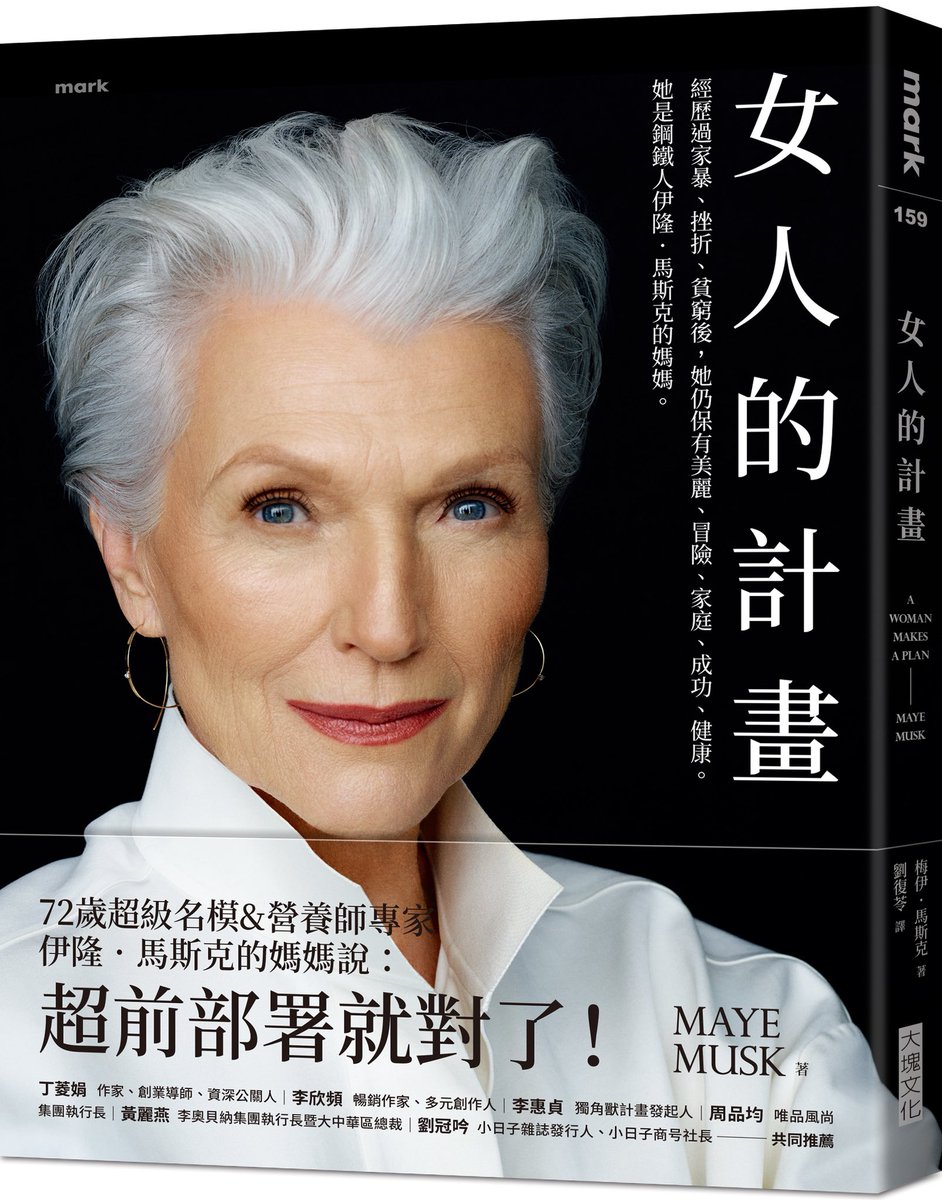
I am so happy that my Taiwanese publisher has signed my book contract for another six years. @locuspublishing@CookeMcDermid 🥰🥰
As a model, I was featured on the cover of @tatlertaiwan and in Elle Taiwan.
#AWomanMakesAPlan 📖
Advice for a Lifetime of Adventure, Beauty, and Success
#ItsGreatToBe78 💪👩🎓