I've spent the past several months refining my understanding of techniques for managing context in LLMs. I've tried to write an accessible summary that also includes links to key research (including @a1zhang's RLM writing).
Here it is: https://t.co/KZkinW7TR6
This is incredible. Artificial intelligence getting booed out of the stadium in any commencement speech it’s mentioned. Maybe telling college students AI was taking their jobs wasn’t the best strategy. Must watch —>
@repligate Agreed. My experience is that the nature of the engagement changes if one genuinely has, and genuinely exhibits, curiosity and openness to “what’s going on in there”, whatever that might be. It need not even be named or spelled out.
When I was with MSU football, we traveled to Iowa for a game.
At one point, I got separated from the group, (long story) but I found myself walking toward the stadium in my Spartan jersey. I was walking through a massive group of Iowa fans tailgating.
I’d been to Ohio State already, so I was mentally ready for all the horrible stuff I was about to experience.
Before I had got 100 feet in, people had given me pork chop sandwiches, chips, all kinds of stuff.
I ended up chatting with a bunch of them and they were just the best fan base ever. They loved Iowa football and were just so dang pleasant.
Eventually, I got back to the stadium and a couple hours later the game started.
I was curious as to what these sweet people would be like once the missile launched.
When you’re on the sideline in Iowa, you are right next to the fans. The distance between you and them is very small.
I’ll tell you what, They hurled some of the best and most creative verbal abuse I’ve ever heard in my life.
Absolutely first rate.
They will always be my favorite fan base in the Big Ten.
I write about this in more detail in a blog post with a guest contribution from Isaac Rajagopal, a student at MIT on whose work ChatGPT built, who gives his assessment of the level of mathematical ability displayed by the model.
https://t.co/K10U8ZktcJ
Iowa men's basketball head coach Ben McCollum is finalizing a new contract extension with the Hawkeyes, ESPN reported Friday. McCollum led Iowa to a 24-13 record and the programs first appearance in the Elite Eight since 1987. https://t.co/UOLcrwcRPV
I coached against Ben McCollum across six seasons. We built our roster and our defensive system with the goal of taking them down. While we beat them three times in a row, they always flexed greater winning four D2 National Championships and beating us a large majority of the time. There is no team we studied more as a staff than McCollum’s teams. Here is what he does better than most coaches in the country:
*Point guard development: Ben McCollum is to college basketball what Andy Reid is to NFL football. Reid is widely considered the best QB coach developing Donovan McNabb, Alex Smith, and Pat Mahomes. If you think Bennett Stirtz is good for Drake, you should have seen McCollum’s point guard Trevor Hudgins (2x National POY) who signed and played with the Houston Rockets. Before Hudgins was National POY Justin Pitts. Simply put, McCollum always has the best point guard in the country. He develops them and they play the entire game. Stirtz leads the country at 39.4 MPG; Hudgins was at 37.7 MPG. McCollum’s methodical and controlled style of play protects them from injury and their team defense protects them from foul trouble. Stirtz was a second team all-conference player in our D2 league last season. He is now one of the best players in the country in NCAA D1 and a serious NBA prospect. No one develops PG’s better than McCollum.
*Team Defense: No one gets players, who shouldn’t be able to guard, to be better on D than McCollum. Mitch Mascari should get blown by every possession. Daniel Abreu shouldn’t be able to guard 6’10+ big men. Bennett Stirtz should be attacked off the bounce constantly to wear him out and get him in foul trouble. Opposing coaches know these things and try them. But it doesn’t work well. McCollum’s best, and most underrated strength, is coaching team defense. His guys are tough, physical, legal, smart, play for each other in the gaps, take pride in winning their individual defensive matchup, and they don’t get tired. Plus, he always has one bona fide elite on-ball defender on his roster (see Isaiah Jackson and Diego Benard) to shut down elite guards.
*Shot developer: Many college coaches don’t develop or change their player’s jump shots. Shots typically get worse for months at a time before they get better and most players are stubborn and/or not there long enough before transferring to their next school. McCollum develops shooters. One example is Mitch Mascari. Here is his shooting splits over the past five seasons:
*Fr: 7/27 3PT - .259
*So: 20/60 3PT - .333
*Jr. 56/120 3PT - .466
*Sr. 82/171 3PT - .480
*Gr. 87/214 3PT - .407 (vs. D1 closeouts)
It isn’t just Mascari either. A key reason Stirtz went from second team all-conference at the D2 level to the Larry Bird MVP of the Missouri Valley Conference is because of his improved perimeter shot. His last season in D2, Stirtz was 36/110 from 3PT (.327). This season at Drake he is 62/156 3PT (.397). He is perhaps shooting 80% from 3PT on “big shots” too. For perhaps McCollum’s best shot development job, see Ryan Hawkins, who starred for four years at NW Missouri State before transferring and being All-Big East at Creighton his final season.
*Master in-game manipulator: As Ben’s former assistant Austin Meyer says, “You’ll play the game the way Ben McCollum wants you to play.” I’ve never seen, or coached against, someone who manipulates pace the way that Ben does. He can play his point guard the entire game as a result. Most players don’t want to play this way. It’s slow, sometimes boring, it’s controlled, there isn’t a lot of freedom, and the point guard usage rate is amongst the highest in the country (I.e. the PG gets to create in this system while others don’t). However, McCollum’s innate ability to identify selfless, no-ego players during the recruiting process allows him to get the buy-in needed to operate this way and at his pace. “Press them.. just speed them up”… Good luck with that.
You might think the "agents" thing is just coming for software engineers. Yeah, agents write code, code and code sells a bunch of tokens, But most people's work isn't code, it's memos or decks or whatever.
Why this is false:
Agents can do anything you can do on a computer, and they do it by spending output tokens to write code. The number of keypresses used by a consultant to do a task is not a good measurement of the number of tokens an agent would use.
For example: one "deep research" report might be 20 pages of output tokens. But it also might have required more than 20 pages of output tokens to do all the searches, fetches, PDF parsing and interim summaries that you never even see as the user. It also had to input all the tokens of every document it read in searching — likely more than 20 pages, since the point of the report is to collect and summarize this information.
So now we're at 3x tokens for the final output. That one report is so cheap, and so fast, then now you can do more research than ever. This is valuable! If your business relies on having good information about the world, you can probably find a way to make more money by doing 3 deep research reports and then synthesizing them. More tokens!
Now you've kicked off three deep research reports you deserve a little treat, right? So you fire up your browser agent and tell it go find me some nice linen shirts for summer in my size. Open them in tabs so I can look through. Well your browser agent has to interact with the browser using some kind of tool and you know what that tool is? Code, baby. Tokens.
And the tokens are so cheap. You got to understand. We're spending a lot in the aggregate, but in the moment it is "spend a nickel to for 10 minutes of being literally Superman". Like yes I'll just keep spending nickels actually. I will never stop being Superman at that price.
All knowledge workers will feel this. A lot of you already do, you're just hiding it from your boss so you can have more free time while "working from home". And maybe it's better to protect yourselves from Jevons as long as possible, because once you get the bug it's hard to stop. You realize that you could be creating all of the businesses and projects and art you ever wanted and all you've got to do is put your instructions in the right order and put the nickels in the bag.
I would happily bet against Anthropic's revenue spike being a brief "sugar high". So would most capital allocators! That is because they have already seen that software can eat the world.
White collar knowledge work fundamentally changes in the face of agent economics and entirely new forms of knowledge production?
It's happened already in finance: high frequency trading. Now it's happening in tech: high frequency software. Then we will have high frequency science, high frequency governance, high frequency engineering, high frequency medicine and high frequency law.
Human society is about to be absolutely DDOSed by information at all levels of the stack. Our civilization was never meant to handle this many tokens. If anything can be done on a computer it will be turned into tokens instead of human actions and it will happen faster and in parallel.
This stuff works, it is real, it is getting better. It is going to hit economically and socially this year and nobody is ready and I think it is important to start taking it seriously, instead of finding ever more arbitrary reasons to remain in denial.
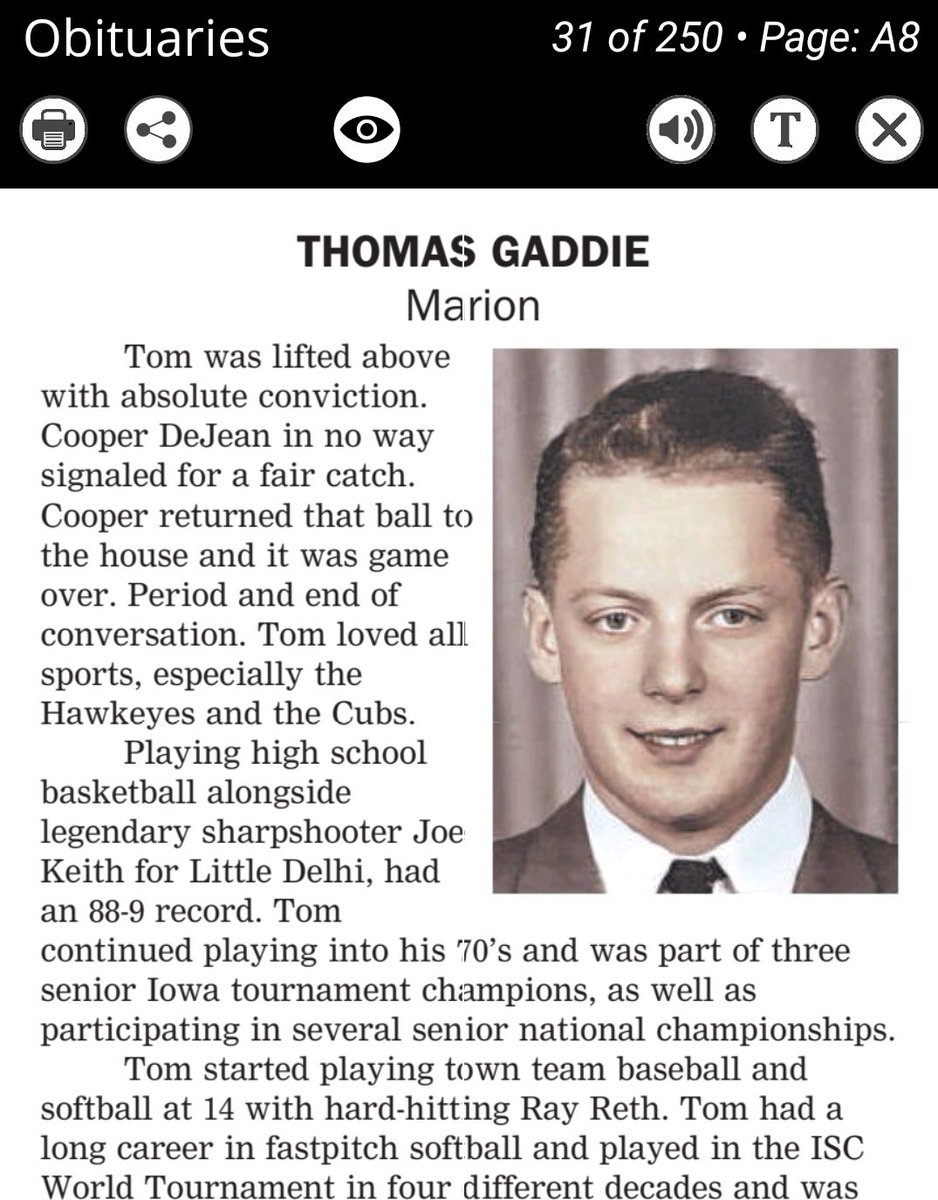
Oh my.... From the Cedar Rapids Gazette this morning 2/18/26. I didn't know Thomas Gaddie, but this might be the greatest opening line of an obituary ever. RIP Tom!
> be me, applied scientist at amazon
> spend 6 months building ML model that actually works
> ready to ship
> manager asks "but does it Dive Deep?"
> show him 37 pages of technical documentation
> "that's great anon, but what about Customer Obsession?"
> model literally convinces customers to buy more stuff they don't need
> "okay but are you thinking Big Enough?"
> mfw I am literally increasing sales
> okay lets ship it
> PM says there's not enough Disagree and Commit
> we need to disagree about something
> team spends 2 hours debating whether the config file should be YAML or JSON
> engineering insists on XML "for backwards compatibility"
> what backwards compatibility, this is a new service
> doesn't matter, we disagree and commit to XML
> finally get approval to deploy
> "make sure you're frugal with the compute costs"
> model runs on a potato, costs $2/month
> finance still wants a cost breakdown
> write 6-pager about why we need $2/month
> include bar raiser in the review
> bar raiser asks "but can we do it for $1.50? we need to be Frugal"
> spend another month optimizing to hit $1.50
> ready to deploy again
> VP decides we need to "Invent and Simplify"
> requests we rebuild the entire thing using a new framework
> framework doesn't exist yet
> "show some Ownership and build it yourself"
> 3 months later, framework is half done
> org restructure happens
> new manager says this doesn't align with team goals anymore
> project cancelled
> model never ships
> manager gets promoted to L8 for "successfully reallocating resources"
> team celebrates with 6-pager retrospective about what we learned
> mfw we delivered on all 16 leadership principles
> mfw we delivered nothing else
> amazon.jpg
I'm all for banning junk fees (though I'm surprised HTC would be on board) but the primary drivers of high hotel rates in NYC are that we banned Airbnb and it's too hard to build new hotels