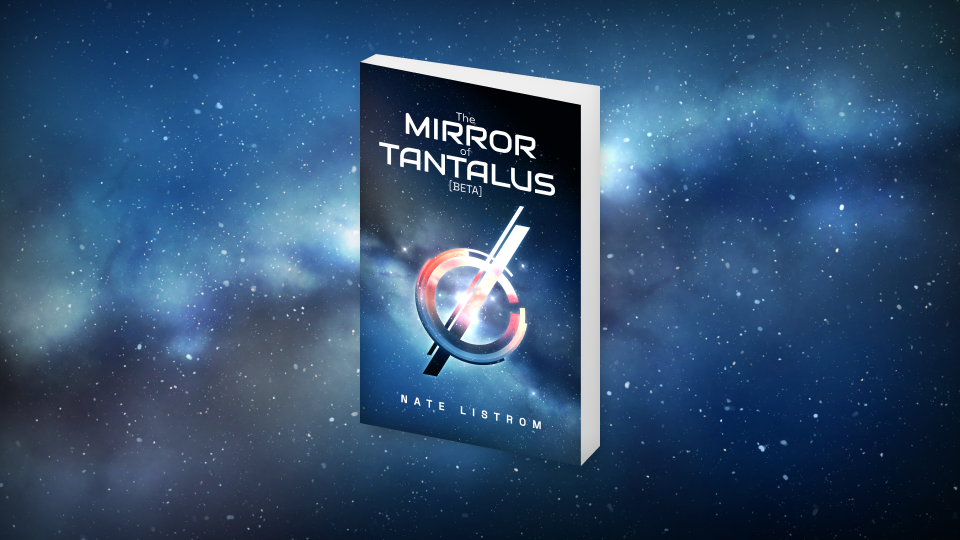
Looking for a great sci-fi read?
I'm biased of course, but I couldn't be happier to introduce you to my novelette, The Mirror of Tantalus.
Space, time travel, politics — this little 17K-word, 2hr read has got it for you.
Free for now in epub or online.
Link below 👇
An old retail manager of mine loved to talk about "Surprise and delight the customer."
It always stuck with me for my screenwriting.
Surprise and delight the audience. In whatever terms the tone and the genre set.
Surprise and delight.
Part of the inciting incident's job in your screenplay is dramatic momentum.
Hence, all the talk about page 12.
You want your inciting incident on 25? That's fine. But you'll still need something in that earlier spot for momentum.
No one wants 25 pages of nothing.
You have an idea for your screenplay. A conflict. A genre. A concept.
Given all that, now ask, "What do we want to see?"
What does this concept promise? What are the great scenes that can explore and heighten this idea?
Then figure out how to make those scenes happen.
"’Just make it compelling,’ […] of course. Yes. Obviously. It's HOW we do this that is the question.”
How, indeed. Both, “how do you even…?” for novices like me and, “in what fashion and evoking what feelings?”
Too much screenwriting discourse is about whether a low-level reader will approve or not, so it gets dismissed as unimportant.
And if that were the only concern, I would agree. But I encourage you to think bigger.
Focus on the fun, creative question: How do you evoke the emotional experience of seeing this movie on the screen?
When you approach your screenplay this way, the small things DO matter. You're fighting over a small percentage improvement here and a small improvement there.
Ultimately, all these things add up to a desired experience that you create.
Because if you want an audience to experience this moment, you have to get the reader to experience this moment first.
You will never hear a novelist or a poet say the words don't matter. Or that where a paragraph goes doesn't matter.
Screenwriting is the only writing I know, where the form itself is dismissed by our most smug.
Perhaps because so many of us judge a screenplay only on whether it sells or not.
So if it sells, it is good. If it does not, it is bad. And if one that sold did not do this thing, then this thing is irrelevant.
But a few of my best screenplays have not sold, let alone been made, and some of my worst have.
If you want to pay the bills, income is a vital metric. But it's not the metric I use for whether the script is GOOD or not.
I am a professional writer, and I take pride in my writing.
"Just make it compelling," is and always has been dumb advice because, of course. Yes. Obviously.
It's HOW we do this that is the question.
If I weren't fighting over the details, I don't think I'd be doing my best work.
Nor do I think I would enjoy the job as much either.
Andrew Hunter Murray and I talked about how he writes novels with Excel, his obsession with finding crazy facts, and why he loves Jane Austen so much.
Timestamps:
0:26 What makes for a good premise?
5:54 How to write Sci-Fi
7:51 Sci-Fi vs. literature
15:41 Why Andrew writes with Excel
18:22 Writing real characters
23:47 How to write a secondary character
30:58 What makes a character feel real?
33:47 Andrew's #1 mantra
38:06 Planning vs. actually writing
40:29 How to find crazy, crazy facts
49:25 Sci-Fi = a window into the present
52:09 Jane Austen
I've shared the full conversation below. If you'd rather watch on YouTube, or listen on Apple / Spotify, check out the reply tweets.
The “secret of the small story” — stakes are relative.
It doesn’t matter if the entire world is threatened if we don’t care about any of the characters or ideas.
And even if the only thing on the line is a sandwich, if the characters care about it enough, it’ll be gripping.
You need high stakes in your story, but stakes are relative.
Sometimes a character just needs to care more.
A good test is that your story should explore one of the most important moments of your character's life.
If it doesn't, maybe the stakes do need to be higher.
I can't tell you how often I read something like this in a screenplay: "The frown on her face deepens."
Those extra words are a lack of confidence. Where else would a frown be?
Early on, direct and simple doesn't feel like it's enough.
But it's not just enough; it's better.
Want your story to be believable? Track the causality.
Even the most outlandish things can feel real if sufficiently motivated.
Want your story to be emotionally impactful? Track the causality.
Motivated moments hit harder.
Another favorite quote about screenwriting that wasn't about screenwriting.
Mesiner was talking about acting here, of course. That each moment is motivated; each moment creates the next.
But before this is the actor's job, it is the writer's. Every story is a chain reaction.
I don't think I've ever worked on a screenplay when I did not think to myself at least once, "This ain't working. This kind of sucks."
Usually page 33 or so.
This is so expected now that I just smile and... carry on.
Like it's part of the process. Which I think it might be.
Best of all, the incentives to constantly maintain and improve the “documentation” are perfectly aligned. It’s not doing something good in the hopes that it’ll help someone. It’s making an improvement and receiving the benefit yourself (and validating it) immediately.
“An improvement from 36% to 77% over two months came from people watching River work, noticing where it got stuck, and writing down what it should have known and helping make River itself a better teammate.”
River is one future of documentation.
I've been saying for a while that apprenticeship is the path forward for junior engineers in this new landscape, but, holy smokes, @tobi has taken it to a new level at Shopify. I love love love this.
It's difficult to discuss screenwriting and not mention structure.
Tomorrow, we'll go back to the basics with 13,000 subscribers and define story structure. We'll explore what it is, what it is not, and why it's so vital.
Interested? The link to subscribe is below. 👇
RAIDERS OF THE LOST ARK is an unquestioned classic; that's nothing new.
Yet by some ungodly voodoo, it somehow gets better as it ages.
I swear, I can find something new to learn every time I watch it.
One thing I realized only after the 20th viewing or so:
It is a near-perfect example of a protagonist and antagonist being "very much alike."
Belloq flat-out tells Indy this in the movie.
So, why is it so well done? Well, the most fundamental way I define a character is:
1. What a character wants.
2. What they're willing to do to get it.
We illustrate these two things by the choices a character makes, and the contrast between Indiana Jones and Belloq is a spectacular case study.
Throughout the movie, they consistently want the same thing. Where they differ is what they are willing to do to get it.
• They both want the idol in the opening. Indy earns it, Belloq steals it.
• They both want the Ark. Belloq is willing to work with the Nazis to get it. Indiana Jones does not like Nazis.
• They both want Marion, and by the midpoint, they both choose the Ark over her!
• But by Act 3, Indy realizes she is more important to him than the Ark. Belloq makes a different choice.
• In the beginning, they both want to see what is inside the Ark. But in the climax, Indy closes his eyes, and Belloq doesn't.
Indiana Jones consistently loses in this movie!
It's not even Indy who ultimately defeats the Nazis. He's tied up and helpless when this happens.
This goes against everything we're told in screenwriting.
Yet, it works. Because this is Indy's story, not the Ark's.
What saves Indy in the end is that he grows.
He changes. He puts Marion first and chooses humility before God.
Belloq doesn't. Belloq doesn't change at all!
And it brings him failure and death.
Two men who want all the same things but choose completely different tactics to get them.
As a result, they receive two different fates.
I was enthralled with Raiders the first time I saw it. It's a great film. But now it means something to me.
Now, I see it as a great story, too.
I love this movie.
What even are story “turning points”???
@SeptCFawkes does a fantastic job of demystifying it: https://t.co/qg1M8ZfY6E (excerpt below)
She covers Shawn Coyne’s Action/Revelation pair. That’s right!
To me there’s one more: Character Decisions 👉 https://t.co/GhWVeF7e3X
Screenplay Consultant notes I give the most:
1. STORY DNA (Hero, Goal, Obstacle, Stakes).
2. Clarity of Character Arc (the flaw is muddy, the learning moments lacking, the arc disconnected to plot).
3. Character Agency.
4. Cause/Effect Storytelling(see #1).
#screenwriting
@Jamie_Nash I think I see.
So when you emphasize consequence, another way to think about that is, “How is what happens next caused by what came before?”
And that specifically in contrast to, “Oh, this [random thing] could happen next because it’s so cool!”
Is that right?