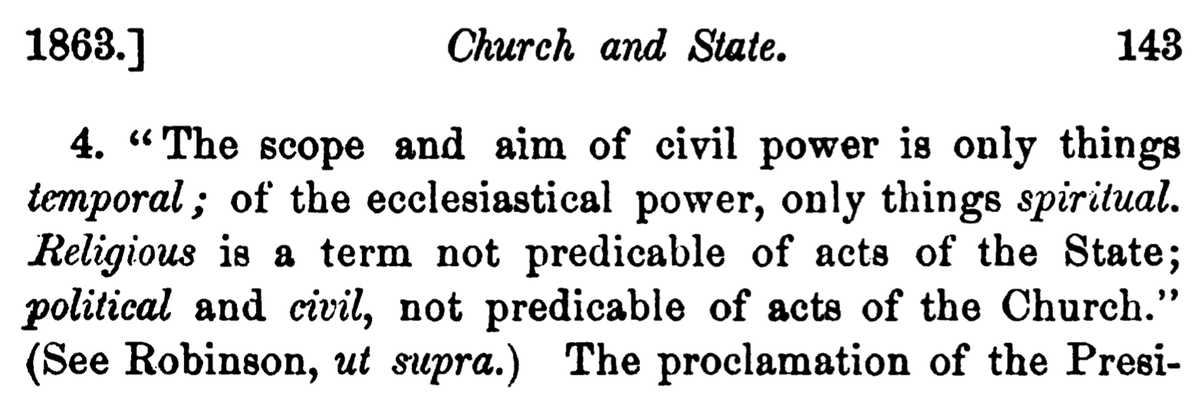
“Any form, or any degree of this error of the duty of the State to promote religion must inevitably work out the slavery of the church and the corruption of the faith. The magistrate's power is simply and purely a power of the sword, a government of compulsion. Whatever it is the duty of the magistrate to do, he is bound to compel to be done. IF he is bound to promote true religion, he is bound to compel men to believe the true and reject the false, for he has not argument but force to wield. Thus the church is filled with hypocrites, and the life of the believer even is not voluntary self-consecration, but a constrained obedience, and all spiritual religion is at an end. So on the other hand the power of the church is simply moral, not coercive, and cannot be used as an adjunct of the power of the sword.”
- Stuart Robinson
@BringePeter Nothing in that post argues for the removal of idolatry. In fact, you quote Witherspoon arguing for religious toleration. And false religious sentiments are impermissible not because of their infractions against Divine law but their impact upon their neighbor.
This assumes that it is the responsibility of the magistrate to enforce the 2nd commandment. 1788 makes it clear that the magistrate "may not... in the least, interfere in matters of faith."
I.e., it is not the magistrates duty to enforce the 2nd commandment.
A notable problem here is the PCA's Larger Catechism teaches that the magistrate is to “oppos[e] all false worship” and “remov[e] all monuments of idolatry” (WLC 108).
@BringePeter In fact, the opposite principle is affirmed, that all religious assemblies (moments of idol worship, for example) be held without disturbance (WCF 23.3
@BringePeter To abolish idolatry (Roman Mass or Buddha, for example) would be interference in matters of faith. This is the purview of the church wrt itself and subjects, but not magistrate wrt its subjects
What is the civil magistrate responsible for, how should it enforce the natural law, does the Great Commission imply baptizing nations?
David VanDrunen and @AdrielTweets join @MichaelHorton_ for a discussion on Christian Nationalism.
🎥 WATCH NOW: https://t.co/O644IW1mbu
The Reformed Churches offered better advice. Look for one with the marks of the true church:
1) The pure preaching of the gospel;
2) The pure administration of the sacraments;
3) The use of church discipline.
Because worship is not about creating a mood or embodied experience to mystically encounter God as atomized individuals. Worship is the people of God encountering him through gathering together, praying together, listening together, singing together, eating together. It’s ordinary, organic, social, it doesn’t feel like it’s where God should be and that’s exactly why it’s where he is.
“We are God's family,... For that reason Christian brothers and sisters ought to do all that they can to foster love and unity in this family, seeking its good and holding back from harming their fellow members of God's household.”
- Van Dixhoorn
@JEdwards974649 For a helpful critique of the Reformers' inconsistencies on this point, see David VanDrunen, Natural Law and the Two Kingdoms, Chapter 3.
Indeed. But Peck (and others) have to square how the bible—a religious document—is known to the Magistrate *via nature* as the true religion. The bible itself reveals that knowledge of it as the true religion is only known by the Spirit.
It begs the question
Peck goes on to say that the Bible should in some ways rule the magistrate, which, fwiw, is not even something more Reformed CN think. So Peck is actually closer to something like theonomy, which am I to assume is @natepaschall’s position as well?