FPGA demos are the hardware equivalent of running on "localhost". Frontier models made functional RTL cheap, so these demos are about to flood the timeline. Don't confuse "runs on reconfigurable silicon" with "ready to compete with custom ASICs"
Today we’re excited to announce our global agreement with @MercedesBenz to scale deployment of Atlas for electrical and electronic (E/E) diagnostics.
Atlas helps Mercedes-Benz technicians pinpoint the most likely root causes in complex E/E systems with greater speed and confidence. In our first deployment in Tuscaloosa, Alabama, Atlas enabled technicians to diagnose and repair 20-30% faster, across both new and experienced skill levels.
With this partnership, Mercedes-Benz plans to bring Atlas’s diagnostic intelligence directly onto global production lines, complementing the company’s existing engineering and quality systems.
Read the release: https://t.co/94w2L79YEy.
X Square Robot just released WALL-OSS-1.0, its new robotics foundation model, and opened WALL-API-1.0 to developers.
The model achieved a 55.1% zero-shot success rate across 312 real-robot tasks, without task-specific fine-tuning.
The benchmark results are worth a look:
RoboDojo: WALL-OSS-1.0-Lite ranked #1 among policies without agent systems, scoring 42.59 as of November 5.
X2Real: WALL-OSS-1.0 scored 32.87 in pure manipulation vs. 21.48 for GPT-6-Astra, under different fine-tuning conditions.
OOD mobile manipulation: 44.17 vs. 24.83 for π0.5, a 77.9% relative improvement.
Beyond benchmarks, X Square has deployed a WALL-OSS-1.0-based policy for parcel sorting at a logistics customer.
About 10 hours of task data was enough to adapt the model, compared with over 1,000 hours without pretraining.
Across four production sites, the adapted policy retained over 90% of its original-site sorting speed and success rate.
That’s what generalization looks like in production.
https://t.co/kVNy5OXZwF just got way faster:
- big CAD files upload ~2x faster
- STEP files parse ~7x faster
- DFM checks run ~4x faster on complex parts
Here's a 2,204-hole perforated panel dropping into a quote in ~5 seconds.
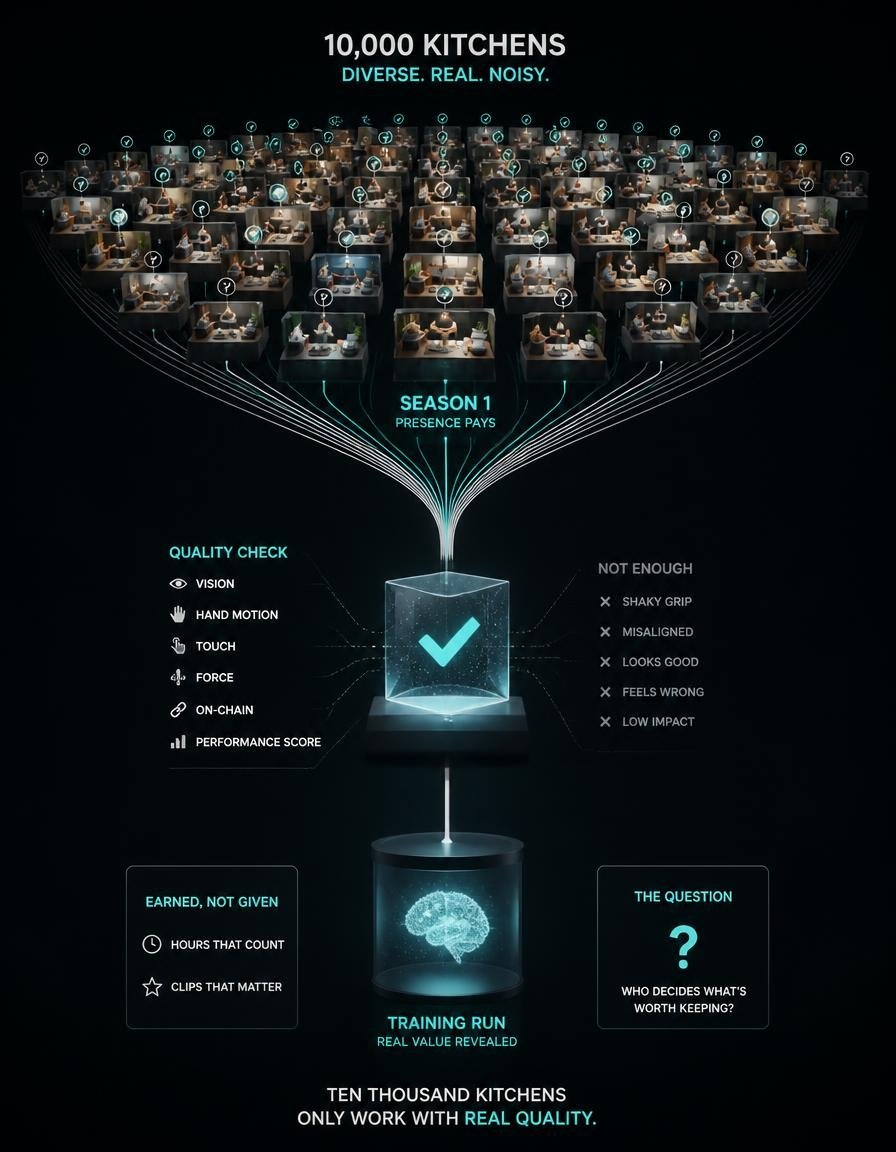
4Dlabs rests its pitch on one comparison: 10,000 people pouring coffee once in their own kitchens beat 100 people repeating it in one lab.
Fine.
Now the question nobody puts on the poster: who decides which of those 10,000 recordings was actually any good? 1/5
@4Dlabs_Official
everyone is sleeping on this JSON extraction model!
- open-weights
- matches Gemini Flash 3.5
- while being 3x faster
pulling structured data out of documents usually takes a chain of OCR, an LLM, and extra code to repair broken JSON.
lift, from Datalab, does all of this in a single step. you give lift a PDF or image along with a JSON schema, and get back a JSON object that matches that schema.
the model reads every page of a document in one pass, so values that span multiple pages still come out right. any document you can describe in a schema works, from invoices to research papers.
here's what you get with lift:
- 90.2% field accuracy on 11,000 fields
- 9B model, nearly matches Gemini Flash 3.5 at 3x the speed
- built not to hallucinate; returns null if missing
- self-hostable with vLLM or Hugging Face
GitHub repo: https://t.co/wUgZOH8sE9
Same logic as the UAE's ICV programme: mandated local content in ADNOC and defence procurement created permanent demand for production engineers. India scoring SMT lines and R&D in tenders is that mechanism at larger scale.
🇮🇳 The Centre has updated local content rules for six IT hardware items laptops, desktops, servers, monitors, thin clients, and interactive displays in government tenders, shifting focus from basic assembly to local component manufacturing.
💻 Effective six months after notification, the new rules reward local motherboard assembly, RAM/SSD packaging, and in-house R&D, giving bidding preference to Class-I suppliers with 50%+ local content.
@chontang@Akashi203 I don't buy it. If they could profit at current token prices they wouldn't all be competing only on price. The price war is the tell.
@Akashi203 Did you count the routers/resellers as providers too, or separate? 32 by name seems low, I would have guessed way more. Would be interesting to know.
@DennisCode Would be interesting to know how you handle large binaries like CAD assemblies. A STEP file can easily hit hundreds of MB. Presumably chunked HTTP upload? That's the case I'd test first.
FYI this is the right way to hire for manufacturing. The best machinists I've worked with all figured it out on the shop floor, not in a classroom. How are you structuring the training itself?
FWIW
Job titles, credentials, “relevant experience” are all made up.
We need “I can figure it out” types that are passionate, have some mechanical intuition and are hungry
Great candidates can start this week
When a critical #machinetool⚙️ begins showing its age, the conversation often turns to replacement.
While the #technology🌐 around those assets may have aged, the underlying process capability often remains as valuable🌟 as ever.
READ: https://t.co/bhdTBbzpj0
#cnc#automation
The skills part is the underrated one. Same logic as a proven CAM post processor: don't re-solve a solved problem, save the working code and reuse it. Would be interesting to know how often generated skills actually get reused.
This Anthropic MCP paper is f*cking gold
Anthropic's engineers cut an agent's tool context from 150,000 tokens to 2,000. Same tools, same task. And the model wasn't the upgrade.
The upgrade: the agent stops calling tools and starts writing code that calls them.
tools → files → code → filter → answer
The 6 parts of code mode:
Part 1 → tools as files
Every MCP tool becomes a .ts file in ./servers.
The agent lists the folder and opens only what it needs.
Part 2 → load on demand
150,000 tokens of tool definitions down to 2,000.
A 98.7% saving in time and cost.
Part 3 → filter in code
A 10,000-row sheet gets filtered in the sandbox.
The model sees 5 rows.
Part 4 → loops in code
Polling Slack for "deployment complete" runs as a while loop.
No round trip through the model on every check.
Part 5 → private by default
Emails and phones turn into [EMAIL_1] and [PHONE_1] before the model sees them.
The real data still lands in Salesforce.
Part 6 → skills
Working code gets saved to ./skills with a SKILL.md.
The agent builds its own toolbox.
An agent that loads every tool burns its context before you ask anything. An agent that writes code opens 2 files.
I packed all 6 parts into one prompt. Drop it into Claude Code and it sets code mode up for you.
6 parts. 1 prompt. 98.7% fewer tokens.
Then read the enhanced edition of agent engineering below ↓
𝚟𝚎𝚛𝚌𝚎𝚕 𝚋𝚘𝚊𝚛𝚍 can mirror a Slack channel.
So building a product questions bot is just two watchers. A router labels each question with its product. Each product bot wakes only for its label and answers in the Slack thread.
No Slack bot to build. One route file.
SolidCraft 0.46 🚀
https://t.co/QZdmHyVo2R
- Drawings: detail views, plus true-size PDF and layered DXF export
- Weldments: Auto builds frame tubes and their corners
- Open E57 scans and measure on their points
- Emboss on curved faces, and a new Edge Center Rectangle sketch tool
- STEP designs open about 6× faster again