A Norwegian neuroscientist spent 20 years proving that the act of writing by hand changes the human brain in ways typing physically cannot, and almost nobody outside her field has read the paper.
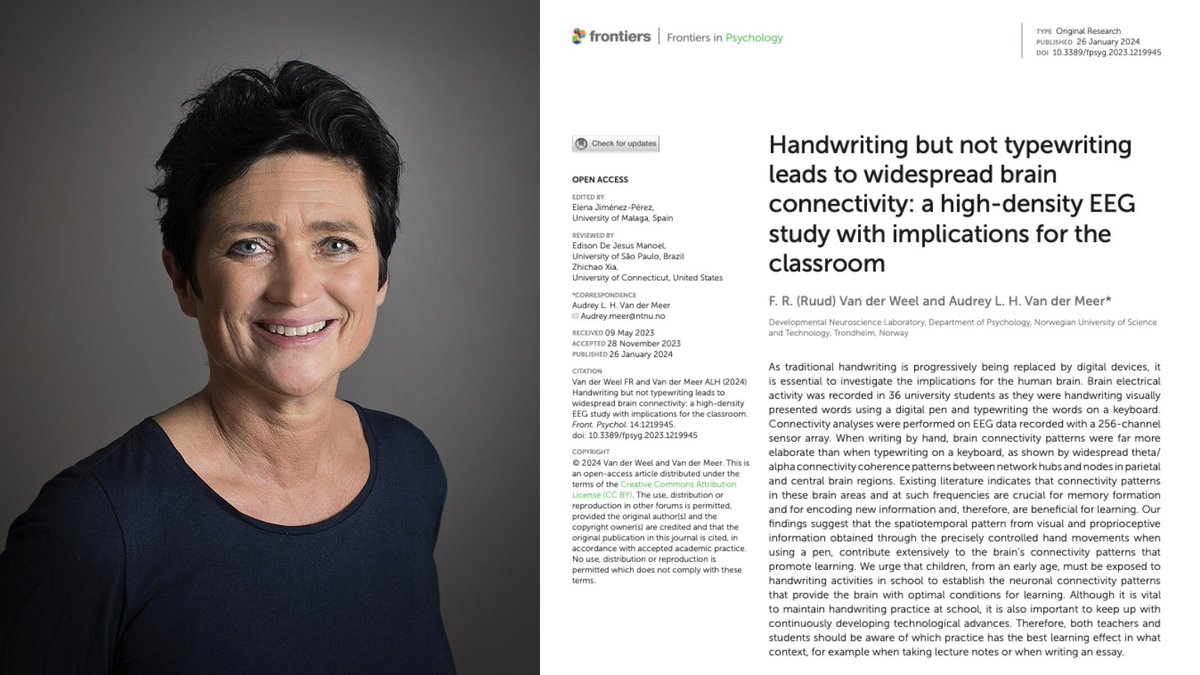
Her name is Audrey van der Meer.
She runs a brain research lab in Trondheim, and the paper that closed the argument was published in 2024 in a journal called Frontiers in Psychology. The finding is brutal enough that it should have changed every classroom on Earth.
The experiment was simple. She recruited 36 university students and put each one in a cap with 256 sensors pressed against their scalp to record brain activity. Words flashed on a screen one at a time.
Sometimes the students wrote the word by hand on a touchscreen using a digital pen, and sometimes they typed the same word on a keyboard. Every neural response was recorded for the full five seconds the word stayed on screen.
Then her team looked at the part of the data most researchers had ignored for years, which is how different parts of the brain were communicating with each other during the task.
When the students wrote by hand, the brain lit up everywhere at once.
The regions responsible for memory, sensory integration, and the encoding of new information were all firing together in a coordinated pattern that spread across the entire cortex. The whole network was awake and connected.
When the same students typed the same word, that pattern collapsed almost completely.
Most of the brain went quiet, and the connections between regions that had been alive seconds earlier were nowhere to be found on the EEG.
Same word, same brain, same person, and two completely different neurological events.
The reason turned out to be something nobody had really paid attention to before her work. Writing by hand is not one motion but a sequence of thousands of tiny micro-movements coordinated with your eyes in real time, where each letter is a different shape that requires the brain to solve a slightly different spatial problem.
Your fingers, wrist, vision, and the parts of your brain that track position in space are all working together to produce one letter, then the next, then the next.
Typing throws all of that away. Every key on a keyboard requires the exact same finger motion regardless of which letter you are pressing, which means the brain has almost nothing to integrate and almost no problem to solve.
Van der Meer said it plainly in her interviews.
Pressing the same key with the same finger over and over does not stimulate the brain in any meaningful way, and she pointed out something that should scare every parent who handed their kid an iPad.
Children who learn to read and write on tablets often cannot tell letters like b and d apart, because they have never physically felt with their bodies what it takes to actually produce those letters on a page.
A decade before her, two researchers at Princeton ran the same fight using a completely different method and ended up at the same answer. Pam Mueller and Daniel Oppenheimer tested 327 students across three experiments, where half took notes on laptops with the internet disabled and half took notes by hand, before testing everyone on what they actually understood from the lectures they had watched.
The handwriting group won by a wide margin on every question that required real understanding rather than surface recall.
The reason was hiding in the transcripts of what the two groups had actually written down.
The laptop students typed almost word for word, capturing more total content but processing almost none of it as they went, while the handwriting students physically could not write fast enough to transcribe a lecture in real time, which forced them to listen carefully, decide what actually mattered, and put it in their own words on the page.
That single act of choosing what to keep was the learning itself, and the keyboard had quietly skipped the choosing and skipped the learning along with it.
Two studies. Two countries. Same answer.
Handwriting makes the brain work. Typing lets it coast.
Every note you have ever typed instead of written went into your brain through a thinner pipe. Every meeting, every book highlight, every idea you captured on your phone instead of on paper was processed at half depth.
You did not forget those things because your memory is bad. You forgot them because typing never woke the part of the brain that would have made them stick.
The fix is the thing your grandmother already knew.
Pick up a pen. Write the thing down. The slower road is the faster one.
I'm just glad Trump voters are getting precisely what they wanted: American involvement in military strikes and maybe even peacekeeping operations throughout the world! USA NUMBER ONE!
Win $100k in Cash & more. Chase your dream. Huckberry will fund it, equip it, and connect you to people who've done it. Your fully funded Dream Year awaits! Enter here: https://t.co/gUnfI0yibu
We're about to get dragged into nation-building 2.0
Israel has formally requested a direct US intervention in its war against Iran. The intervention itself will seem easy, relatively speaking. It's the aftermath you should worry about. What we're likely looking at is yet another nation-building exercise in the Middle East—except on a much vaster and more complex scale than anything attempted in the post-9/11 wars.
In other words: another decade or two wasted in the Middle East. If you don't want that, pray for rapid de-escalation.
I should know: I wrote one of a very few attempts at imagining, concretely, what a post-Islamic Republic scenario might look like (I'll link it in a reply here). That was in 2012, when I was younger and more naive about the limits of American power. But also: when Washington was still basking in the (admittedly fading) glow of the unipolar moment.
So let's try to re-imagine things for our moment.
1. The false premise: First, it's worth noting that in the lead-up to this war, hawkish voices in Washington and Jerusalem insisted that it would just be a matter of getting out of Israel's way. "This isn't nation-building or US boots on the ground," they said. "We should simply allow our allies to fight their various regional battles."
Well--here we are. The Israelis have now sought direct US involvement.
But even if Team Trump doesn't directly join the fighting, American boots will end up on the ground, and on a massive scale, because regime collapse, the apparent Israeli goal, will be a colossal headache. Israeli bombing will break the Iranian state, and then the Israelis will "internationalize" the aftermath. Because Israel itself neither can nor wants to put the pieces back together.
In reality, "internationalization" will end up meaning: Uncle Sam, roll up your sleeves. The Europeans can only contribute marginally. The Persian Gulf monarchies might throw money at it, but they can't and won't do the lifting. Russia will remain distracted by Ukraine. The Chinese will opportunistically pick up scraps; but Beijing won't lift a finger to repair what it didn't break.
As much as we might talk about a post-hegemony moment, these other actors will still try to get the declining hegemon to solve problems of that scale. And they will say, with some justice, "Look, it was your client that broke it, with your apparent approval. So pretty please, get to work." So let's outline the crises.
2. State authority: This is the biggest one, obviously, and it contours all the others. The central problematic of Iranian history is the relationship between state and society. What the optimistic hawks will say is that Iran isn't Iraq. It's not an artificial creation imposed on Arab and Kurd, Sunni and Shiite. For millennia, Iran's constituent ethnicities have related to each other organically as Iranians.
This is true. But it doesn't get us around the steep struggle to stabilize relations between state and society in the aftermath of a collapse. The unchanging principle of Iranian political life has been estebdad, or arbitrary rule, and it remains so today.
One defining feature was state ownership of all land. The state could grant plots to various classes as a special privilege, but never as a matter of right. Moreover, all economic activity, agricultural or otherwise, involved winning the favor of the state. "Social classes did not enjoy any rights independent from the state," as the Oxford historian Homa Katouzian has noted, and "there was no law outside the state, which stood above society, despite a body of rules that were subject to rapid and unpredictable change." Thus, "unlike in Europe, the state’s legitimacy was not founded in law and the consent of influential social classes." From the satrap to the peasant, all lived in fear and at the mercy of the state.
The arbitrariness of power extended to its source at the throne. Rulers exercised power because they possessed divine grace, and they possessed divine grace because they exercised power. Rebellion was thus a fine way to seize power, so long as you succeeded. If you didn’t, you might have been beheaded if you were lucky, or had boiling oil poured down your throat if you weren’t. With no formal rules of primogeniture, the death of each shah triggered a succession crisis. The heirs-designate blinded or castrated male siblings to secure their own ascent.
Estebdad etched itself into Persian culture. Poetry reached sublime heights precisely through obliqueness, conversation turned indirect—a mask against repression. The ornate manners of Iranians relate to this, as well. The result: brilliance in individuals, but chronic distrust in society. Without lasting institutions or principles, Iran's politics swing between bursts of idealism and long stretches of cynicism. Justice depends not on systems, but on the temperament of rulers.
I don't have an answer to this problem and how it might ramify post-collapse. But then again, I'm not the one pushing for escalation and ignoring the aftermath problem. The answer that the Israelis and American hawks seem to have settled on is the person of Reza Pahlavi, heir to the final dynasty. There is some appeal to a monarchic restoration, to be sure. A shah can serve as a visible symbol of unity and continuity.
But Pahlavi has not inspired confidence in recent years. Collaborators I know have described him as lazy, incurious. One doesn't see much of that trim Cossack's austerity and steel that allowed his grandfather to forge a modern nation-state out of the malaria-ridden had-been Persian Empire.
Reza (the grandson) made a grave mistake, in my estimation, by seeming too eager to be parachuted onto the Peacock Throne by an IAF F-35.
Then, too, we don't know how Iranian society's perception of the throne has shifted after nearly five decades of rule by a theocracy with republic elements. Anyone who confidently says, "Iranians await their king" is larping.
But his character and capabilities are finally beside the point. The real issue is that even if he were a supremely popular character, he would need massive outside assistance to even begin to assert control over the capital region, let alone a far-flung country of 90 million souls. . . . Which brings us to the other crises.
Call them headaches from hell.
3. Separatism: Although Iran was called "Persia" by the ancient Greeks, Persians make up only a bare majority of the country. About a quarter are Azeri or Turkic people, including, by the way, the supreme leader. There are Kurds, Lors, Baluch, Arabs, and smaller gropus. And again, it's true that Iranian identity binds these peoples together in a way that is not true of "artificial" states Iraq or Lebanon.
Even so, in part as a result of the Islamic Republic's maltreatment, that organic identity has frayed somewhat. More to the point, various external actors like the Baku regime in Azerbaijan and the PKK movement are bent on carving out Iranian territory. They are sure to capitalize on the instability that follows a regime collapse.
Now you might say, "Good! Who cares! Let Iran get broken up." Except, remember our main problem: maintaining a legitimate central authority that relates in a stable way with its society. Whether the West tries to install Pahlavi or social democrats or whoever, that central authority cannot be seen to compromise on Iran's territorial integrity. If it does, it collapses. If it doesn't, civil war.
And there you have the recipe for a civil war, with ethnic, sectarian, and ideological dimensions, that can radiate instability into Iraq, Turkey, Azerbaijan, Pakistan, Afghanistan, and elsewhere, places where the US has troops, allies, and serious interests. Madness!
4. Regime remnants: The hawks insist that only a tiny minority of Iranians supports the regime; everyone else, in this telling, is a mini-skirt-wearing, underground-rave-attending spiritual denizen of LA or Miami, who just happens to be living in Iran. Nonsense. There is no way to scientifically poll Iranian society, and I'm always frustrated when asked to offer a back-of-the-envelope breakdown of what share of the society is opposed to the regime, etc. What we do know is that the Islamic Republic enjoys a core of support among a not-significant share of the population, either as a result of Islamic ideological combination or the material benefits they and their family members have drawn through membership in groups like the IRGC and the basij paramilitia.
Plus, even the secularist-minded opponents of the regime are by most accounts rallying to the flag as we speak. I made numerous phone calls inside the country yesterday, and the impression I got was that the nezam and the people are being brought closer as a result of the Israeli actions. The state-society alienation is dissipating somewhat, as popular athletes make military salutes in solidarity with the armed forces, etc.
Maybe that rally-to-the-flag effect won't last as the invasion continues, but you have to ask yourself: How likely is it that this new, post-Islamic Republic regime will have to confront a remnant of some size? I'd say highly likely, which is another reason why it's folly to believe that the regime can be collapsed without American forces having to stand up a new state.
5. Nukes and Hormuz
Remember the separatist polycrisis above? Well, among those groups are hard-core Sunni Islamists inspired by different shades of Al Qaeda/ISIS ideology. Now, keep in mind that Iran is also home to a near-completed nuclear program. Who is going to secure said program against said Islamists or other interlopers? That's right---the United States.
Iran also sits on the Strait of Hormuz, through which travels 20 percent of the world's energy. If radicals take it over, who do you think will be tasked with dislodging them and securing Hormuz? The French? The Germans? The Malaysians? No, it's going to American troops.
Maybe Israel's military maximalism is so valuable to America that it's worth bearing all these risks and costs and burdens.
Or maybe Washington can truly shirk the aftermath, thus encouraging other actors to take it up. Maybe China will step in, after all, given its dependence on Iranian energy. But then you have China expanding its footprint, which sort of defeats the logic of containing Beijing and the whole pivot to Asia.
But I simply don't see America being able to stay away, even in a post-hegemony environment, because the Gulfies and others will demand it, and they have enough sway within the US alliance architecture that we won't be able to remain deaf to the demand.
BTW we just happened to have a pair of fake legs on the BREWMITE set that Jason definitely didn’t use at all but signed them anyway so RT for a chance to win one
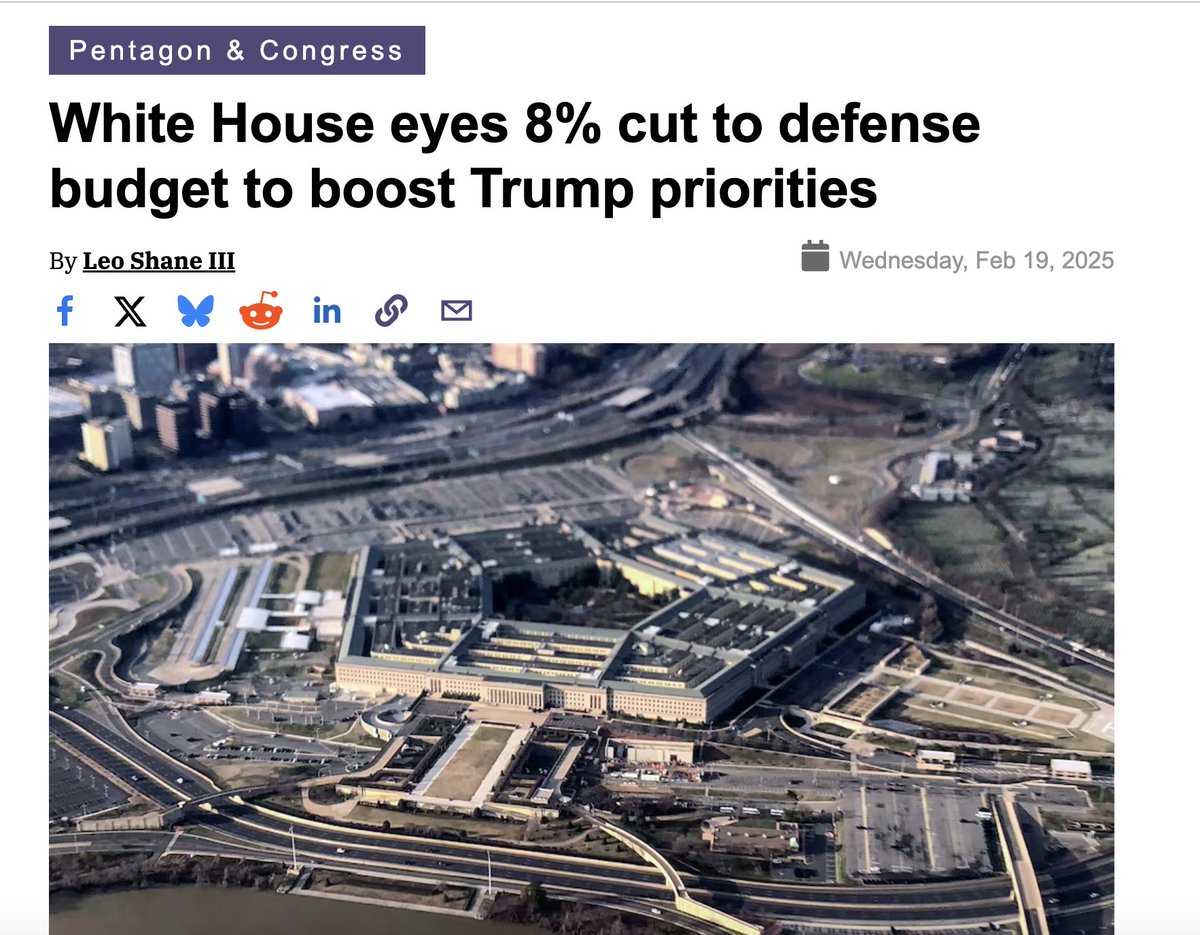
Trump, Feb. 19, 2025: We're cutting the Pentagon budget by 8%!
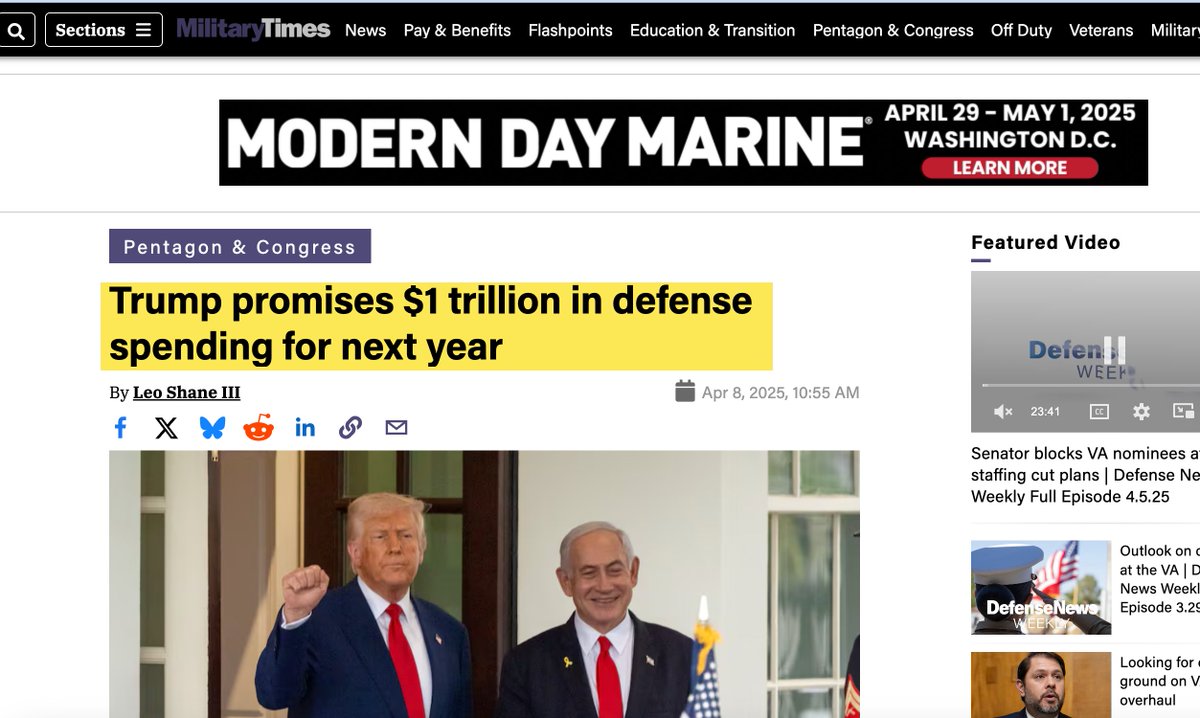
Trump, yesterday, during his WH meeting with Netanyahu: we're so excited we're increasing military spending by $150 billion to create the first-ever trillion-dollar annual Pentagon budget!
“On a crisp Sunday morning in September, The American Courage sailed The Cuyahoga River…
But another act of American courage was about to take place on land, fifty yards from the ship.”
This is the story of The Cuyahoga Catch:
Revealed: New and extraordinarily powerful footage of the aftermath of the rescue of 2,500 Jews being taken by the SS from Belsen to Theresienstadt by train in April 1945 has emerged after nearly 80 years.
Read my exclusive piece for the @Independent: https://t.co/TAhfnFJHt6