New Yorker staff writer, Vogue contributing editor, semi-pro eavesdropper, overcaffeinated earth child.
Now writing THE PRIVATE ORDER for Penguin Press.
Just a reminder that my courteous, well-dressed, low-volume newsletter—announcing new pieces of my writing, my occasional public appearances, and nothing else—has been compelled to change platforms. It is now on Substack, and you can sign up here. https://t.co/sZDb711yrz
When Salon started, in 1995, the idea that an ambitious magazine could exist only online was unprecedented. Within three years, it had hundreds of thousands of readers, illustrious contributors, and mentions in the same breath as its print peers. A brave thing—gone not forgotten.
The @NewYorker's James Daunt profile is excellent, as advertised. My favorite bits were the quotes from his sister, who sounds like a riot. https://t.co/8juj0Mzpdp
@chaykak I don’t want to misattribute origins, but I do remember when this became an ironic half-joke (and subsequent dek usage) around the Slate editorial table circa 2009.
Does your favorite bookstore pass the Daunt Audit?
@anniepop_pop and I read @nathanheller's “The New Age of Reading,” in @NewYorker then visited bookstores in LA and NC looking for Dauntisms: face-out covers, display tables, staff picks.
https://t.co/7A9zo1p3NQ
i want a letterboxd but instead of movies is magazine articles. like what if i have a lot of thoughts about the latest Atlantic cover story... what if i reread a 1998 harper’s story and thought it was lit… there’s a great newsletter called Last Week’s New Yorker but it isn’t enough… let a thousand flowers bloom
In next week’s @NewYorker, I write on “Lincoln in the Bardo,” the opera by Missy Mazzoli and Royce Vavrek, which premièred at the Met last week. https://t.co/JYC7T8IFgE
In “The New Age of Reading,” the staff writer Nathan Heller says that news of the demise of reading is greatly exaggerated. He lays out his case to David Remnick. https://t.co/GXWhdmyw5N
From the daily newsletter: James Daunt, the chief executive of Barnes & Noble and Britain’s Waterstones, presides over billions in sales. In the digital age, how does he keep making books irresistible? https://t.co/6VfiktxNXT
In this week’s @NewYorker, I profile James Daunt—founder of Daunt Books, now transformative chief executive of both Barnes & Noble and Waterstones—and look closely at both the art of the ideal bookstore and the future of reading. https://t.co/fmQBxsQGkI
I spent some time with George Lucas and Mellody Hobson; here's the first look at the huge and unusual museum they are opening in Los Angeles, after about a billion dollars of their own money and years of lost access to their dining-room table. https://t.co/TkjqOO8oms
Here's Fabio Bertoni, The New Yorker's own general counsel, on Kash Patel's lawsuit against The Atlantic and defamation lawsuits more generally. https://t.co/edbvAiREDS
RIP MTT. His arrival at the S.F. Symphony, in 1995, brought the most excitement for a conductor I've seen directly. He made it one of the most vaunted, proudly daring orchestras in the world. Thrilling, for a kid, to see someone remake his creative world. https://t.co/5r3lBIHNwV
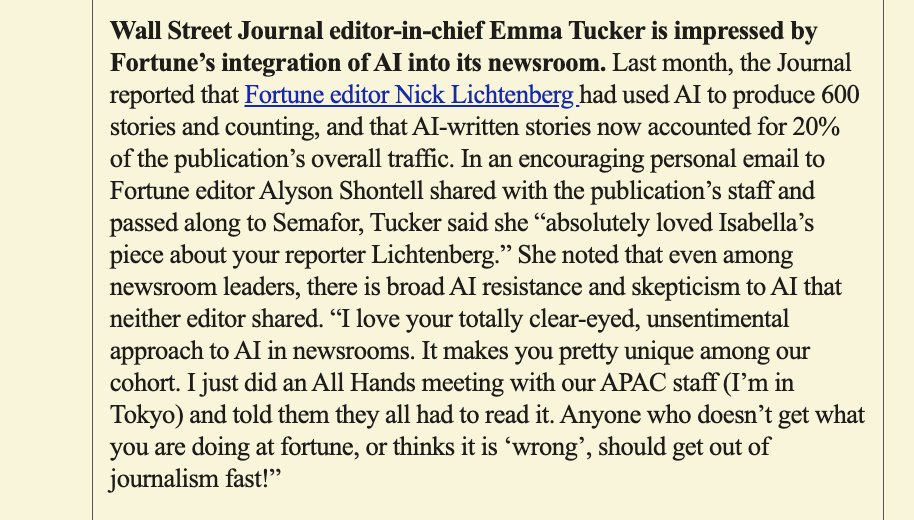
It's interesting that production volume—"600 stories," etc.— is seen to be the value hill to climb in journalism right now. I know of few people who feel they're running out of news to read.
In an email shared with me, WSJ EIC Emma Tucker praised Fortune's use of AI in its journalism, saying "anyone who doesn't get what you are doing at Fortune, or thinks it is 'wrong', should get out of journalism fast!"
Enjoyed reading this dispatch by @nathanheller from a Delhi roadside tea stall feeling the squeeze of war.
“The locals are facing surging prices. But the rest is normal.”