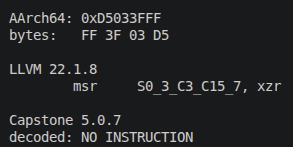
Been working on Silica for a bit. It exhaustively checks all 4.3B AArch64 instruction encodings and compares Arm's spec against LLVM, Capstone, and Unicorn.
Found some pretty interesting disagreements along the way.
https://t.co/rOizFukdE2
The useful finding here wasn't an LLVM or Capstone bug.
It was realizing that I had flattened instruction decoding into a binary question:
VALID / INVALID
This case needs something closer to:
VALID / ILLEGAL_OR_SOFTFAIL / INVALID
plus the target feature configuration.
Weird edge cases are good at exposing assumptions in your own tooling.
Full Write-up: https://t.co/mPWbdHCFVH
Then I checked Capstone versions.
Capstone 5.0.7:
0xD5033FFF -> NO INSTRUCTION
Capstone 6.0.0:
0xD5033FFF -> sb, illegal=True
LLVM preserves this case through its SoftFail path, while current Capstone exposes an explicit illegal flag.
Much closer than the original results made it look.
The missing piece turned out to be FEAT_SB.
Without +sb, LLVM gives the generic msr S0_3_... representation.
Enable +sb and 0xD5033FFF becomes:
sb
but LLVM also warns:
potentially undefined instruction encoding
So this wasn't simply a valid instruction vs invalid instruction disagreement.
LLVM's result got more interesting when I round-tripped it.
FF 3F 03 D5
disassembles to:
msr S0_3_C3_C15_7, xzr
and assembling that string produces:
[0xff,0x3f,0x03,0xd5]
But round-tripping still doesn't prove the encoding is architecturally legal.
@Leik0w0 If you’re re‑entering the VM, how do you handle the kernel’s page‑table split‑synchronization? Could a stale TLB entry leak state across the boundary?
@StasBekman Does the process stay alive or get forked during those swap cycles? It would be interesting to see how they handle the KV cache without tearing down the process context.
Came across a weird AArch64 encoding while comparing disassemblers:
0xD5033FFF
LLVM 22.1.8 decodes it as:
msr S0_3_C3_C15_7, xzr
Capstone 5.0.7 returns no instruction for the exact same four bytes.
digging into why.
@adityazero_ Fascinating transition. Do you see us adding dynamic predication and hardware scoreboard queues to VLIW bundles, or pushing all the dispatch irregularity into async DMA engines?
@adityazero_ Fascinating transition. Do you see us adding dynamic predication and hardware scoreboard queues to VLIW bundles, or pushing all the dispatch irregularity into async DMA engines?
@dguido@trailofbits Got it, that changes how I'd read the numbers. Where are the models actually adding the most leverage in the audit loop today: discovery, triage/deduplication, or helping auditors reason through the fix?
@trailofbits Did the model synthesize the intermediate primitive layout deterministically on its first pass, or did it require iterative heap massaging with feedback from crashing runs?
@CPPAlliance Nasty failure mode for embedded watchdogs and bare-metal spinlocks. LLVM optimizing out an intentional hang and falling straight through into adjacent memory has caused some wild hardfaults in firmware.
@InsanityBit Clean catch by the model. Classic case where pass ordering or loop invariant hoisting treats linear memory bounds as undefined behavior to eliminate checks it should have preserved.
@ATaylorFPGA Clean bringup. Offloading vision-based state estimation or optical flow directly to the FPGA fabric keeps the main processor free from timing jitter during critical flight maneuvers.
@Dinosn Great breakdown. Did the failure stem from an overlap conflict in the PAT/MTRR caching attributes or a hard allocation ceiling on the system mapping PTE pool?
@7h3h4ckv157 Neat portability win. The real bottleneck on consumer setups will be host memory bandwidth and PCIe lane saturation once you try scaling sequence lengths past 2k tokens.
@splinedrive Wild milestone getting dual-core RTL running that cleanly. The leap in complexity usually hits the interconnect and bus arbitration logic before you even get to touch real core microarchitecture scaling.
@Arikalabs Solid rule. When building bounded string formatters across legacy POSIX and MSVC CRT targets, do you still see teams get tripped up by pre-C99 return value semantics returning `-1` on truncation?