I was privileged to recently teach a breakout at my church's men's event on "How Christians Should Think About AI."
AI is a hot topic right now, and I think the implications of this new technology and its effects on how we understand our worth, value, and place in society will be significant.
I use and develop with AI for myself and my clients literally every day. These are issues that I've personally been thinking about and wrestling with for quite some time as I've seen some of both its positive and negative impacts.
Like any new/powerful tool, AI has great potential to do some really good things, and some really evil things.
Thankfully, Christians don’t have to navigate this moment without clarity. We can continue to turn to God’s Word for a biblical perspective.
What I'm sharing here is just the tip of the iceberg. There are many angles from which Christian leaders will need to provide direction and clarity. But my hope is that churches and pastors will take this opportunity to increase their congregation's Biblical literacy in Biblical Anthropology.
Being a Spirit-filled follower of Christ in an artificial/AI age matters more than ever.
Most people treat Easter as a holiday.
Christians treat it as the event history pivots on.
The resurrection of Jesus is not a nice story about hope.
It's a claim about what actually happened.
And if it happened, everything changes.
Death is not the end.
Forgiveness is available.
The same power that raised Jesus is alive and present.
Paul laid it out clearly: "If Christ has not been raised, your faith is futile and you are still in your sins." (1 Corinthians 15:17)
He also said: he has been raised.
That's what Easter asks you to evaluate.
Not whether you like the story. Whether it happened.
If you're wrestling with that question, I'd love to talk.
Comment or DM me.
The resurrection is the most falsifiable claim in the Christian faith.
Paul wrote: "If Christ has not been raised, your faith is futile." (1 Corinthians 15:17)
He wasn't speaking poetically.
He was laying out a condition.
If the tomb isn't empty, Christianity collapses.
2,000 years later, it hasn't collapsed.
The historical case is stronger than most people realize.
The tomb was empty.
Over 500 people saw him.
The disciples died for what they witnessed. You don't die for a story you know you invented.
Easter is tomorrow. Don't let it be just a holiday.
If you're working through what you actually believe about Jesus, I'd love to talk. Comment below or send me a message.
#Easter2026 #Gospel #Resurrection #Jesus
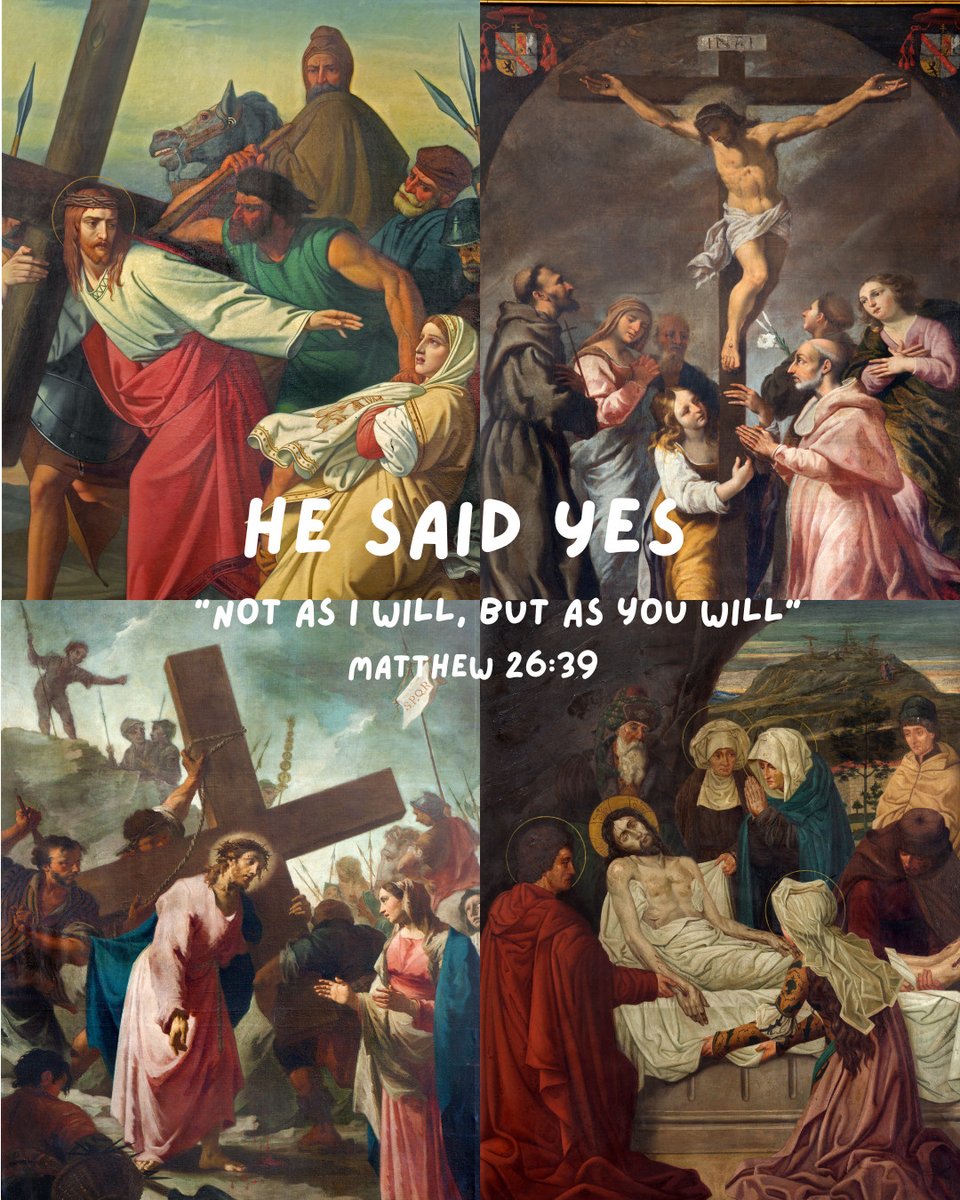
In Gethsemane, Jesus prayed: "If it is possible, let this cup pass from me."
It wasn't possible.
The cup was the full weight of God's judgment on our sin.
Every act of our rebellion.
Every relationship broken by our pride.
Every moment of our cruelty and selfishness.
Jesus was about to absorb all of it.
And He still said yes.
Because of what was on the other side.
You and I were on the other side.
Good Friday is heavy. Sit with it.
Don't rush to Sunday until you've actually stayed in Friday.
Jesus said "yes" to the cross.
Have you said "yes" to Jesus?
#GoodFriday #Easter2026 #Gospel
Tonight is Good Friday.
The day Jesus was betrayed, tried, mocked, beaten, and crucified.
He didn't die because things got out of hand.
He went willingly.
He carried the weight of every wrong thing we've ever done.
And he died so we wouldn't have to.
That's more than religion.
That's eternal love.
If you've never accepted the sacrifice of Jesus for yourself, let this Good Friday be the day you do.
"For God so loved the world, that he gave his only Son, that whoever believes in him should not perish but have eternal life." John 3:16
#GoodFriday #Gospel #Jesus
What angels did when people worshipped them: refused it.
What Peter did when Cornelius bowed to him: refused it.
What Paul and Barnabas did when the crowd called them gods: tore their clothes in horror.
What Jesus did when the crowd worshipped him on Palm Sunday: He accepted it.
When the Pharisees told him to make them stop, he said:
"If these were silent, the very stones would cry out."
Every prophet, apostle, and angel in Scripture refused worship.
Jesus expected it.
That's not the behavior of a humble teacher or a good man.
That's the behavior of someone who is either a liar, lunatic, or Lord.
Casual Christianity: I show up when I can. I try to live well. Jesus is part of my life.
Committed Christianity: Jesus owns my life. He's not just one part of it.
These aren't the same thing with different commitment levels.
They're built around different centers.
One keeps you at the middle of the story.
The other moves Him there.
The Palm Sunday crowd was casual.
Genuinely enthusiastic on Sunday.
But they were gone by Friday.
When Jesus becomes just one of your priorities, you'll sacrifice him when he costs you something.
When He's the one who owns all your priorities, the calculus changes entirely.
The same crowd that shouted "Hosanna" on Sunday was shouting "Crucify him" on Friday.
5 days.
The people who followed Jesus for what he could do for them had no category for a Savior who suffered.
They wanted a king who would fix things.
He gave them a cross.
Faith built on what Jesus does for you will crack when he doesn't do what you expected.
Faith built on who He is holds.
How much time did you spend with God this week?
Compare that to how much time you spent asking him for things.
The verse most quoted as a promise is actually a description of intimacy.
"Delight yourself in the Lord" is not a prerequisite to get what you want.
It's what happens when you've actually been with Him.
People who delight in God don't use him.
They know him. And knowing changes what they want.
"I'm spiritual but not religious" is one of the most culturally acceptable sentences you can say right now.
It also describes almost no one in Scripture.
The people Jesus poured into formed a community.
That community met together, ate together, shared their lives, and held each other accountable.
They called it the church.
Being connected to Jesus without being connected to his body is like saying you're married but you prefer to date.
The commitment is the point.
Which local church are you actually committed to right now?
God's Plan A for your spiritual growth is not a podcast.
I love podcasts, and they can help, but they can't replace God's primary vehicle for your transformation.
The local church is where you get known.
Where you serve people you wouldn't choose.
Where you're held accountable by people who see you throughout the week.
That friction is a feature, not a bug.
The Christian life was designed to be lived in proximity.
Where are you doing life with a local community right now?
The crowd on Palm Sunday was screaming "Hosanna."
It means "save us now."
They were desperate.
Roman occupation. Political oppression. No freedom. No horizon.
And here comes this man riding a donkey into Jerusalem.
And they cry out: Save us. NOW.
Here's the sad irony:
They were crying out for exactly what Jesus came to give.
They just didn't know the kind of saving they actually needed.
They wanted a political rescue.
He came to offer something Rome could never take away.
The prayer was right.
The theology was incomplete.
Their understanding of Jesus' identity was flawed.
But Jesus would accomplish His purpose.
Matthew 21:1-11
Before: John the Baptist. Voice in the wilderness. Baptized Jesus. Heard the voice of God.
After: Sitting in prison. Facing execution. Sending a message: "Are you really the one?" (Matthew 11:2-6)
His circumstances broke him open.
But his doubt drove him TOWARD Jesus, not away.
That's the only right move with doubt.
John got that right.
Judas had doubts too, but his drove him to unbelief.
Same raw material. Two completely different directions.
Today is Sunday. Somewhere right now, someone is hearing about Jesus for the first time.
The Gospel:
God is holy.
We fall short.
Jesus died in our place.
He rose.
Trust him.
He's coming back.
If you've never said yes to that, today is a good day.
AI tools for sermon prep, volunteer scheduling, and follow-up automation free up the shepherd.
More time with people.
More time following up.
More time doing actual ministry.
The printing press changed how Scripture spread.
The phone changed how pastors stayed connected.
Email changed admin work.
AI is another tool. Use it well.
If you're leading a church, here's a question worth sitting with: how many people in your congregation know how to have a quiet time?
How many know how to study their Bible on their own?
How many have been shown, step by step, what spiritual disciplines actually look like in a regular week?
Sunday morning services can be top-tier, but if people leave with no idea how to be a self-feeder in the Word and prayer throughout the week, we've missed the mark.
Equip the saints for the work of the ministry.
That starts with them knowing how to engage with God through prayer and His Word daily.
The deepest discipleship often happens over a meal.
Hard questions. Honest failures. Watching someone actually live out the faith.
Church programs help, but relationships are key.
Who are you investing in right now?
Grace means God saves you despite you.
The criteria: faith in Christ.
His death covers your sin.
His resurrection is the proof it worked.
You didn't earn your salvation, so you can't lose it through performance.
If you've never actually received the free gift of salvation, today can be the day!
I'm happy to help, just comment below or send me a DM.
Due process is not a modern Western invention.
Numbers 35:12, written ~3,400 years ago: "The manslayer shall not die until he stands before the congregation for judgment."
No execution without a trial.
The principle is older than you think, and it came from God Himself.