Welp, I think we're done here.
Trump himself is now saying he buckled under the pressure of Hormuz.
It's as bad as it could possibly be. He's saying aloud that Iran can have anything it wants because America can't afford the staring contest.
If this is his own explanation in his own words, then the fact that the sanctions relief is front-loaded...suddenly becomes important. The fact that the inspections regime that will verify compliance will be negotiated by an American side that has already admitted defeat, that needs this more than the opponent needs it...is now significant. And the fact that the proxy system is now recognized as legitimate by the United States -- is suddenly exactly the disaster you feared it might be.
And the fact that America has declared aloud that it's not actually capable of imposing its will even in the world's most vital energy chokepoints, causing its allies in the Gulf to already begin to seek a new accommodation with Iran -- makes all of this worse than Obama and worse than the JCPOA.
Remember: the great unfixable flaw of the JCPOA that none of its boosters ever had a good answer for was that it merely kicked the can down the road. It solved nothing.
Trump's deal, as of this moment, is not even close to accomplishing so much.
"Iran never won a war and never lost a negotiation," Trump famously said of Obama's deal (as a reporter reminded him at today's press conference). Ironic that the Iranians would win a negotiation most spectacularly against a man who styles himself the greatest negotiator to ever grace the White House.
So what does it all mean?
It means that in the coming years, nuclear programs will sprout like mushrooms after the rain throughout the Middle East. It means that many nations will now build out new and larger ballistic missile arsenals.
It means that the state system will give way before the march of the region's transnational ideological axes. Minorities will again be trampled, new wars will be fought by stronger states to dominate the power vacuums within weaker ones.
You're thinking of Israel in Lebanon -- but that's just a specific campaign against a specific enemy. Think Turkey, which right now occupies a region of Syria vastly larger than Israel's presence in Lebanon. Think heightened Iranian support for the Houthis in Yemen and a new influx of money and guns to the different sides in Libya.
It means, in other words, that we will have a few more wars to fight, a few more technologies to invent to deal with this new age of cheap missiles and drones -- and also of supersonic Chinese missiles bearing nuclear warheads that Iran will eventually, inevitably, be capable of deploying against us.
And it didn't have to be this bad. (And maybe, when he's heard all the criticism, it won't be.) He could have left something, anything, to concede later. He could have kept the Iranians a little bit in the dark, just a smidgen, as to just how defeated America feels.
Israel's position in all this is simple, and more or less unchanged from last week. America gave us more than we had a right to ask for. But we may be going it alone from here out.
Dust off the nukes. Maybe test one somewhere far away from anywhere. Quadruple the interceptor production lines, double the size of the Mossad and the Air Force. And no, don't let Hezbollah breathe, not for a second.
It's the 1960s again. And Israel will have to defeat a couple more enemies before it can once again eke out a few decades of peace.
At long last, the UN Human Rights Council has formally acknowledged that Hamas in Gaza carried out executions, torture, improperly used medical facilities for terror purposes, and engaged in violent abuses against women and children after October 7. The report captures only a fraction of what actually occurred, in part because documenting these crimes is extraordinarily difficult and because Gazans fear retaliation if they report anything to the UN or other investigators. The findings on Hamas were buried beneath a long section on Israeli settler abuses in the West Bank, but even so, this marks a significant shift for an international body that has long struggled to speak plainly about Hamas’s brutality in Gaza.
Most importantly, the report acknowledges but barely scratches the surface of how extensively Hamas has weaponized Gaza’s medical infrastructure, embedding fighters in hospitals, using patients as shields, and turning civilian facilities into operational hubs. The UN even notes that Doctors Without Borders evacuated non-essential staff from Nasser Hospital because Hamas was interfering with the hospital’s operations.
When I shared this information, including testimonies from Gazans who documented Hamas’s fascistic behavior inside hospitals, and photos of fighters emerging from Nasser Hospital after the ceasefire, the online “pro-Palestine” chorus had nothing to offer except accusations of Zionist collaboration, accusations of betrayal, and personal insults. This UN report is an indictment not only of Hamas, a violent extremist terror organization responsible for immense suffering, but also of every activist, journalist, and academic who chose to look away. It shows that Hamas’s crimes were so egregious, so undeniable, that even a slow, hesitant, and often ineffectual body like the UNHRC could no longer pretend not to see them.
Shame on anyone who still defends Hamas or ever believed its violence constituted “resistance” on behalf of the Palestinian people.
This is inversion so callous it's hard to believe.
The Holocaust had a survival rate of about 30%. Millions of people disappeared from European cities and towns over several years. Everybody knew because it was happening all around them.
Gaza has a survival rate, despite the worst and most deadly and horrible periods of the war, of 97%.
All the dead Jews were noncombatants. A large percentage of the dead Gazans were combatants.
And the Jews of Europe, even as their millennia-old civilization was being systematically wiped out, wanted nothing from the societies that surrounded them except to be allowed to live in peace.
Gaza's leadership of religious fanatics, meanwhile, wants every last Israeli dead and gone, is willing to fight to the last Gazan to achieve that aim, has said so publicly and worked for decades to blow up every peace attempt -- and even now believes that Gaza's destruction would be a worthwhile sacrifice to lay on the altar of Israel's destruction, because their god told them so.
So Israelis can reasonably believe, given those features of the Gaza war that aren't true about any genocide ever, and were pretty much the opposite of what was happening in the Holocaust, that Gaza's suffering is a bad and painful war, but not remotely a genocide.
But the point of it all, of course, is not to analyze Gaza, but specifically to lump it together with the Holocaust -- to cast the Jews as the new Nazis.
The only reason this person would dare to make such an insanely ahistorical and immoral parallel is because this is the heart of the bigoted propaganda campaign in which he enthusiastically participates: The point of it all is to make the Jews into the Nazis.
A culture that obsessed about Jews being evil and was then shocked by the Holocaust into obsessing about dead Jews as the apotheosis of righteous victimhood is now obsessively engaged in knocking Jews off that moral pedestal they themselves put them on.
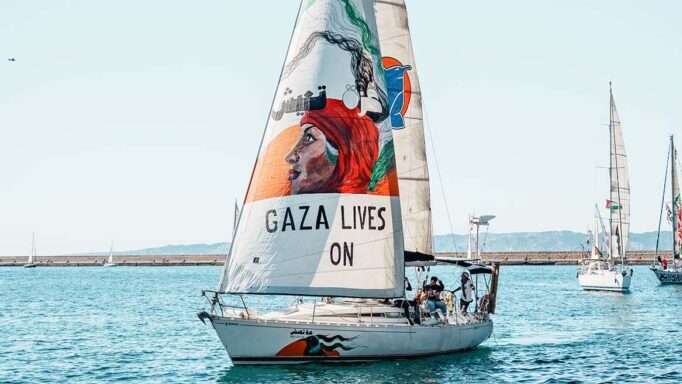
That's why they don't care one whit about Hamas massacres of Gazans, about genocidal wars in Syria or Yemen (even when they've funded and armed the sides), about flotilla activists currently held by the Libyans...literally nothing triggers a response except Jews.
They still, even after all these generations, no matter what else is happening in the world or in their own societies, can't stop thinking about Jews.
And as we Jews learned in the 1940s -- the actual, historical 1940s, not the weird fantasies conjured up by these bigots -- a whole society can be in the grip of a callous, destructive bigotry and still believe it is true and righteous.
Gaza's Deradicalization, Part 2: For years before October 7, Hamas’s leadership indoctrinated its followers, Gaza government employees, segments of the public, and anyone gullible enough to believe the group was preparing to “liberate” Al‑Aqsa Mosque in Jerusalem. Hamas and other jihadist movements have long framed Al‑Aqsa as the cosmic justification for their armed “resistance,” elevating it into a sacred pretext for endless violence.
The video here captures this delusion perfectly: a theatrical “practice run” in which Hamas militants reenact a fantasy conquest of Jerusalem, blending imagery from Saladin’s era with catapults and swords with apocalyptic, end‑times mythology that are Armageddon adjacent and simulate the return of Jesus to end the anti-Christ or “the Dajjal.” Actors dressed as medieval warriors, crowds chanting “To Jerusalem we march, millions of martyrs,” and a staged “liberated” Old City all served to reinforce a mass hallucination that Hamas alone could deliver a new Islamic victory.
One of Gaza’s central deradicalization challenges is dismantling this warped place that Jerusalem and Al‑Aqsa have been forced to occupy in the collective Palestinian psyche. The site and the city hold deep religious and cultural meaning, but Hamas has turned them into Trojan horses; vehicles for jihadist ideology, emotional manipulation, and political recklessness. The group routinely slapped “Al‑Aqsa” onto its wars and operations to sanctify the indefensible, with the so‑called “Al‑Aqsa Flood” of October 7 being the most catastrophic example. Even some Palestinian nationalists, including Yasser Arafat, used the label, calling the Second Intifada the “Al‑Aqsa Intifada” to legitimize what ultimately proved a fatal strategic error that derailed the Two‑State peace process.
Al‑Aqsa must be restored to what it actually is: a holy site that should one day be accessible to Palestinian Muslims, Arabs, and Muslims worldwide. A serious, phased conversation will be needed about how Muslims and Jews can safely access and share this sacred space with mutual respect and practical separation. But after nearly two decades of Hamas rule, Gaza’s immediate priority must be Gaza itself – its reconstruction, governance, security, and social healing, rather than reckless political gambles taken in Al‑Aqsa’s name.
Never again can Al‑Aqsa be weaponized to justify violence, launch wars, or make catastrophic decisions that cost tens of thousands of Palestinian lives and destroy entire generations.
The Prophet Muhammad shared in a Hadith that the sanctity of a Muslim’s life outweighs even the sanctity of the Kaaba in Mecca. That principle underscores a truth Gaza must reclaim: human life is infinitely more sacred than any stone, shrine, or symbol, whether in Mecca or Jerusalem.
Learning from Jewish Diversity: Over the past few weeks, the fractures within Jewish, Israeli, Zionist, and pro‑Israel circles have been impossible to miss. Religious, political, ideological, organizational, and strategic divides have erupted into open accusations: some are “too extreme,” others “too soft on Israel’s critics,” “reckless,” “undiplomatic,” “not pro‑Israel enough,” “sabotaging the cause,” or even “endangering Jewish safety.” Whatever one thinks of these claims, the reality is clear: Jewish communities and Israeli society contain a wide spectrum of socio‑religious and political diversity.
Across that spectrum, there is space, sometimes narrow, sometimes wide, for people to express their unique identities, their Judaism, and their individual politics. The communal infrastructure is vast and enviable: JCCs, Federations, JCRCs, Hillel, Atid, AIPAC, Israel Policy Forum, J‑Street, JVP, the World Zionist Organization, ZOA, ICC, AJC, ADL, Birthright, and dozens more. Add to that the Reform, Conservative, and Orthodox movements, plus the full range of political organizations in both the U.S. and Israel. This is not a monolith; it is a sprawling ecosystem.
That is precisely why simplistic labels like “Zionist” obscure far more than they reveal. And it is why I often find myself wishing that Palestinian, Arab, and Muslim Americans had anything comparable. Instead, there are fewer than a handful of national organizations, political and student alike, that enforce near‑total conformity on the Israel and Palestine discourse, despite the fact that Palestinian, Arab, and Muslim Americans hold a wide range of views on Hamas, Gaza, Israel, peace, pragmatism, the U.S., and belonging.
One of my deepest frustrations with certain Jewish groups of a particular political orientation is the role they expect me to play as someone from Gaza. Consciously or not, some want me to perform the part of the Palestinian victim who reinforces their own narratives. They recoil when I speak about Palestinian failures, Hamas’s catastrophic impact on Gaza, or my efforts to build bridges with center‑right Jewish and Israeli audiences. To them, these points “distract” from the larger story of Israeli wrongdoing. And if my words are cited by conservative pro‑Israel voices, that becomes the ultimate offense: “tokenization,” even though anti‑Israel activists routinely cite these same groups when convenient.
The result has been predictable: invitations withdrawn, doors quietly closed, and participation discouraged. I failed to play the role they had scripted for me; a victim to be wielded in their internal communal battles. And for that, I was sidelined.
Once again, the Gaza “aid flotilla” demonstrates how utterly useless and moronic forms of “activism” are a drain of resources and human power that could have been allocated elsewhere to actually make a difference, not just make a point. This is what happens when Bill Murray’s “Groundhog Day” film becomes somewhat of a reality; when a failed strategy is repeated again and again on a recurring time loop that always produces the same outcome with the same exact worthlessness. Ironically, the Gaza “aid flotilla” trying the same failed thing over and over while expecting different results, somewhat mirrors what Palestinian factions and political leaders have been doing for decades, especially when it comes to the “resistance” narrative – as if the Palestinian people need any more external affirmation of failed and miserable actions that have only produced death, destruction, and failures. Of course Israel wasn’t going to allow these ships to go through; of course Israel will try to intercept these ships in international waters to avoid having to deal with them on its soil; of course Israel will face no real pushback or meaningful opposition to its actions against the flotilla, and therefore, you’re not going to “draw attention” to Israeli actions no matter how aggressive and hostile they are.
Gazans don’t need symbolic amounts of aid to “draw attention” to their plight; hundreds of trucks enter the Strip daily loaded with supplies and materials that are quantitatively greater per capita than aid entering Sudan, South Sudan, Yemen, Mali, Ethiopia, Somalia, Syria, Cuba, Afghanistan, or the DRC. What Gazans need is someone to call out the unequal distribution of aid and assistance; Gazans need someone to expose Hamas’s crimes against an exhausted population; Gazans need attention drawn to the Egyptian siege of the Rafah border crossing and the prevention of thousands of patients and travelers unable to pass through Cairo’s airport to the outside world; Gazans need pressure on Hamas to disarm and sacrifice so that 2 million Palestinians can live and have a chance at reconstruction and a better future; Gazans need financial support to purchase inflated food and basic items that the cost of the “aid flotilla” could have paid for; Gazans don’t need performative sympathy but require actually helpful actions which often mean working with Israel, Egypt, the US, and those with influence in a pragmatic, unemotional manner.
Enough with the flotilla bullshit – enough with Western activists having sex, dancing, and playing sports on boats while sailing to “save” Gazans – stop wasting time, resources, and attention and do something meaningful for once in your lives!
The Gaza war is constantly described as uniquely destructive and deadly. It isn’t. By every key measure, recent wars, including those fought by the US and western allies, have been similar or worse than Gaza. Here are the facts to cut through the propaganda:
The Arab Word is Watching a Different War:
Three reasons why it has been difficult to understand the Arab position:
The first is the Arab relationship with Iran. From the vantage point of Brussels or London, Iran presents itself as a resistance movement with a grievance against American hegemony and Israeli occupation, and this presentation maps comfortably onto familiar Western anticolonial frameworks.
What it does not map onto is the lived experience of Arab populations in Lebanon, Iraq, Yemen, Bahrain, Syria, and across the Gulf. In those countries, Iran's presence meant Hezbollah holding the Lebanese state hostage to Tehran's decisions, thirty-five armed factions in Iraq drawing salaries from Iranian funds channeled through the Iraqi national treasury, and Houthi commanders answering to the Islamic Revolutionary Guard Corps while firing on Arab civilians from Yemeni soil. Freedom is not the word any serious Arab observer would use for what Iran brought.
Indeed, the Arab world's quarrel with Iran runs far deeper than American bases or Israeli airstrikes. What drives it is the systematic subversion of Arab sovereignty by a foreign power that uses the language of Islamic solidarity as cover for an imperial project conducted through proxies.
The second dimension is the proxy question itself, where Western analysis fails most comprehensively. Iran goes far beyond supporting armed groups. Parallel state structures get built inside Arab countries, financial systems get captured, and political figures get installed who owe their existence and survival entirely to Tehran.
The Iranians who have administered this project understand it as the export of a revolution, but what Arab populations have experienced is closer to a colonial occupation conducted through intermediaries, and as of now, they’re not mourning the Islamic Republic.
When Westerners treat these proxy networks as instruments of legitimate resistance rather than as mechanisms of subjugation, they endorse an imperial project while believing themselves to be opposing one, and as a matter of fact, make themselves the legitimizing force behind Iran’s war against the Arab world.
The third dimension is the most counterintuitive for a Western audience, and it is the one most consequential for how the current war is understood and misunderstood. For Arab nationalists, including secular nationalists and even those with deep reservations about Israeli policy, Iran represents a greater and more immediate threat than Israel does.
This is a position that Western media are structurally ill-equipped to render intelligible, because Western discourse on the Middle East has been organized for decades around the Israeli-Palestinian conflict as the primary axis of regional injustice.
The result is that when Western governments and Western publics take strong positions against Israel’s actions against Iran’s operations, they believe themselves to be standing with the Arab world. In reality, they are advancing a position that the Arab world does not share and has not asked for, while ignoring the threat that Arab governments and Arab populations actually live with.
The rhetorical use of Israel as a perpetual alibi for Iranian aggression has been one of the Islamic Republic’s most durable tools, and Western opinion has served as the unwitting amplifier of that tool across the entire duration of the Islamic Republic’s existence.
https://t.co/32dwric9G6
I recently did an interview when I was in Jerusalem and dropped a concept I've been working on for a bit (with a podcast of my own forthcoming). That concept is this:
The Israel Question
My case is that before WWII and the Holocaust and the re-establishment of the state of Israel in 1948, almost everywhere in the world, and certainly Europe, was consumed with something called "The Jewish Question." After WWII, the Holocaust, and the re-establishment of the state of Israel, the Jewish Question rightly became unaskable* because its intrinsic evil was deeply recognized (*except in Islamist states).
Because of these two things:
1) The Jewish Question becoming unaskable in civilized society; and
2) The state of Israel being re-established,
I insist that the Jewish Question got relocated to something I call "the Israel Question."
All the "just asking questions" crap we hear today is just asking the Israel Question.
So what is it?
We start with the Jewish Question. What is "the Jewish Question"? The Jewish Question is "what do we do with the Jews, on the presumption that we don't want them?" It is intrinsically antisemitic and shouldn't have taken the Holocaust to show how bad it is.
Why is that presumption part of the question, which has historically been framed merely as "what do we do with the Jews?"? The reason is simple: if your answer to "what do we do with the Jews?" is roughly "let them be part of our society with freedom to be themselves," you wouldn't ask the question about what to do with them at all. The question wouldn't just be unasked because there's a ready answer; it would be moot and irrelevant. There's no need to ask the question at all unless you see Jews as a problem to begin with. Thus, the question rests on that presumption ("we don't want them (here)") and is intrinsically antisemitic.
So that's the Jewish Question: What do we do with the Jews, on the presumption that we don't want them (here)?
Different people proposed different answers throughout history. The Romans didn't want them in "Palestine" anymore and chased them into Diaspora in AD 70-74, for example. Martin Luther suggested horrible things in the 1530s after he kinda went nuts in his latest years. Karl Marx suggested you make them not Jewish anymore, and preferably Communist, and the problem solves itself because they're not Jewish anymore but Communist comrades. Hitler suggested first to relocate them all to Madagascar and, upon recognizing that's ridiculous and impossible, the "Final Solution," which was to find and murder ALL of them, in order to rid Europe of them entirely.
Again, my case is that we don't ask the Jewish Question anymore in civilized parts of the world because we recognize it as being not just antisemitic but a gateway to hell. The Jewish Question is anathema in modern civilized societies.
Roughly at the same time as humanity finally started that realization baldly in the face, the state of Israel re-established itself in its historical homeland. Not only is this good on its own, but it also provides a failsafe should the morality slip and the Jewish Question arise in earnest again. With Israel, and its IDF and thus the ability to defend themselves at need, Jews can make aliyah and escape any society that decides to ask the JQ and thus reopen the gates to hell within its own borders. And good luck dealing with the IDF, as history has shown.
Thus arose a replacement question, a proxy for the Jewish Question that could be asked even though the JQ was off the table: the Israel Question.
What is the Israel Question? Simple: "What do we do with Israel, on the presumption that we don't want it (not just there, but anywhere)?"
The Israel Question seems distinct from the Jewish Question, and on technicality (but not in substance) it is. This allows the Israel Question to pose itself as a high-minded, fully socially acceptable geopolitical topic of debate instead of the rank antisemitism that it's actually serving.
The Israel Question is "just asking questions" about the state of Israel and its role in the world (on the presumption that we don't want it, thus the relentless impossible standards Israel is held to under its gaze). It's very high-minded. It's just global politics, you know.
The Israel Question takes forms like
-whether Israel destabilizes the Middle East by its mere presence,
-if Israel is really legally entitled to be there at all,
-if Israel defending itself against its hostile neighbors is a form of implicit aggression that causes secondary problems like mass migration,
-whether Israel should be forced to share its land with people who want to kill Jews because they are Jews and do impossible things to make it work even when it cannot work by definition,
-whether Israel is really defending itself or just starting random wars,
-if Israel's military (IDF) or intelligence service (the Mossad) secretly controls other countries including its putative allies,
-whether Israel is really a good ally or an ally at all to the countries with which it is in alliance,
-if Israel has secret ambitions to illegally conquer foreign lands for its own and force, coerce, blackmail, or trick other nations to do its dirty work in the process,
-if Israel deserves any kind of aid packages, moneys, or alliances and if it actually deserves to exist if any such things help its security,
-and on, and on, and on.
See, these questions aren't about JEWS. They're just high-minded geopolitical questions about Israel and its role in the world.
But these "just asking questions" questions are the Israel Question in disguise: ultimately, what do we do with Israel, on the presumption that we don't want it?
The Israel Question, and its "just asking questions" disguises, again, simply don't exist without the presumption of not wanting Israel. If your answer to "what do we do with Israel?" is "treat it like any other sovereign nation," there's no impetus to ask the Israel Question at all, and many of its disguises are moot too. All of them are moot once the impossible standard lurking beneath them is exposed, and that impossible standard is the hidden Israel Question.
The thing is, the Israel Question is just the Jewish Question by proxy, though. The question is ultimately "what do we do with the one place Jews can unequivocally defend themselves, presuming we don't want such a place?" (Again, if that presumption isn't there, there's no reason for the question and thus no question to begin with.)
In other words, the Israel Question is still "what do we do with Jews, presuming we don't want them?" with only the slightest caveat in possibility but only very rarely in intention.
Of course, the presumption of the Jewish Question is called "antisemitism," as we already discussed, which makes the Jewish Question itself antisemitic.
Similarly, the presumption of the Israel Question is called "anti-Zionism," as should be obvious, which makes the Israel Question itself anti-Zionist.
But the Israel Question is the Jewish Question by proxy, so the underlying anti-Zionism is antisemitism by proxy too.
We spend a lot of time these days seeing not just the reinvigoration of the anathema Jewish Question itself but far more the Israel Question, which would rob the JQ of its failsafe, which the Jews call making aliyah. And we're supposed to tolerate it and pretend it's just high-minded policy discussion about big geopolitical matters that are detached enough not to be immoral, or, in some cases, people fool themselves into believing that first.
We flatter ourselves with high-minded platitudes like, "of course anyone should be able to question the activities any state at any time" or "of course people should be allowed to criticize and question a government," as though those are actually what the Israel Question is about. Yes, "of course," those things are on the table, and every Israeli debates them daily, but not on the presumption that Israel's existence is not actually wanted.
This is why the formal definition of antisemitism is correct to name holding Israel to an impossible standard or one beyond that any other nation would be held to when discussing matters of its sovereignty, existence, security, or role in the world. It is right to name what amounts to the Israel Question as antisemitism because it is antisemitism, only thinly veiled.
We should learn to recognize the Israel Question for what it is, both for the evil, potentially genocidal antisemitism it actually expresses and for its presentation as a hidden presumption tucked underneath seemingly high-minded, fair-game "just asking questions" questions.
The rise of the Israel Question is the rise of the Jewish Question by proxy, and the response to the Jewish Question we have all understood as moral bedrock for civilized societies is "never again." Thus, the response to the Israel Question is also "never again." In light of its undeniable and rampant rise, it is therefore wholly appropriate and necessary to take the bold, righteous, and courageous stand of our time.
Join me in saying, then, NEVER AGAIN IS NOW!
@Emeliarjl @nagajaguarking That’s a fairly consistent statistic found across all Mediterranean countries. And science has found that increased exposure frequently leads to a higher likelihood of developing an allergy. Which disproves whatever bigoted point you’re attempting.
@AyOdeh Standard protocol in any parliament if you were to interrupt or heckle a foreign dignitary. Israel members of parliament have “parliamentary immunity” which protects them, some countries don’t. @ayodeh knows there are no repercussions and this just a publicity stunt.
@P3ng1z@kareem_1087@JulesJudea@Mish_K_ If the IDF can’t defeat Hamas in two years, there’s no chance of Gazans overthrowing them. But I also do believe that whilst Hamas is unpopular, nobody disagrees with their intentions against Israel. So due to both of those points, the status quo remains.
“The hypocrisy must stop. The reality must be accepted: peace will never come while Hamas remains intact. There is no future in which Gaza flourishes while Hamas remains in power. There is no future in which Israelis or Palestinians are safe if October 7th, hostage taking, lawfare, and human shielding is seen as a path to political leverage.”
@Joeonguitar @skankyskunk47 @CryptoSavingExp More like $600 in parts and labour, and then all the other costs of producing an iPhone and running a business:
- Manufacturing (Materials + Labor): ~30–35%
- Operating Costs (Marketing, Distribution, etc.): ~20–25%
- Research and Development: ~10–15%
- Profit Margin: ~25–30%
@freemonotheist This is flawed rhetoric posited by uneducated fools. Semitic refers to a language group including Arabic and Hebrew. But the word anti-Semite was formed in the 19th century in English as a translation of the German term Judenhass ('Jew-hatred')