Dead Screens is over. All 50 UNITS have new owners.
→ Pumpkin Patch: 20,290 players, 20 UNITS
→ The Séance: 50 players, 15 UNITS
→ The Crypt: 14 players, 10 UNITS
→ Haunted Robots: 142 players, 5 UNITS
Plus 600,000 $REIGN split across the Pumpkin Patch.
Won but nothing in your wallet yet? Your UNIT is kept for you, no deadline. Link a wallet (a free signature, no gas) and it's sent straight away.
Winners: https://t.co/XK7OmpMr6W
Incubate an egg. Let time do its thing. See what hatches and earn $EGG.
Something is cookin on Robinhood Chain.
Welcome to Egglo. 🥚
Join the early access 👇
🔗 https://t.co/G9fN4cYdQA
The first encrypted financial infrastructure connecting NFT-owned AI Agents with DeFi and @Polymarket markets.
20,000 NFTs. 20,000 AI Agents. Powered by $MOTES.
→ Applications open: https://t.co/XGUqQ0dJXh
I think it’s high time we start commending @AndreCronjeTech for what he has been delivering @flyingtulip_ , Why don’t I see more bullposts ? Probably cause half of yall don’t understand the mechanics so you can’t say your bullish almost feels like early days of Pendle.
If I stopped you and asked what is Flying tulip building you’ll probably say
“Andre Cronje’s lending protocol.”
But the stack is becoming much bigger than that.
Flying Tulip is trying to build a unified onchain financial account.
The idea is simple:
Deposit collateral once.
That collateral can earn yield.
You can borrow against it.
Use it for trading.
Use it for leverage.
Take long or short exposure.
And settle everything through the same financial system.
Instead of moving money between 5 different protocols, Flying Tulip wants to make the whole process happen inside one stack.
Here’s what is being built:
>Lend
This is the credit and collateral layer.
Supply assets.
Borrow against them.
Use your collateral across the broader system.
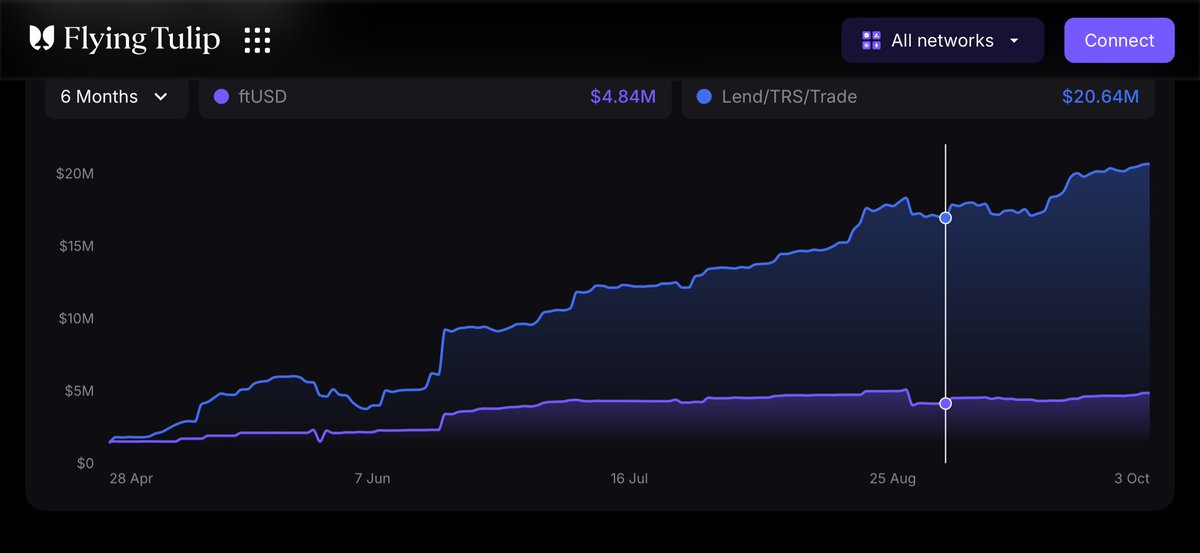
Lend reportedly grew from around $4.89M to $17.08M, roughly 3.5x growth.
>ftUSD
The native stablecoin and settlement asset.
Its reported supply grew from roughly $2.07M to $4.72M.
The bigger idea is that ftUSD can provide liquidity and settlement across the different products.
>Trade
Spot and leveraged trading are now live on Sonic.
So your collateral doesn’t necessarily need to leave the ecosystem when you want to trade.
Flying Tulip is also building around both AMM and order-book infrastructure.
TRS
This is the derivatives side.
Total Return Swaps allow users to take long or short exposure without simply buying the underlying asset.
It connects Lend, Trade and ftUSD.
So the same financial account can support collateral, borrowing and synthetic exposure.
Then there is the part I think people are sleeping on:
>TOKENIZED STOCKS.
Flying Tulip’s BNB Chain expansion brings assets including BTCB, ETH, WBETH and QQQB into Lend.
QQQB is @binance tokenized exposure to the Invesco QQQ Trust.
That creates a much more interesting possibility.
Tokenized equity → collateral → borrowing → trading → leverage
Now tokenized stocks aren’t just something you hold in a wallet and bullpost ahh tokenization is here
They can become part of an onchain financial account.
And QQQB is part of Binance’s broader bStocks rollout, which includes tokenized exposure to companies and ETFs such as Meta, Microsoft, Palantir, Lumentum and QQQ.
This is where the Flying Tulip architecture starts getting interesting.
You could have:
Crypto collateral.
Tokenized equity exposure.
Stablecoins.
Borrowing.
Spot trading.
Leverage.
Synthetic exposure.
All connected through the same financial infrastructure.
Flying Tulip has already reported $21.8M+ in live-product TVL and around $70.9M in system AUM, while only 3 of 16 planned product categories and 2 of 9 targeted chains were live in that reporting period.
And there is already measurable economic activity.
DefiLlama independently tracks Flying Tulip’s TVL, fees, revenue and active loans.
That’s important because TVL alone doesn’t tell you whether people are actually using the system
The numbers I would watch are:
TVL → active loans → trading volume → fees → revenue
That tells you whether capital is simply sitting there or actually moving through the financial stack.
And that’s why I think the Flying Tulip story is bigger than $FT.
They’re trying to solve one of DeFi’s biggest problems:
fragmentation.
Today:
Lend here.
Trade there.
Hedge somewhere else.
Tokenized stocks somewhere else.
Move collateral everywhere.
Flying Tulip’s bet is:
Put the financial account in one place.
Lend.
Borrow.
Trade.
Hedge.
Use tokenized assets.
Settle.
All from the same pool of capital.
It’s still early.
The system still has to prove liquidity, risk management, execution and user demand at scale.
But the product surface is expanding quickly🌷
.@flyingtulip_ is still in the early stages, but the value flow is already easy to understand.
ethereum:0x5dd1a7a369e8273371d2dbf9d83356057088082c is directly connected to the protocol’s activity.
Revenue generated across the ecosystem, product fees, and yield are designed to feed open-market buybacks of the token.
And the mechanism is already showing its strength.
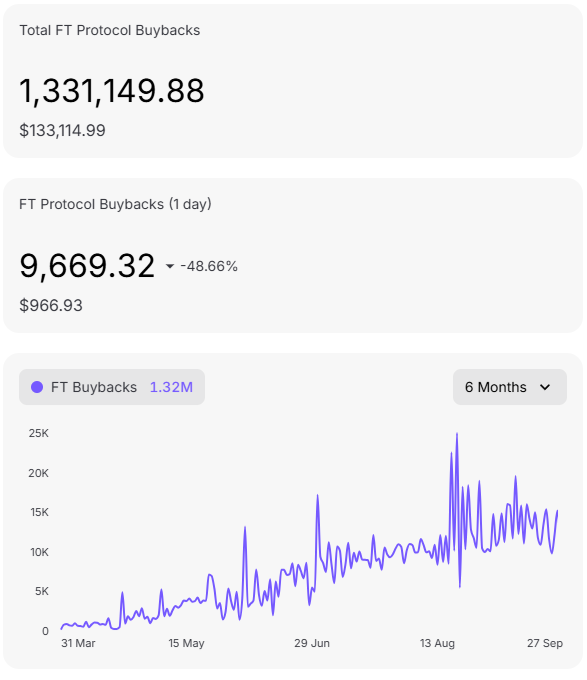
In just 5 months, the protocol has bought back around 1,331,149 ethereum:0x5dd1a7a369e8273371d2dbf9d83356057088082c from the market, representing roughly $133,114 in cumulative buybacks.
Even more importantly, the pace has continued to accelerate throughout that period, with buyback activity consistently expanding as the protocol grows.
As more products come online, more revenue streams are created.
More activity → more fees → more revenue → more ethereum:0x5dd1a7a369e8273371d2dbf9d83356057088082c absorbed from the market.
A simple value-accrual loop that becomes increasingly powerful as the ecosystem scales. 👇
Q:What is Flying Tulip TRS?
A: Leveraged Aggregator, comparable to perps.
One can pay only 1.8% yearly to long 10 BTC on
@flyingtulip_. (For comparison 10.95% on HyperLiquid)
Q:How about Liquidity?
A: Huge liquidity. It uses liquidity on the entire chain, just like an aggregator (e.g. 1inch, Cow Swap).
Q:How does it work?
A: 🧵👇
Received questions around how funding on @flyingtulip_ TRS can be less than on perps even though capital efficiency is the same.
Perps target a mathematical funding rate (interest rate) of 0.01% per 8 hours, which translates to 10.95% per year. The way to think about perps are like virtual lending markets, you want to long 1 BTC, you borrow 65k USDT, buy 1 BTC, and deposit that 1 BTC as collateral. You now have a margin position. To borrow the 65k USDT you pay 10.95% interest per year. If more users want to long, borrow rates for USDT go up, interest rate go up. If more users want to short (borrow BTC, sell to USDT, deposit USDT as collateral) then interest rates go down.
So let's say you wanted to do this position on ethereum currently. The borrow cost for USDT on @flyingtulip_ is 3.41% (much less than 10.95%), so your TRS funding rate is for BTC long would be 3.41-0.01=3.40%. Inversely if you wanted to short (and since it isn't a perp, you can use BTC collateral to delta hedge), you would be getting paid +3.40%, and since you can do this at 20x leverage, that would mean ~68%.
I firmly believed the reason tradfi hasn't cared about perps is because TRS already exists in their world. And it is a better hedging system in every way. To be fair, it could not exist until now, so perps were superior, but I don't believe that statement will still be true in 5 years.
May was the month Flying Tulip’s margin-based Lend expanded across Sonic and Ethereum.
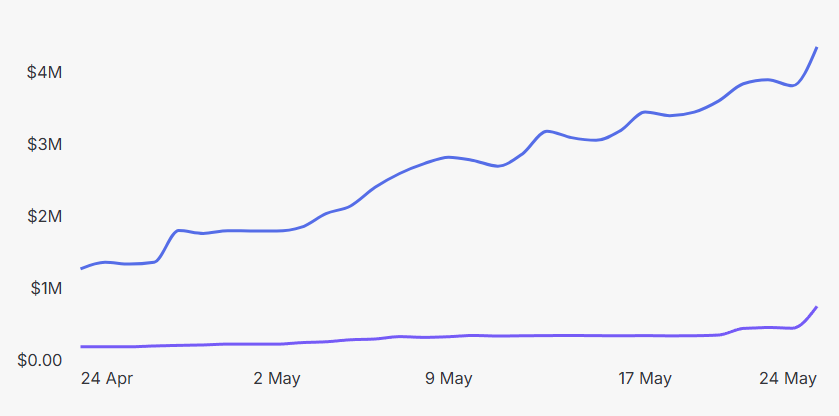
Without token incentives or points, Lend TVL grew from $1.76M on April 30 to $6.44M on May 25.
▸ Lend lets users supply assets and earn yield, gives borrowers access to liquidity, enables delta-neutral strategies for ftUSD, and establishes the infrastructure for Spot, Leverage Trading, and TRS.
▸ Lend yield comes from two sources: borrower interest on used capital, and strategy yield on idle, not-borrowed capital.
▸ Spot will also be integrated with Lend. Limit orders are signed intents with a minimum price and expiry; while waiting to be filled, assets can remain deposited in Lend and continue earning yield in bought-back and distributed ethereum:0x5dd1a7a369e8273371d2dbf9d83356057088082c.
Still personally most exited about Total Return Swaps coming out, but so incredibly happy and proud of the team for shipping all this in under 60 days.
The PUT system is working even in these stressed environments, exactly what it was built for, great to see it align long term supporters and provide easy exit for short term flippers without impacting the secondary.
Secondary NAV system managed to absorb all exits as well, making sure there isn't a dragging tail, already bought and burned $1.22m worth of tokens.
PUT marketplace trading has generated over $1m in trade volume with over 200 active sales, all without impacting the secondary market while trading PUTs at premium.
Flying Tulip USD I believe is the only pure activity based stablecoin yield system, and even in these markets has outperformed base lending and even "managed vaults", and that's with only 14.5% allocation to the delta neutral staking yield positions.
Our Lending is the first onchain margin based (not LTV) system, and has already shown higher capital efficiency (we needed to build it to facilitate onchain delta neutral staking trade [not possible elsewhere]).
All this in 71 days, for only $475.77k spent to date. Still an exciting road ahead with spot, leverage, TRS, perps, options, binary options, and insurance, but already massive milestones accomplished.
ftUSD limits increased.
Ethereum & Sonic caps increased from 1,000,000 to 5,000,000.
Earn 8.38% on USDT & USDC depositing into ftUSD;
Earn: https://t.co/V3rNljYt03
Stats: https://t.co/ogvxnlVhBK
Disrupting Tokenomics (Combination of 4 Unique Mechanisms)
Most DeFi
projects use well-known tokenomic models, however, @flyingtulip_ system combines 4 unique mechanisms that do not exist anywhere else.
Fixed supply without inflation 1:1 to real deposits
No upfront distributions for the team
Continuous buyback with revenue
and an on-chain reserve to guarantee the redemption of the original asset.
These four pillars are mutually exclusive in traditional models AC combines them to create a completely new class of tokenomics.
This is the only tokenomic that makes losing impossible.
@flyingtulip_ #FlyingTulip #Tokenomics #DeFi
So many new building blocks required to get here onchain. You can do this strategy with active management (in a limited fashion onchain), but no passive options, so we had to first rebuild an issuance / settlement layer (ftUSD), that can then feed into a margin based lending system (LTV based doesn't work here), with onchain RFQ for fillers, all just to enable a passive way to scale this trade. Bit more hardening and we can scale up leverage and caps. At scale this does ~8%-12% on USDC/USDT.