New full-length lecture now available — Stroke Imaging: Review and Future Directions https://t.co/pDmMxC1SQr via @YouTube. Geared toward learners interested in stroke imaging & intervention. Enjoy & check out my other lecture content! #MedEd#FOAMed#FOAMRad#RadRes#NeuroRad
If you are only looking at the ears in patients w/otalgia, you need LISTEN UP!
In 50% of cases, the source of pain isn’t the ear!
So-called “referred otalgia” comes from other nerves in the head & neck
Do YOU know which?
I’ll show you how to remember them—just hear me out!
➡️Referred otalgia is a “sensory error.”
🔸Multiple nerves converge in the head & neck and CNS can’t determine which one the pain comes from
🔸Same mechanism why a patient’s left arm hurts during a heart attack!
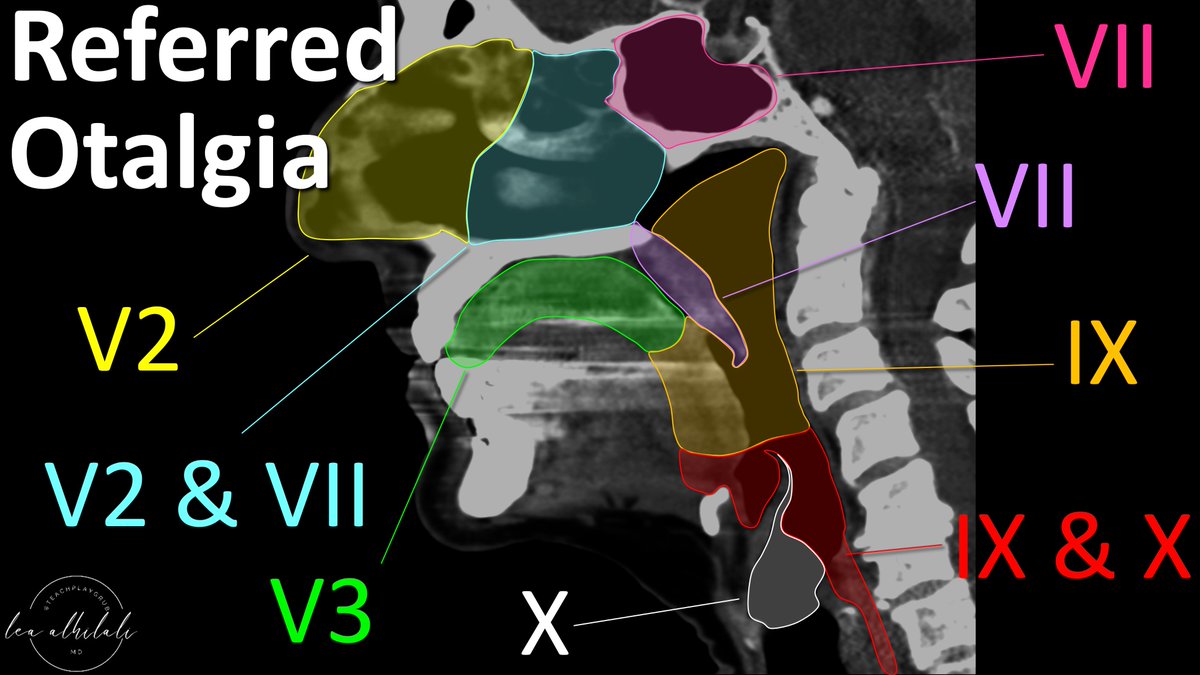
➡️Ear is innervated by the trigeminal, facial, glossopharyngeal, & vagus.
Pathology affecting these nerves in other places can cause otalgia. Here’s where to look:
▶️Trigeminal V2
🔸Causes otalgia via the auriculotemporal branch of V3
🔸Nasal cavity pathology can cause V2 referred otalgia
🔸Remember: V2 is where you go aaah-chooo
▶️Trigeminal V3
🔸Can cause otalgia via the auriculotemporal branch
🔸Oral cavity pathology and jaw can cause V3 otalgia
🔸Remember: there are 3 types of taste in your mouth (salty, sweet, bitter) = V3
➡️Facial VII
🔸Can cause otalgia via its posterior auricular nerve
🔸Sphenoid & soft palate pathology cause VII otalgia
🔸Remember: Seven & Sphenoid & Soft all start with S
➡️Glossopharyngeal IX
🔸Otalgia via nerve of Jacobson & tympanic plexus
🔸Pathology in the pharynx can cause IX otalgia
🔸Remember: glossoPHARYNGEAL causes otalgia from the PHARYNX
➡️Vagus X
🔸Otalgia via the tympanic nerve & auricular nerve
🔸Pathology in the larynx can cause X otalgia
🔸Remember: the shape of X looks like the larynx in the coronal plane: wide supraglottic larynx, narrow larynx, wide again in the subglottic larynx
Remember, when it comes to pain where you LISTEN, you have to know where to LOOK!
Top tips 🤓☝️Always consider a nasopharyngeal mass in adults with a tympanomastoid effusion. ☝️Primary parapharyngeal space lesions are rare but displacement patterns are important #hnrad#radiology