This month we celebrate Nature Physics' twentieth birthday, consider the flexoelectricity of water ice, and feature a Perspective on chiral phonons.
Have a look at https://t.co/rw5cog4BOn
The potential similarities in the superconductivity in nickelates and cuprates is a topic of debate. Now a distinct likeness is observed in the electronic properties of these materials, which hints that the microscopic mechanisms may be related.
https://t.co/ztUC4UJWNF
Classical approaches to imaging through complex media do not account for the quantum nature of the incident field. Now, images encoded on an entangled two-photon state are shown to transmit through a scattering medium whereas scattered by classical light.
https://t.co/8eTFs1ajol
In neurons, the mapping from inputs to output involves complex biophysical processes. Despite this complexity, it is now shown that simple artificial models explain a large fraction of the variability in neuronal activity.
https://t.co/Q7rjfhzSvd
In our latest issue, we advocate for a proactive approach to science communication, learn of the capilliary Leidenfrost effect, and find hopfions in a magnetic material.
Check it out: https://t.co/CvTXeoz3HI
How magnetic impurities influence superconductivity and electronic order in kagome metals remains unclear. Now anisotropic Kondo resonances intertwined with the superconducting gap are observed in a magnetically doped kagome superconductor.
https://t.co/Pb5dLxzEHL
It is known that active learning is more effective than lecturing at improving learning of physics. Now it is shown that some widely used active learning approaches are more effective than others.
https://t.co/91eTH6IjkI
Vacuum fluctuations amplified by a cavity can control and modify quantum phases. Now, strong anisotropic transport is demonstrated by manipulating quantum Hall stripes in a two-dimensional electron gas.
https://t.co/6rXu44RFrF
Deviations from the textbook current–phase relationship of a Josephson junction can arise from the intrinsic physics of the junction, but also from the inductance of metallic traces. Now a scheme has been developed to distinguish these cases.
https://t.co/MOxt8fC1WN
Non-Hermitian systems support non-trivial topological effects, yet eigenvalue braiding remains difficult to control and observe. Now, active tuning of laser modes enables programmable and directly observable braiding on an integrated photonic chip.
https://t.co/hosWuYdOEI
How angular momentum is exchanged and conserved among lattice modes has been difficult to measure experimentally, but has now been observed via a coherent three-phonon scattering process in a topological insulator.
https://t.co/1eIgM3UAH9
Massive spatial superpositions are a resource for quantum interferometry, but it has been hard to generate them beyond single atoms. Now spatially entangled massive states are realized through the tunnelling of atomic clusters in optical lattices.
https://t.co/wPluYQSDDx
A tunable artificial crystal in a shallow GaAs quantum well is shown to enable interaction-driven insulating behaviour. Electrostatic control tunes the band structure from graphene-like to kagome-like bands.
https://t.co/yuHISmbLGQ
Transport of charges has been widely studied in 2D moiré materials. However, charge-neutral collective excitations are difficult to access, especially when they are decoupled from charged quasiparticles. Now they are observed in a moiré homobilayer.
https://t.co/kk4Rz1YmK5
Coupling semiconductor qubit devices to microwave resonators provides a way to transfer quantum information over long distances. A flopping-mode qubit that combines strong coupling to photons with good coherence properties has now been demonstrated.
https://t.co/oAweEOvzAO
Higher-order interactions in quantum harmonic oscillator systems can result in useful effects, but they are hard to engineer. An experiment on a single trapped ion now demonstrates how spin can mediate higher-order nonlinear bosonic interactions.
https://t.co/pDt9gk5DgV
Symmetry rules usually prevent interactions between distinct vibrational modes. Now it is shown that charge order fluctuations can mix modes, enhancing the chiral lattice response in a ferroaxial electronic crystal.
https://t.co/kqVDjpPxv9
The mechanical stability of proteins affects their import into the nucleus. Now it is shown that protein transport in and out of the nucleus depends on the local mechanostability of the protein cargo.
https://t.co/hzDEIRufdI
During development, cells acquire their identity—a process that depends on epigenetic modifications such as methylation. Now, a statistical physics analysis of methylation helps explain embryonic symmetry breaking.
https://t.co/lr8H7Sresl
Quantum simulation of equilibrium many-body systems requires the ability to sample from the thermal distribution of quantum states. An algorithm has now been proven to be an appropriate quantum analogue to classical Monte Carlo methods.
https://t.co/1NpGmey25z
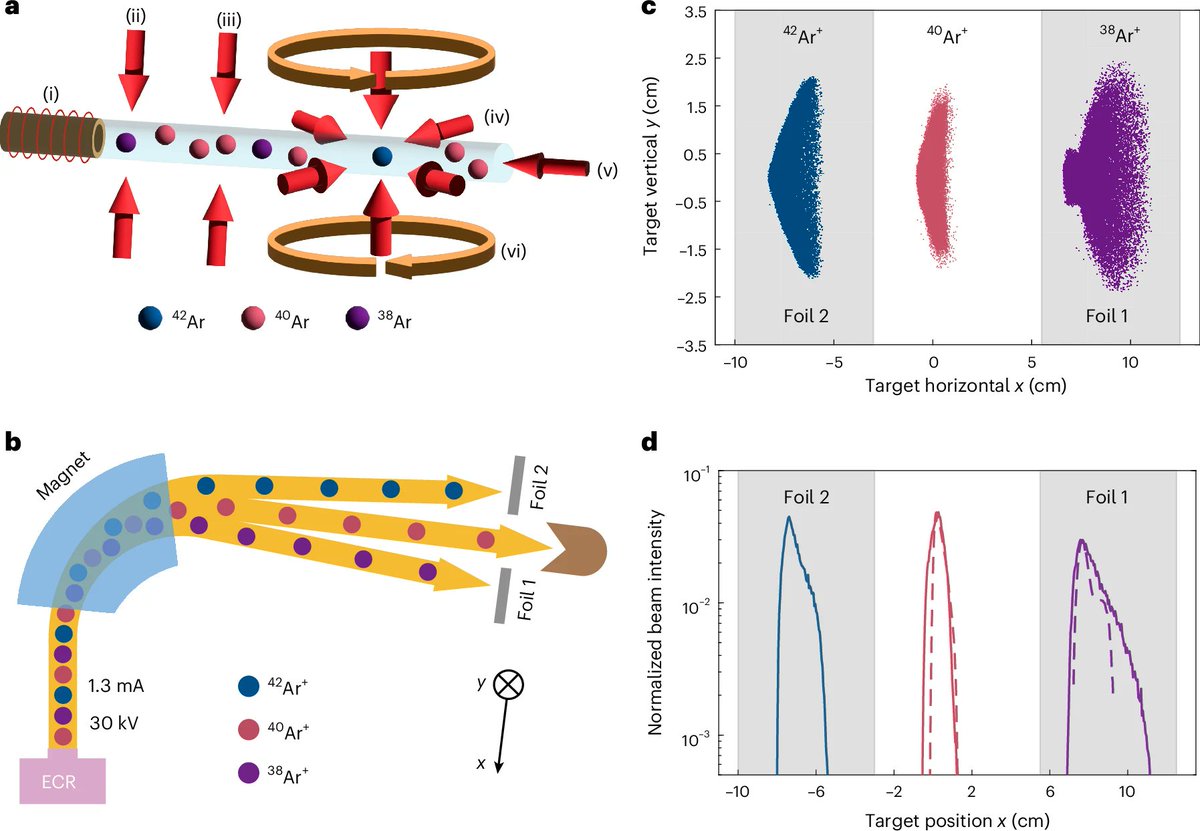
Argon-42 is a background in experiments that search for dark matter or neutrinoless double-beta decay. Now, the isotope’s abundance is measured by combining a laser-based atom trapping technique with isotope pre-enrichment.
https://t.co/0zGjL2MVeQ