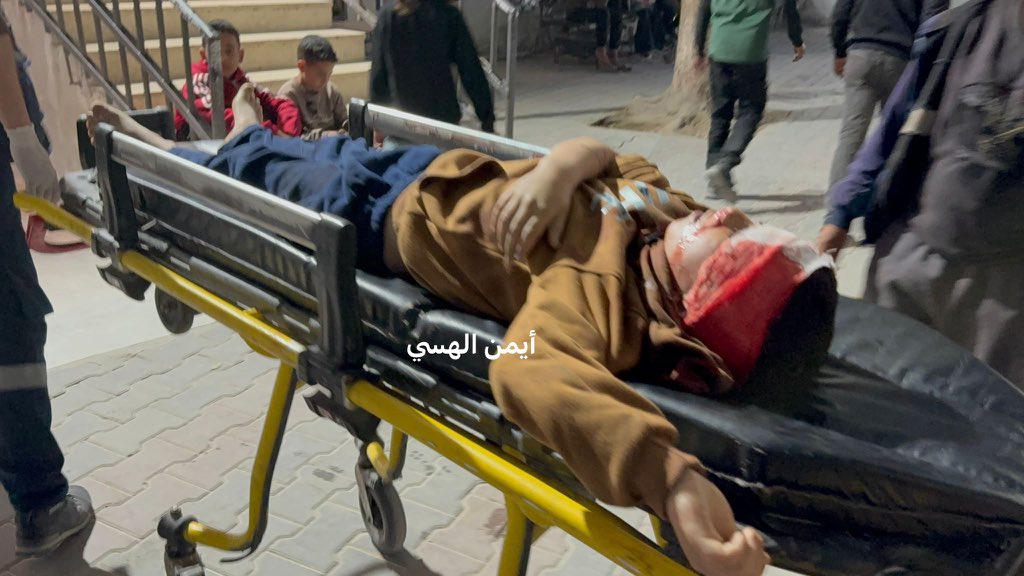
Unfortunately, I’m fading 💔
With a heart full of pain I tell you: I was diagnosed with severe malnutrition from endless hunger.
My body is breaking, my strength is gone, and I can’t afford food or medicine.
If you’re scrolling, please leave a dot (🍉) — even a dot means we’re not invisible.
https://t.co/5LHVvEAx70
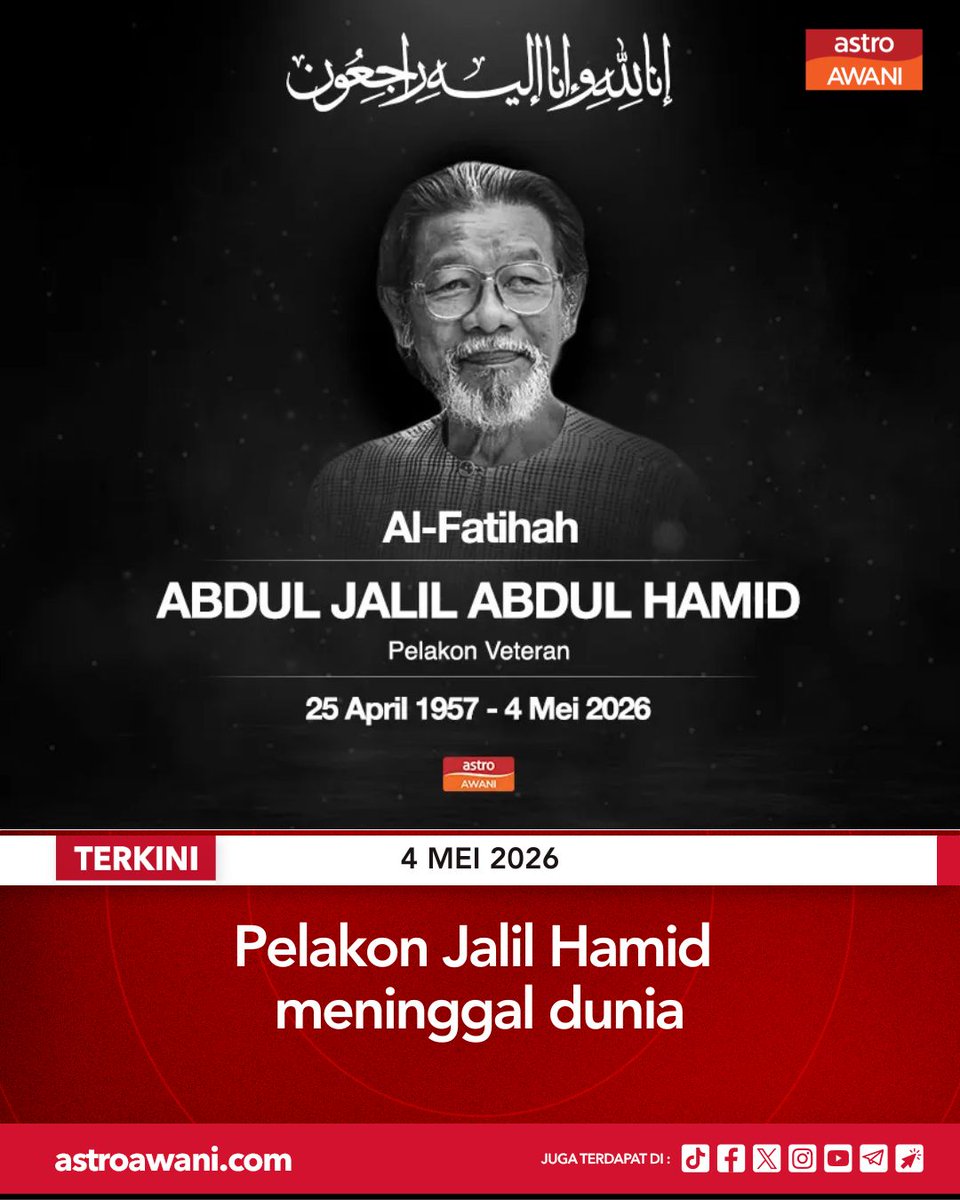
Pelakon veteran ternama tanah air, Jalil Hamid menghembuskan nafas terakhir pada 12.30 tengah hari tadi.
Berita duka pemergian seniman berusia 69 tahun itu disahkan anak Allahyarham, Afiqah Jalil di akaun Instagram.
Menurut Afiqah, bapanya meninggal dunia selepas tertidur usai menunaikan solat Subuh.
Kata Afiqah, Allahyarham ditemui tidak sedarkan diri oleh ibunya ketika masuk ke bilik tidur sebelum disahkan meninggal dunia di rumah.
#AWANInews
Berita lanjut di: https://t.co/FDPt1goruG
Israel is still committing genocide in Gaza‼️
Israel is still committing genocide in Gaza‼️
Israel is still committing genocide in Gaza‼️
Israel is still committing genocide in Gaza‼️
Israel is still committing genocide in Gaza‼️
Israel is still committing genocide in Gaza‼️
🚨HEARTBREAKING: Amid Israel’s ongoing blockade, displaced Palestinians in Gaza are struggling daily just to access clean drinking water.
With infrastructure shattered, many are forced to rely on mobile water tankers, paying high prices for something that should be a basic right.
🚨 BREAKING: Four Palestinians were killed in an Israeli airstrike targeting a civilian vehicle in western Gaza City: Eyad Al-Shanbari, Salah Al-Shanbari, Shaaban Ayesh, and child Khaled Naeem Abu Nahl.
🚨 Testimony: Israeli Army Turned Gaza Aid Sites Into “Field Day of Violence”
Former U.S. Marine and ex–Gaza Humanitarian Foundation site manager David Mcintosh gives testimony describing what he witnessed in Gaza.
He alleges that the Israeli army treated the situation as a “sadistic field day,” firing at starving Palestinians trying to access food, and turning aid distribution sites into extremely dangerous zones that put humanitarian workers and civilians at severe risk.
🚨During the past three hours, Israeli occupation forces killed:
▪️two people southeast of the Gaza City
▪️one person in Al Sheikh Ridwan neighbourhood, northwest of the Gaza City
▪️two people in Al Moraka City
▪️a woman in a displacement camp in Khan Younis
IRAN IS FUCKING PISSED
🇺🇸 When VP JD Vance said:
“Trump told him that if 🇮🇷Iran commits to not having nuclear weapons, he will make Iran 🇮🇷 prosper economically and great."
🇮🇷Iran has responded to the VP and Pres saying:
"Look at how prosperous all these countries like Syria 🇸🇾, Afghanistan 🇦🇫, and Iraq 🇮🇶 became after trusting Israel 🇮🇱 and the United States 🇺🇸."
You can’t come back from that bro 😭😭😭😭😭😭😭😭😭😭😭
Red lines being drawn across the Strait of Malacca, and hearing it described as “moving to the centre of gravity”, is not a comforting thought when you live just 40 minutes from its shores.
The Trump regime is in complete chaos. Former NATO Supreme Allied Commander Adm. James Stavridis acknowledges the Pentagon had to walk back Trump's insane full blockade order. The incompetence and delusion of Trump continues to help Iran and wreak havoc on America's armed forces.
My brain can’t comprehend how a monkey and a penguin get more attention than an actual human baby, starving in the middle of a genocide. People in Gaza deserve to live too. No child deserves to be starved to death or shot in the head.
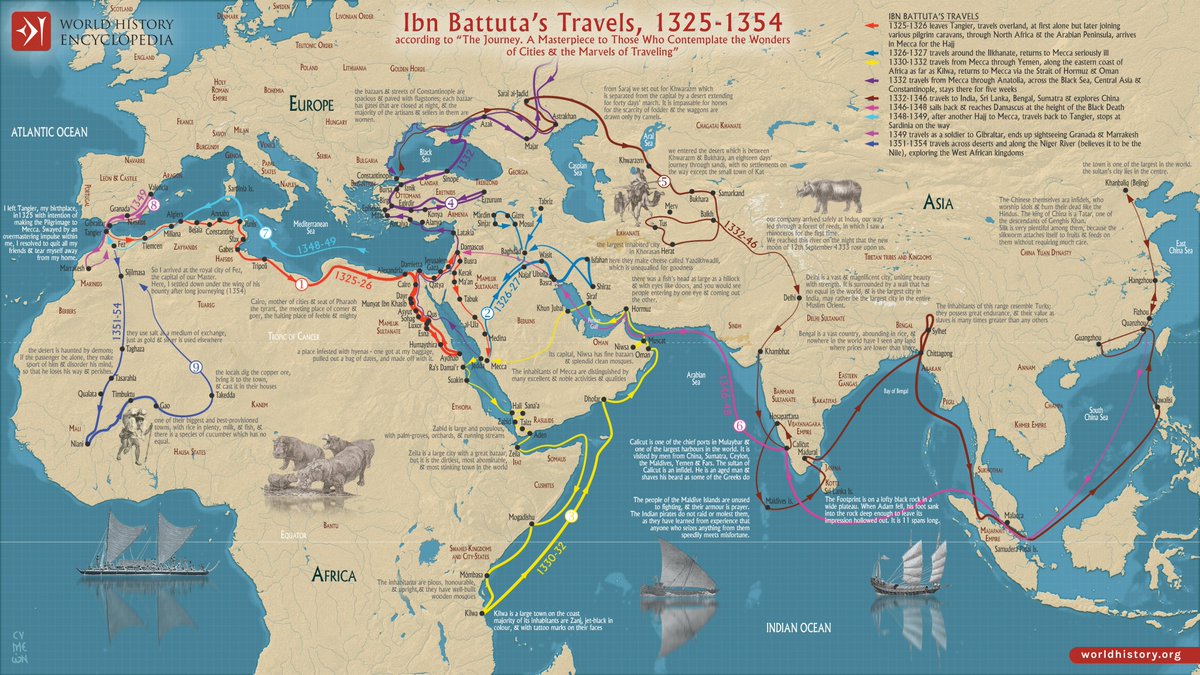
Ibn Battuta left home at 21 to complete a religious pilgrimage that should have taken sixteen months. He came back twenty-nine years later.
Just look at the map, he is a man that truly lived an odyssey.
I've gathered some highlights from his 117.000 kilometer journey.
Here we go:
🔸Born February 24, 1304, in Tangier, Morocco, into a family of Islamic legal scholars and judges. His name, literally, means "son of a duckling."
🔸Trained as a qadi, a Muslim judge with authority over religious and civil matters. That credential would open doors on every continent he visited. He was smart enough to know it.
🔸Left home riding alone on a donkey. On the road to Mecca he developed a fever so severe he had to tie himself to his saddle to avoid collapsing. He kept going. That became the pattern.
🔸In Alexandria, early in the journey, a holy man named Sheikh Burhanuddin told him he would travel to India, Sind, and China, and meet specific scholars there by name. Ibn Battuta did exactly that. He recorded the prophecy without apparent amazement.
🔸Completed the hajj in 1326, then joined a caravan heading into Mesopotamia. He had discovered, somewhere along the North African coast, that he simply loved to travel.
🔸One caravan he joined functioned as a moving city. When it stopped, food was cooked in giant brass cauldrons for the poor. It had its own markets, luxury goods, and fresh fruit. At night they lit torches along the entire length of the column, turning the darkness into what he described as radiant day.
🔸What followed is almost impossible to compress. Persia. Iraq. Azerbaijan. Yemen. The Horn of Africa. Mogadishu. The coast of Kenya and Tanzania. The Crimea. Constantinople. Central Asia. India. The Maldives. Sri Lanka. Sumatra. China. Mali. He crossed the Sahara. He rode the Grand Canal. He visited Beijing, Hangzhou, and Guangzhou, and reportedly saw the Great Wall.
🔸117,000 kilometers in total. That surpassed Zheng He's 50,000 and Marco Polo's 24,000. He did it without a mission, a sponsor, or a navy.
🔸His method was elegant and entirely parasitic on a single fact: the Islamic world in 1325 stretched from Morocco to the Malay peninsula, and everywhere within it, a scholar who could speak Arabic and recite the law was guaranteed hospitality.
🔸Ibn Battuta exploited this with genius. He arrived in courts as a learned man, was appointed qadi, collected gifts, gathered a retinue, married locally, then left.
🔸He documented death rituals everywhere he went with the detachment of an anthropologist. In Turkey, forty days of mourning for a ruler's mother. In Iran, a funeral that resembled a wedding celebration. In some regions, slaves and concubines buried alive with the deceased. He recorded all of it and moved on.
🔸In Delhi, the Sultan appointed him grand qadi of the city. His employer was a ruler described as an extraordinary mixture of generosity and cruelty. Ibn Battuta watched friends executed regularly, feared for his own life daily, and eventually fell into disgrace. He wrote about the sultan with a psychologist's precision, terror and fascination running through every line.
🔸Then came the shipwreck that saved his life. Appointed as the sultan's ambassador to China, he loaded ships with hundreds of gifts including horses, slaves, and gold. He missed the departure to attend Friday prayers. The ships sank in a storm. Everything was gone. He was alive, stranded, and too afraid to return to Delhi to explain what had happened. He sailed to the Maldives instead.
🔸In the Maldives he served as qadi, married into the ruling family, got involved in local politics, and came close to making a play for the sultanate itself. He found the situation too dangerous and moved on.
🔸He survived bandits, shipwrecks, and a sultan's suspicion. On one occasion he was robbed and escaped with nothing but his trousers. He caught up to his caravan on foot and kept going.
🔸By the end, the Rihla records encounters with over 60 sultans and more than 2,000 prominent figures. He made himself welcome, or at least useful, in virtually every court he entered.
🔸He kept no journal. Everything he recorded, he carried in his head for decades. When he finally dictated the whole account, he reconstructed twenty-nine years of travel entirely from memory.
🔸Some scholars believe sections describing China were lifted from earlier authors. His account and Marco Polo's share suspiciously similar passages. He had no notes to prove otherwise.
🔸Near the end of his life, the Sultan of Morocco insisted he dictate the whole account to a scholar. The result was titled A Gift to Those Who Contemplate the Wonders of Cities and the Marvels of Travelling, now known simply as the Rihla.
🔸Then he was appointed a judge in Morocco and vanished from history. He died in 1368 or 1369. His work was unknown outside the Muslim world until the nineteenth century.
🔸His contribution to geography is considered as great as that of any geographer, yet for centuries he appeared in no textbook, Muslim or Western.
To conclude: Ibn Battuta did not set out to be an explorer. He set out to fulfill an obligation and found he could not stop. What he produced, one man's firsthand account of the medieval Islamic world from Morocco to China, is a document with no equivalent in any other civilization of its era.
Marco Polo had backers, a trade route, and a famous name. Ibn Battuta had a credential, a memory, and an inability to go home.
As always, if you have a figure that should be honored and immortalized with a card, I'd love to hear your suggestions.