"And that's what education is in prison. It's an opportunity at a new life.”
College in prison changes lives—leading to increased employment opportunities and lower recidivism. https://t.co/OfWNsmQgCV #WatchNow
Eric Adams's new mental health "plan" misses the mark—and dangerously so—by asking police to respond to matters they simply are not equipped to handle.
https://t.co/7RNVxRJjTZ
The criminal legal system creates unjust barriers, like restrictions on mail and visitation, that make it harder for incarcerated people to stay connected to loved ones—even though these connections are key to helping them succeed when they return home. https://t.co/AfEL33AbOJ
“They go above and beyond to make things a little bit more uncomfortable for us.”
A new policy in New York state prisons restricts the number of packages that incarcerated people can receive directly from family and friends to JUST TWO a year. https://t.co/fG9VSsaL3o
Hawai`i made headlines over the summer for bringing its population of girls in long-term juvenile detention to zero.
This milestone was the result of long-term efforts to divert girls into community-based programs, but the work isn't over: https://t.co/ZC0KnOgxcw
Nationally, an estimated 11 million people have a suspended driver’s license simply because they cannot afford to pay off traffic fines, court fees, and the like.
I wrote about the nonsensical, counterproductive laws that criminalize people who can't pay.
For over two decades, Derrick Sprouse's driver's license has been suspended simply because he cannot afford to pay off his fines and fees.
Like Derrick, the daily lives of nearly 11 million people in the U.S. are impacted by these suspensions: https://t.co/uTtkgQ9DUZ
.@chesaboudin's recall shows why we can't reform our criminal legal system in a vacuum. We need to invest in community services—which are proven to make our communities safer.
@sammccann and @nickturner718 explain: https://t.co/xfIDNcKlak
Driver’s license suspensions for unpaid debt are counterproductive and only serve to punish poverty, writes the @verainstitute. Read more:
https://t.co/hbmPPW3TZS
For over two decades, Derrick Sprouse's driver's license has been suspended simply because he cannot afford to pay off his fines and fees.
Like Derrick, the daily lives of nearly 11 million people in the U.S. are impacted by these suspensions: https://t.co/uTtkgQ9DUZ
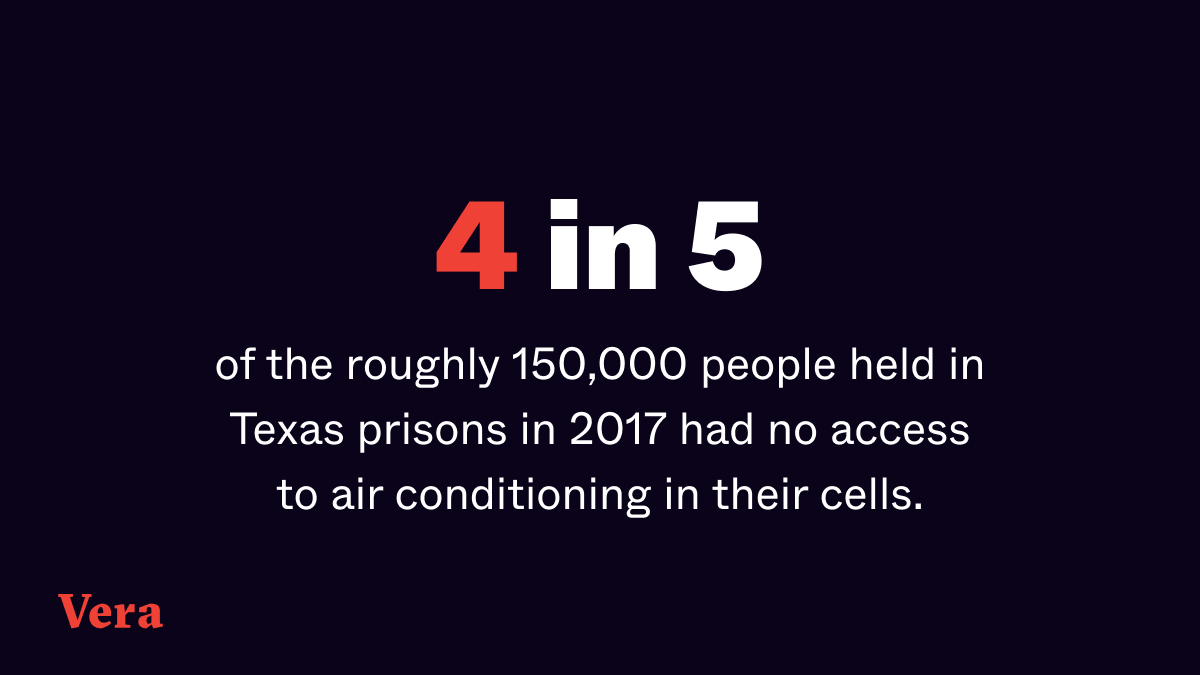
This issue isn't unique to Texas. States across the U.S, including California, Florida, and Louisiana, lack universal air conditioning in prisons. With the impacts of climate change already keenly felt by incarcerated people, policymakers must act now: https://t.co/muADF6XH60
There seemed to be real change on the horizon last spring when the Texas House passed a bill that would expand air conditioning in prisons.
But the bill died in the Senate and with other attempts railroaded, volunteers are stepping in to take action. https://t.co/SOP3gbFsSo
In Texas prisons that lack air conditioning, summer temperatures can routinely exceed 100°. These suffocating conditions are so brutal, they've been called a violation of human rights.
As the climate crisis worsens, so too will this humanitarian crisis: https://t.co/muADF6XH60
Missouri becomes the latest state to ban physical mail, including photos and handwritten letters, in prisons.
It's only the private companies that photocopy and digitize mail that stand to benefit. https://t.co/03FbCL489k @ShahlaFarzan
For people who are incarcerated, a letter or photograph from home goes a long way. But more jails and prisons are introducing cruel policies that mean people in those facilities never get them.
https://t.co/LcAzFvMNKk
Hyperallergic reporter @_elainevelie on the banning of @hthompsn's text on the Attica uprising in NY prisons & the twisted world of jail book bans, with @PENamerica's @JRTtager
https://t.co/1q1M9DZ1JA
What is clear is that restrictions are expansive, arbitrary, utterly absurd. And prisons’ book-banning practices could be far more extensive than we know. https://t.co/aU6zXh9tyu
It is almost impossible to gauge how many facilities have restricted access to books. Just last month, another @OfficialFBOP facility started requiring people in prison to buy books themselves, from one approved vendor. @peterjtomasek investigates: https://t.co/b0NZCeCq08