co-initiator @QBlockchain | decentralized governance | previously: lawyer, tech CEO, business builder | join me if you want to build intergalactic organizations
📢 Q token holders!
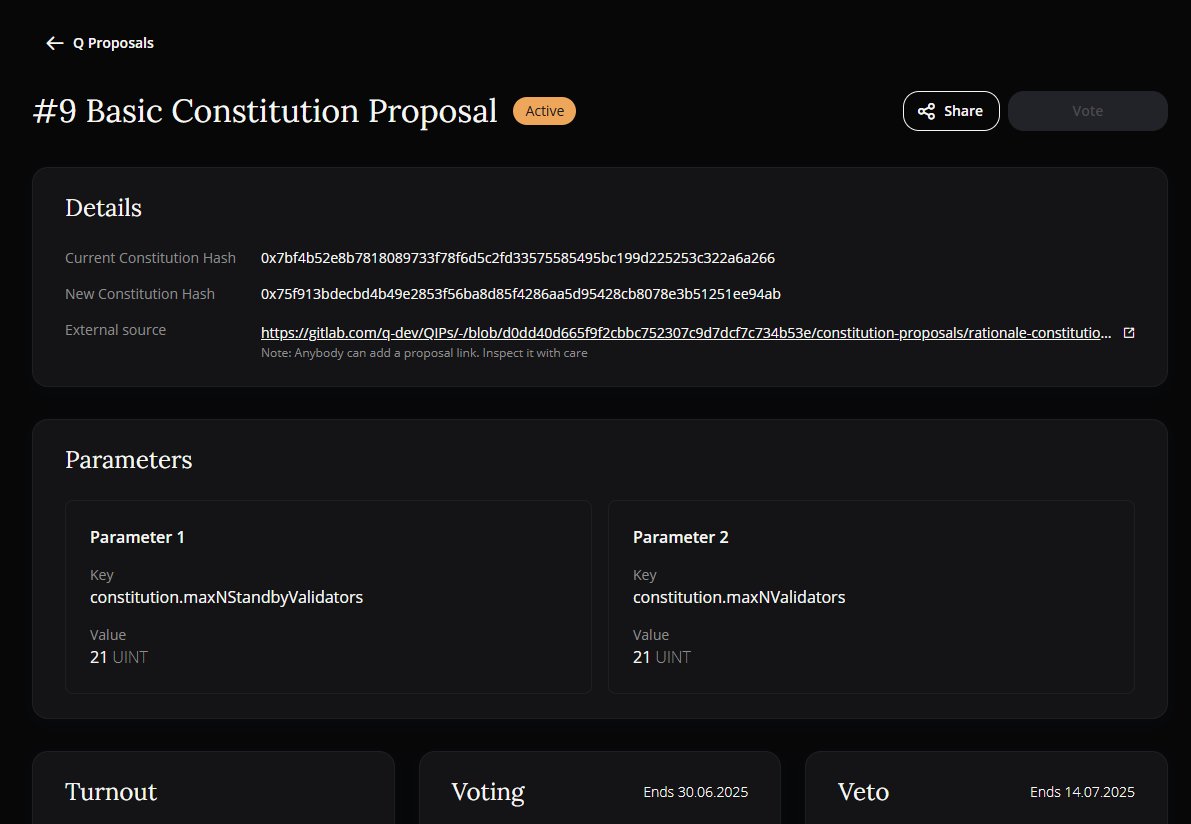
📜 A Constitution update proposal is live onchain. The proposal suggests to change two parameters: the number of validator nodes and the number of root nodes.
Make your voice heard and vote on this proposal!
The link to the proposal, including the rationale behind it, is in the comments.
🚨 The Stanford Blockchain Governance Summit starts tomorrow!
The event features four speakers who are supporting Q as root nodes. If you're there, make sure to check out their talks:
➡️ @IncompleteRules - The External Validity of Blockchain Governance: Automated Penalties and Digital Constitutionalism
➡️ @MarinaMarkezic - Crypto Regulation: Current and Future, U.S. and Europe
➡️ @martin__a__s - Enforcement of Subjective Rules in Decentralized Systems
➡️ Anja von Rosenstiel - Decentralization and DAOs in a Regulated Data Economy
With the power outage in Spain and Portugal, we hope that all Q community members there are safe!
For those who are running a node in this area, here is a reminder of what happens:
Q has pioneered the concept of “constitutional slashing”.
This means that although uptime requirements for node operators (validators and root nodes) are mandatory, slashing of stake in case of downtime is not automatic. Slashing proposals are evaluated by Q’s root nodes, who can take into account circumstantial factors – like a nationwide power outage – when making slashing decisions. The process and their scope of discretion is clearly defined in the Q Constitution. And in case of disputes, Q’s dispute resolution mechanism is in place to resolve the situation.
This approach is unique to Q and protects node operators from unfair slashing of stake.
This approach is in stark contrast to slashing rules in other networks, where power outages – although entirely outside the control of node operators – can lead to serious slashing penalties (e.g. via correlation penalties).
The Q community believes that constitutional slashing is not only fairer, but also promotes a healthy and geographically diverse validator set.
Good governance is the foundation of all economic activity.
Q provides foundational governance infrastructure for the decentralized world.
Get in touch with the Q community to learn more!
GM and happy weekend everyone!
While everyone has been speculating about the latest discoveries below the pyramids, we have received exclusive pictures that show what's going on there:
Shared Governance Security a key concept introduced by Q Protocol.
The principle is simple: Security increases when it is shared.
This is the basic idea behind smart contract platforms like Ethereum, which provide shared transaction security for the applications building on it.
Q expands this concept to governance: applications building with Q do not have to bootstrap their own governance security. They can simply use Q's governance features and enjoy best-in-class governance security from Day 1.
The result: Higher governance security at a lower cost.
Just use Q!
Whatever your view on the case at hand, this is a great example of the power of constitutional slashing. As a refresher, check out this thread:
https://t.co/VKrKsSRous
What’s next?
Sign up to AKO’s newsletter at https://t.co/JHjsWFDSJe for updates on how you can join AKO 3.0.
The future of mobility is collaborative, and your voice matters. ✨ Let’s go and a bridge between innovation and community! ⚡️(5/5)
Protocol upgrades on Q work without the dreaded multisigs that are used by many other protocols.
How does this work? Here are some of the main elements of the upgrade process:
➡️ the Q Constitution prescribes rules and procedures for protocol changes
➡️ implementation requires Root Node approval (or is subject to Root Node veto)
➡️ Root Nodes are diversified in terms of geography, industry and infrastructure, mitigating risk of capture
➡️ the process is subject to strong checks and balances, including slashing penalties for Root Nodes in case of non-compliance with the Q Constitution
➡️ Q’s in-protocol dispute resolution procedure provides a path to challenge upgrade decisions
0/ Did you know that… under Q’s modular governance architecture, QGOV token holders can delegate decisions to dedicated Expert Panels?
Here is how this works: 🧵
Welcome @lobarb to Q's Fees & Incentives Expert Panel!
The Q token holder vote was positive, and the root node veto period has passed without any veto votes. This means that the new member of the Expert Panel is confirmed!