Head of English/Media @ St Benedict's College. CCEA examiner. AQA Subject adviser. Head of Yr12. Father of four, Man Utd fan and GAA enthusiast. #tnn#antroim
Quick quiz... Which of these do you think is supported by evidence?
❓ Students learn best when teaching matches their learning style.
❓ Highlighting is an effective revision strategy.
❓ You only use 10% of your brain.
❓ Retrieval practice improves long-term learning.
This month's TeacherToolkit resource investigates common education myths to help teachers ask better questions about teaching and learning.
🤔 How many would you answer correctly?
🚀 Explore the NEW resource here:
https://t.co/i18Do32zDl
✍️ Sign up as a school for #TheToolkit licence = immediate access to ~370+ resources https://t.co/qHFcqZ9fQi
🗣️ Learn more https://t.co/KWzeqohtFe
🏆️ FREE trial https://t.co/r0K3i5epLz
Assessment, Standards and the Bell Curve https://t.co/mv71C0u3m0 via @teacherhead
I’ve been writing about this stuff for years. Ideas moved on a bit but lots of this unchanged .. from
2013.
After the death of Jason Arday, Will Self asks what happens when newspapers, platforms, editors and audiences become components in a machine nobody admits to controlling.
The public interest is not the same thing as the public being interested. https://t.co/FwczdbQWsY
The SHOW method is for teachers AND for students.
Hang this chart on your wall to remind you of 4 ways you can nudge students into explaining their thinking instead of just giving an answer. AND teach students to use it when they talk with partners and in groups!
S — Sounds like... "It sounds like you're saying..." (restate what you heard) H — How... "How did you get that answer?" O — Other way? "Is there another way to solve it?" W — What... "What do you notice? What are you thinking?"
Four simple sentence starters that turn a quick answer into a conversation and help students SHOW their thinking, not just state it.
Get the FREE download here. https://t.co/eIm6YCFd0K Save this one for your lesson planning binder. 📌 Or download the entire article and read it with colleagues as a mini-PD.
Why this framework #5...
The GIST of instruction is about preparing learners for the work session task by giving them what they need to successfully enter the task without doing the thinking for them—and to set them up to take on the task in the work session.
GIST = Guided Information, Skills, and Tools
🧭 Guided Information gives learners the essential background, concepts, vocabulary, and context they need to understand the learning.
🛠️ Skills provide the strategies, processes, or procedures learners need to successfully engage in the task.
🧰 Tools give learners resources they can use when they get stuck, need support, or are ready to move forward independently.
🎯 Keeps instruction focused on what learners actually need for the learning target and task.
🪜 Provides just enough support to make productive struggle possible without removing the challenge.
🚀 Transfers responsibility to the learner by preparing them to use the information, skills, and tools on their own in the work session task.
The goal of instruction is not to tell learners everything. Give them the GIST, then give them the opportunity to do the learning and be ready for the work session task.
“You cannot see students being cognitively overloaded.”
That may be one of the most important and unsettling ideas from our conversation. @DylanWiliam@bamradionetwork https://t.co/EtP0MFhrpJ
Why this Framework works #3:
Success Criteria make the learning target visible and actionable.
Strong success criteria:
🎯 Clarify what success looks like so learners know what quality work includes.
🧠 Focus attention on the right features so learners know what matters most in the task.
📍 Support self-monitoring so learners can judge where they are and what they still need to improve.
💬 Make feedback more useful because comments can be tied directly to clear expectations.
🔄 Support revision so learners can use evidence to improve their work instead of simply completing it.
🚀 Build independence by helping learners rely less on the teacher to tell them whether they are successful.
Success criteria do more than describe the finish line. They help learners navigate the path to get there.
Copilot for teachers.
As the Copilot rollout begins across the North of Ireland, teachers are gaining access to increasingly powerful AI tools through EdIS/C2k.
Here are four practical ways Copilot can support teachers while professional judgement remains central.
THREAD: @LauraTrottMP and others have pointed out (following the Panorama episode) that the failings in underperforming schools deserve far more attention. What do those failings look like? I've spent 6 years out of 17 in the profession in those environments:
Here's WHY this framework works for learning for the next few posts. Starting with the Opening.
The Opening is not something that happens before learning. It's the first act of learning. A strong Opening:
• Clarifies the target so learners know where they are going and what deserves their attention.
• Activates prior knowledge so new learning can connect to what learners already understand.
• Sparks purposeful thinking so learners begin doing the cognitive work immediately.
• Provides early evidence so the teacher can identify readiness, misconceptions, and needed support.
A well-designed Opening prepares learners for what comes next while helping the teacher decide what should come next. Not just something to keep kids busy.
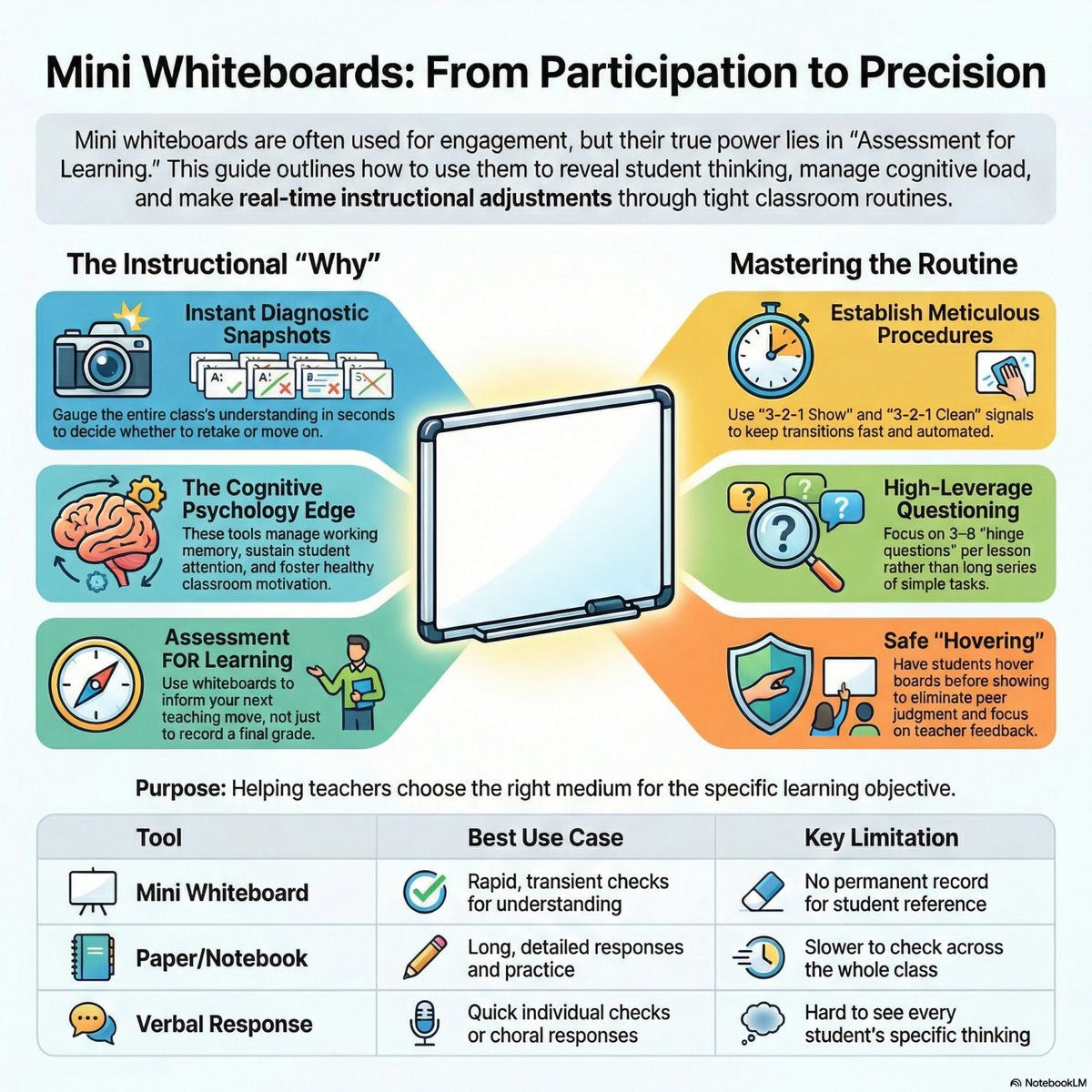
I can't imagine teaching without mini whiteboards and yet last year was my first year ever using them. Looking back, I realize I need to practice white board routines on day 1. I will be starting instruction on day 1. They can get to know each other and I them "while" we are working not "separate" from working.
@AmberBHaven@AndrewWatsonTTB@SoLInTheWild@bamradionetwork https://t.co/tWU40sQQ8g
I've had a lot of teachers ask if they could simply get access to my entire Google Drive resource library.
So here it is.
Inside you'll find thousands of classroom resources I've created over the years, and I'll continue adding new materials as I make them, so the library will keep growing over time.
If you find the resources valuable and would like to support my work, you're welcome to make a donation here.
Thank you so much for your support. It truly means a great deal.
Donate Here: https://t.co/Kh3vNM6AVt
Link to Google Drive: https://t.co/mXFYuqOMX6
Also, if you know other educators who might benefit from these resources, I'd be incredibly grateful if you shared my email newsletter with them. Word of mouth makes a huge difference and helps me continue creating and sharing free resources. Thank you for your support!
Link to Newsletter: https://t.co/PN25xeYl5A
Thank you again for your generosity and support. It truly means more than you know.
—Brian
A man spends 50 years teaching at MIT.
He knows his time is running out.
So he records one last lecture—
everything he knows,
distilled into a single hour.
He died 5 months later.
This is that lecture.
The most important hour
you'll watch this week.
👇 Bookmark it for later
A community college professor named Marty Lobdell taught the same study skills lecture for 30 years. The video quietly became one of the most watched educational recordings online, with over 10 million views.
He spent his career watching students fail not because they were lazy, but because no one had taught them how their brain actually works when learning something difficult.
The lecture, “Study Less Study Smart,” contains a powerful framework.
Your brain cannot sustain focus the way most people believe. Studies show the average learner hits a wall between 25 and 30 minutes. After that, efficiency collapses. You’re still sitting there, but almost nothing is being absorbed.
Lobdell told the story of a student who planned to study 6 hours a night, 5 nights a week. Thirty hours total. She failed every class. She was not lacking effort. She was confusing time near books with actual learning. The fix is simple: when focus drops, stop, take a 5 minute rewarding break, then return. That reset makes a massive difference.
He also destroyed the myth of highlighting and re reading. Recognition is not the same as recall. To prove it, he read 13 random letters. Almost no one remembered them. Then he turned them into “Happy Thursday.” The entire room recalled them instantly. The brain stores meaning, not repetition.
This is why elaborative encoding works so well.
Finally, he shared the most important principle: 80 percent of study time should be active recitation. Close the book and explain the material in your own words. Teach it to someone else or an empty chair. Retrieval is where real learning happens.
His closing line stuck with me: If this information does not change your
behaviour, you have not actually learned it.
The best students do not study more hours. They stop confusing the feeling of studying with the reality of learning.
Another standout from ‘Live Anthology: From the Vault Vol. 1’—“County Farm,” recorded in 1997 at the Fillmore in San Francisco, CA.
‘The Live Anthology - From the Vaults, Vol. 1’ is out now in an ultra-limited stormy cool blue edition exclusively in the Tom Petty Store. Curated by Tom himself, these performances were handpicked from decades of The Heartbreakers’ legendary live performances.
Grab your copy now before they’re gone! https://t.co/a5ZeqevCiO