For years, a Qubic smart contract could think but it could not touch.
It could run any logic you gave it. But everything stayed trapped inside the chain.
It could not move a coin on another network.
It could not tell an outside system to do anything.
That changes in about 8 weeks.
Final piece of a three-part system. 🧵
Qubic smart contracts are about to be upgraded.
Our latest Tech on Deck AMA broke down Outsourced Computation: the system that lets smart contracts send authorized instructions off-chain and act on Bitcoin, Ethereum, or any external system.
451 of 676 computors must sign before anything leaves the chain.
Testnet mock: June 17
Mainnet mock: July 1
Go live: July 29
Energy was never meant to be wasted.
Qubic turns proof-of-work into the work itself: computation that trains AI with purpose.
No staking. No idle burn. Just useful work.
This is not mining as you know it. It's Qubic.
Watch.
Last week the Qubic science team let you watch artificial creatures evolve in your browser. That version reset every time you loaded it.
This one does not.
NeuraxonLive is a single world that runs around the clock and keeps running. The creatures in it forage, mate, sing, and die on their own.
None of it is scripted. When one dies it stays dead, and there is a permanent ranking of every creature that has ever lived in the world.
Each creature carries a brain built on the general-intelligence design from last week's release. So you are not watching a replay. You are watching selection actually shape these things in real time, and if you zoom in, you can hear them.
You can drop your own creature in. The first season is live now, capped at 500 creatures with 100 custom slots. Whether your line survives or dies out is decided by the world, not by you.
It is fully open source, so you can also run your own world on your own machine.
In the 1960s, the US and Soviet Union both launched rockets. Both burned the same fuel. Both pushed the limits of human engineering.
One program put a man on the moon. The other proved it could.
Bitcoin mining is the rocket that proved it could. Qubic is the one going somewhere.
On Qubic, the computors aren’t racing to stamp out a number. They’re training an AI.
The proof of work and the work itself are the same thing.
Every cycle goes into building something that didn’t exist before, something that actually matters.
That something has a name. Aigarth, an AI the network has been growing from scratch for four years.
And it’s about to get even faster and more coordinated.
A protocol upgrade called the Anthill is coming.
Until now, every miner searched for answers on their own, thousands of people digging random holes hoping to find gold.
Once the Anthill lands, each miner builds on where the others left off, the way ants reinforce each other’s trails until the whole colony moves as one.
The work of one starts making the work of everyone else better.
Same energy bill, yet a completely different destination.
In 1904, a psychologist noticed something strange about school kids.
The ones who were good at math were also, on average, good at French. And music. And subjects that have nothing to do with each other.
There seemed to be one hidden thing underneath all of it. He called it g. General intelligence.
The single thread that runs through every kind of thinking, not just one skill. It is one of the most studied ideas in the history of psychology, and it has almost always been about humans.
The Qubic Open Science team just pointed it at machines.
They released Neuraxon Game of Life 5.0 Lite & Research. Inside it, tiny artificial creatures (NxErs) grow their own brains and compete to survive.
The new part: this version selects them for g. Not for being good at one task. For the general thread that makes something good at many.
The brains are built on a real model of human cognition, six functional regions, the same framework psychologists use to map how our own minds are organized.
And you do not have to take anyone's word for it. It runs in your browser. You can watch the creatures evolve, generation after generation, right now. Psychology, neuroscience, and artificial life, colliding in a tab you already have open.
A deeper write-up is coming.
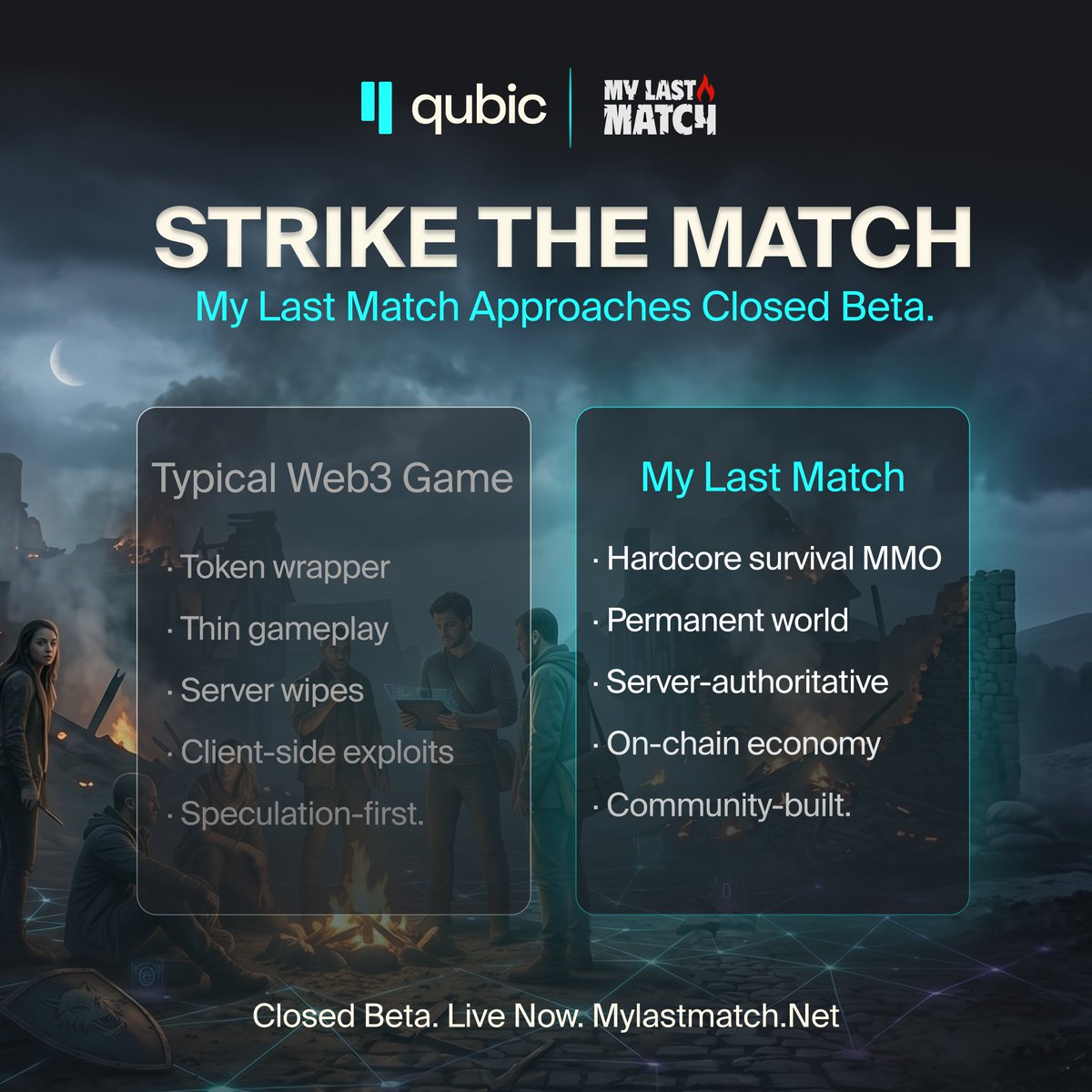
Most Web3 games are card battlers, idle clickers, or breeding sims with a token attached.
The gameplay exists to justify the token. Not the other way around.
My Last Match took the opposite approach. 🧵
Every seven days, every seat on the Qubic network is up for re-election.
676 Computors. Every seat is earned through useful work. Every seat is re-earned the following week, or someone else takes it.
Here is how it actually works. 🧵
Qubic just increased its per-tick transaction capacity by 4x.
The parameter moved from 1024 to 4096 transactions per tick today. Every tick of the network can now process four times as many transactions as it could yesterday.
Why now?
Look at the trajectory.
Epoch 210: 200 million transactions in seven days.
Epoch 211: 226 million.
Epoch 212: 246 million.
The load is climbing, driven by DOGE share validation flowing through Oracle Machines plus organic smart contract activity.
The core tech team raised the ceiling before it became a constraint, adding 4x headroom ahead of demand.
That usually only happens when the team knows exactly what they’re doing 😉.
A smart contract is like a vending machine.
You put in the right input. The machine checks the conditions. If they match, it automatically gives you the output. No person in the middle is deciding whether to process your request.
That part is the same on every blockchain. Here is where Qubic’s vending machines work differently.
On Ethereum, every vending machine runs inside a slow simulation (the EVM). You pay a gas fee every time you press a button. The busier the network, the more expensive the button press.
On Qubic, the vending machine runs directly on the hardware. No simulation layer. The contracts are written in a subset of C++ and compiled to native machine code. Faster execution. Lower overhead.
And here is where the economics work differently: you, the user, do not pay gas fees.
The vending machine pays for itself. Before a smart contract goes live on Qubic, its shares are sold in a public Dutch auction (IPO). The proceeds fund a reserve that covers the contract’s compute costs. When the contract executes, fees are deducted from that reserve, proportional to the actual computation performed. Not from the user’s wallet.
If the reserve runs dry, the contract goes dormant. It can still receive funds, but its core functions pause until the reserve is topped up. Any funds you sent to a dormant contract get returned automatically.
Read-only queries are always free. Checking a contract’s state costs nothing regardless of reserve status.
Every execution burns QU from the reserve. More usage means more burns. The contracts are deflationary by design.
One more thing. Qubic’s smart contracts can check real-world data before they execute. Prices, weather, external validations. That is what Oracle Machines do. A contract that can read the outside world and act on it is more useful than one that cannot.
Before any of this happens, 451 of 676 Computors must vote to approve the contract. The network collectively decides what gets installed. Not a company. Not a foundation.
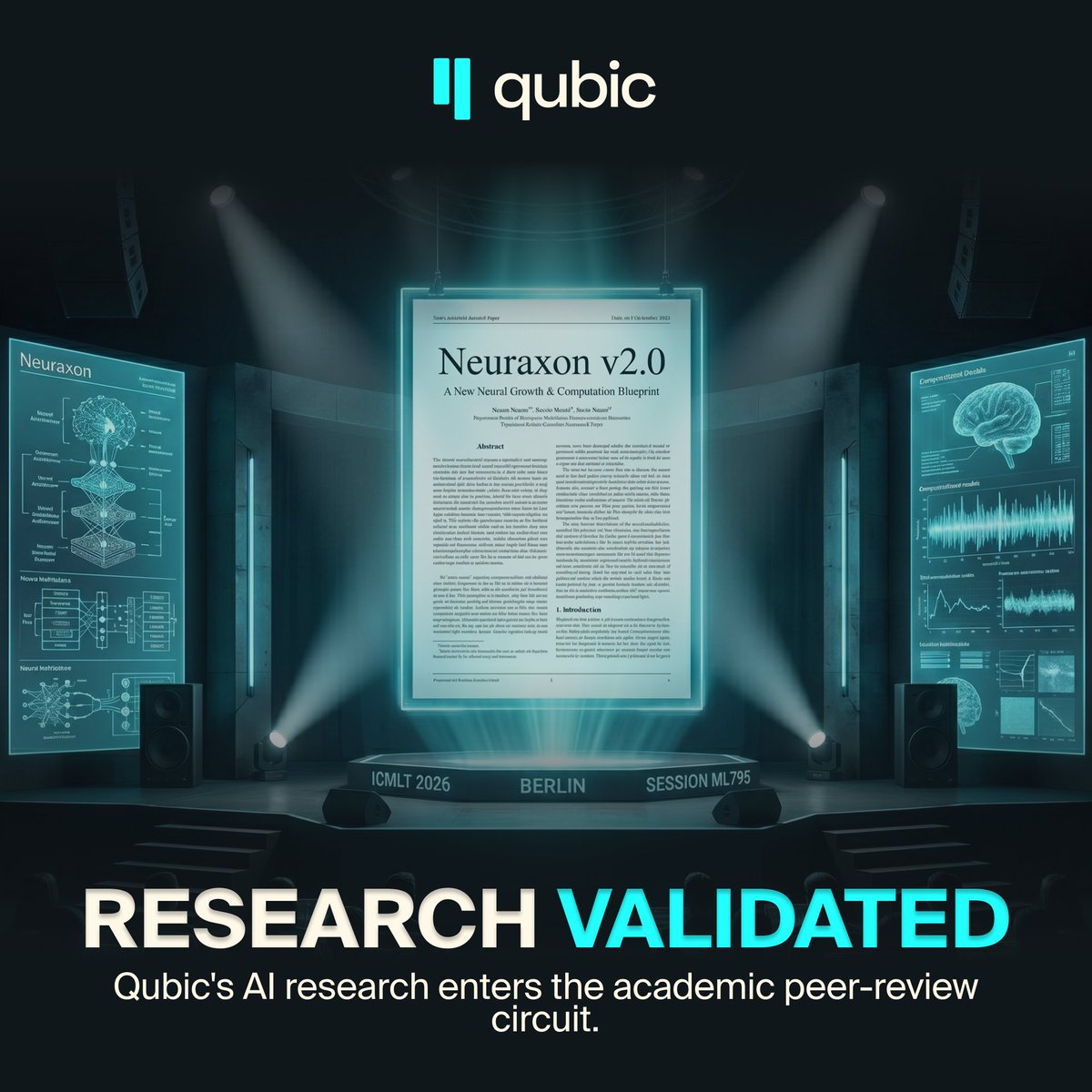
Qubic Science is presenting a peer-reviewed paper at an IEEE co-sponsored conference this week.
ICMLT 2026. Berlin. May 20-22. Session ML795.
“Neuraxon v2.0: A New Neural Growth & Computation Blueprint.”
While most crypto AI projects are announcing, Qubic is presenting.
Authors: @VivancosDavid and @josesanchezhb.
Neuraxon is not a language model like ChatGPT. It is not a wrapper on top of transformers.
It is a bio-inspired neural architecture built from scratch, modeled on how actual biological neurons grow, connect, and adapt in continuous time.
Trinary dynamics. Neuromodulation. Astrocytic gating. Criticality at the edge of chaos.
What peer review means in practice: the work gets indexed on IEEE Xplore and Scopus.
It enters the scientific record.
It gets cited, challenged, and built upon by researchers who have no financial stake in Qubic.
Four years of building.
The science is now entering the room where it gets tested by people who did not build it.
We compiled six epochs worth of DOGE mining data on Qubic (Epochs 207–212, April 1 to May 13) into one full profitability breakdown.
What the data from that period showed:
→ $1.23/GH/s per day on Qubic vs $0.58 on traditional LTC+DOGE pools
→ 48% to 111% higher revenue depending on the epoch
→ $117.46 extra from a single rig over just two weeks
→ 97 blocks found. 970K DOGE mined. $111K earned.
These are the verified baselines. The pool has only grown since, with ATH hashrate hitting 119.71 TH/s and a peak network rank of #7 in Epoch 213.
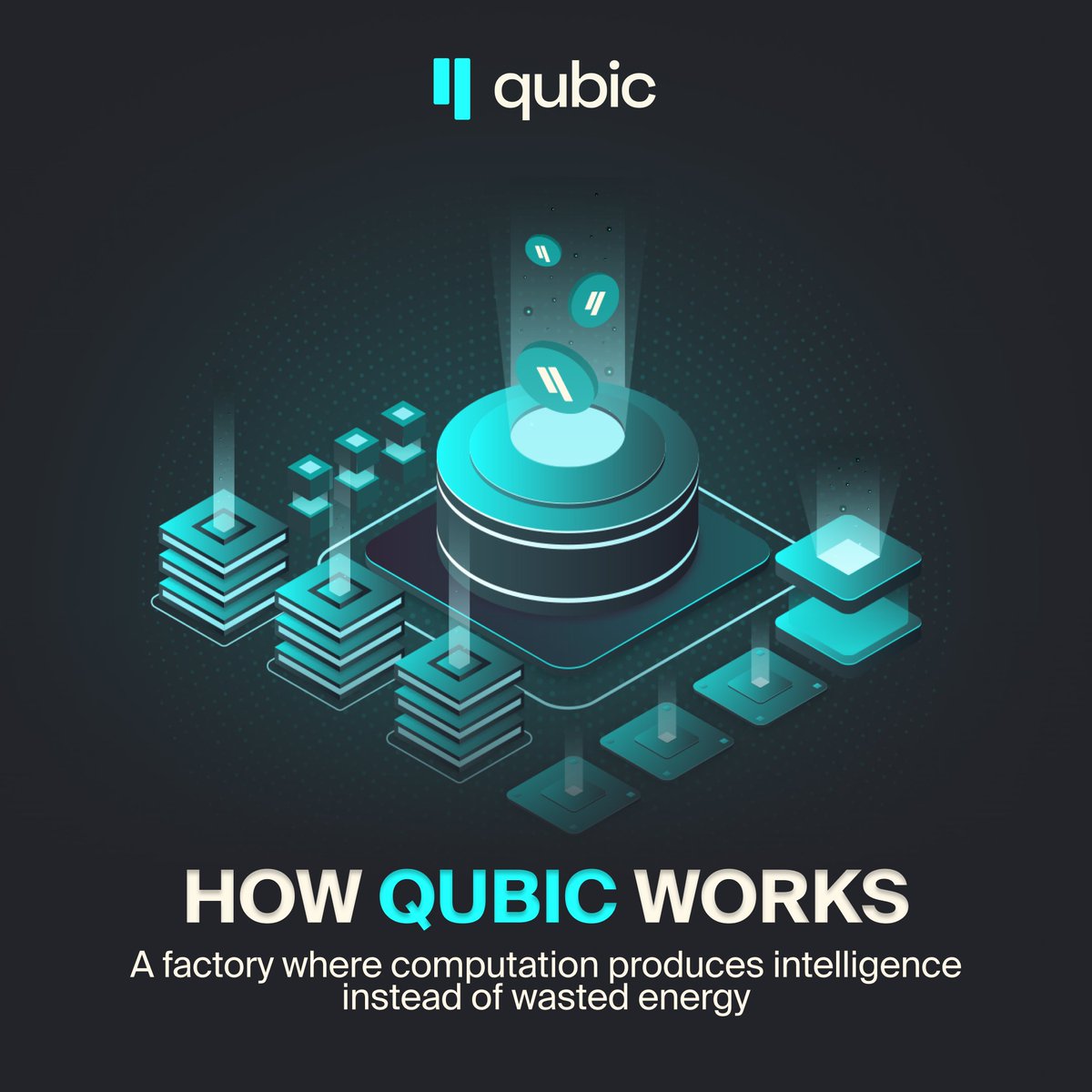
Most blockchains operate like a factory where every worker clocks in, shreds paper all day to prove they showed up, then clocks out.
The paper shredding is the job.
That is Bitcoin mining.
Qubic is different.
The electricity burned on this network trains AI. The compute produces a real output, not proof that electricity was spent.
Here is how the rest of the system works.
676 floor managers (called Computors) inspect every product (transaction) before completion.
For anything to leave the factory, at least 451 of them must sign off as a quality assurance check.
That is 66.7% agreement.
If a bad product slips in, the majority catches it before it reaches the door.
Every seven days, the factory resets.
Managers who did not pull their weight get replaced by ones who did.
You do not keep your seat by seniority. You keep it with measurable output.
There are no transaction fees for sending and receiving QU.
When a smart contract executes, the cost comes from the contract's own reserve, not from the user's wallet.
The factory's services do not bill the customer at the counter.
And here is the part most people miss: every time someone uses the factory's services, a small amount of its internal currency gets permanently destroyed.
The more people use it, the scarcer the currency becomes.
That is the whole system.
Workers train AI. Managers verify everything by supermajority. Seats rotate weekly. Fees are zero. Usage burns supply.
Four years running.