Microsoft 1986 vs Anthropic 2026
- When MSFT IPO'd in 1986, the world's biggest company was IBM (~$73B). Microsoft listed at ~$0.7B under 1% of IBM. It had to 100x just to match the #1
- If Anthropic IPOs at ~$900B, the world's biggest company is Nvidia (~$5.2T). Anthropic would list at ~17% of Nvidia, only ~6x to reach #1
Another way to look at it:
MSFT's IPO was 0.004% of world GDP, a rounding error.
Anthropic at $900B is ~0.8% of world GDP / ~3% of US GDP, as a single company, before it lists.
Looks like the huge returns that AMZN (6300x) and MSFT (4400x) gave the public markets, can't be repeated by Anthropic.
Anthropic has confidentially submitted a draft S-1 registration statement to the Securities and Exchange Commission.
Pending completion of SEC review, this gives us the option to pursue an initial public offering.
Read more: https://t.co/onGZAhRLvD
My biggest takeaways from @benedictevans:
1. We’re in 1997 for AI—it’s as big a deal as the internet or mobile, and only as big a deal as the internet or mobile. We’re at the stage where most stuff kind of doesn’t work yet, most of what people will build hasn’t been built, and it’s not clear how any of it will work when it does. Some people in tech have bought clusters of Mac Minis, while even among 13-to-18-year-olds, only about 15% to 20% are daily active users of AI. The companies that win may not exist yet, and the use cases that matter most are probably invisible to us today.
2. Every technology wave brings ways to ruin people’s lives, deliberately or by accident, and we need to be conscious of that without panicking. Every wave of technology—databases in the 1970s, social media in the 2010s, AI today—creates new ways to harm people. We need to be conscious of these risks, build safeguards, and hold people accountable. But we also can’t let fear of potential harms stop us from capturing the benefits. The goal is thoughtful deployment, not paralysis.
3. Things will probably be okay—but “on average” hides a lot of individual pain. We’ve been automating jobs and creating new jobs since 1800. Each time, you can see the jobs that will disappear but not the new jobs, because they don’t exist yet. We go through frictional pain, dislocation, people lose jobs, towns get hollowed out, and it all sucks. But we come through richer, and we’re not worried about crops failing anymore.
4. If you’re worried about your job, the worst thing you can do is stick your head in the sand and declare AI evil. Yes, some professions face major questions, particularly if you’re an associate or would have been thinking about becoming one. The pyramid structure of professional services may fundamentally change. What helps is submerging yourself in AI, understanding what you can do with it, how it changes things, and how you can be a great hire in this new environment. That may still not be enough, but it’s the only path forward.
5. The history of accounting shows us how automation often increases employment rather than decreasing it. Despite adding machines, punch cards, mainframes, databases, ERP systems, cloud software, spreadsheets, and PCs, the number of accountants keeps going up. This is the Jevons paradox: when you make something cheaper or easier, you don’t do the same amount of work for less money. You often do vastly more because the ROI changes.
6. Distribution is becoming a more valuable moat as software gets easier to build, which favors incumbents. As AI makes building software cheaper and faster, the market gets noisier. More products launch, more companies compete for attention, and breaking through becomes harder. This means distribution—the ability to reach customers and get them to use your product—matters more than ever.
7. Foundation AI model companies won’t have lasting pricing power, and value will likely accrue up the stack. The models don’t seem to have network effects, so there’s no winner-takes-all dynamic. If you have indefinite competition between three to six foundation model providers, and the models look like undifferentiated commodities to users, why would anyone have pricing power? The current pricing chaos—people spending $1.5 million on inference in a month—is temporary disequilibrium, like someone getting a $50,000 mobile data bill in 2010. The steady state will look different.
8. OpenAI and Anthropic are buying consultancies and PE firms. This seems counterintuitive—aren’t these the companies that should need consultants least? But the reality is that companies don’t have people sitting around waiting to reimagine all their internal workflows and figure out which could be automated with AI. That’s a project requiring five to 10 people spending months working it out, then actually implementing it across vertical and horizontal systems.
9. The fundamental question isn’t whether AI automates your job—it’s whether your profession is a "task" or a job. Some jobs are just tasks, and when you automate the task, the job disappears (i.e. elevator attendants). But in most professions, the task you think you’re being paid for isn’t actually what you’re being paid for. McKinsey doesn’t get hired to produce a 75-slide deck—they get hired to walk through your enterprise, understand the politics, talk to customers, and figure out what you actually need to do. The deck is just the artifact.
10. The anti-AI backlash is real, and a fuzzy mass of different concerns, some real and some not—much like the social media backlash. There are tangible concerns: electricity bills went up in some places, though this applies to very few locations objectively. The water consumption issue is largely false; data centers use about 0.017% of U.S. water consumption. There are real questions about jobs, though economists can’t yet find clear consensus in the data about AI’s employment impact. There’s also the culture war over AI-generated content and “AI slop.” The challenge is that all of this creates political pressure even when the underlying facts are unclear or contested.
The end of the software era is the beginning of the harness era.
The LLM is the smallest part of the system. The harness around it does the work.
7 components separate a demo from a production agent : 🧵
This is the brutal new reality for people starting bootstrapped SaaS in 2026.
A few thoughts on how this might play out for bootstrapped builders in 2026:
- distribution was always an important thing, now it's the ONLY thing. The climbing gym software backed by the climbing influencer is the one that wins.
- niche down even more, accept lower revenues. Be the best climbing gym software in the EU that handles specific insurance and data requirements
- don't bother building software, just help other businesses implement AI and secure the consulting bag.
It's so interesting, I find myself on both sides of the AI SaaS Squeeze and I'd love some thoughts.
On the one hand we've got a ton of SaaS portfolio companies, and the market has suddenly gotten brutal (see below).
On the other, I'm also now an SMB owner with @bkup_climbing. 6 months ago I needed to choose some climbing gym SaaS to run the business. Despite there being ~10 companies making dedicated climbing gym software, they were all terrible. But my plan was to still pick the least bad one because building and maintaining SaaS was hard.
But it suddenly become very much not hard. I finally gave up and built dedicated software to run our gym... it took 2 weeks to build everything we needed. A massive scope: membership billing, CRM, marketing automation, check-ins and front desk, digital waivers, events, inventory and point of sale, tap to pay terminal integration, marketing automation, mobile app... all of it, done, working just like i want it, trivial to maintain and improve.
With a v1 for our gym, I set a team of agents to the task of turning it into a best-in-class multi-tenant SaaS product for other climbing gyms. Which is now also, amazingly, done.
As we onboard beta users, I'm wondering what the right strategy is. i'm overall not very optimistic about the future of the standard issue vertical SaaS business model, so I think a radical reconsideration is warranted. Something like:
- give the core SaaS away for free, but charge ~$1-2k/mo for a dedicated AI agent that can use the app for you.
- open source it entirely, but charge for customizations and tweaks
- some kind of WordPress model where the core software is free but very useful plugins are paid
- something I'm not thinking about at all
Thoughts?
See also, the AI SaaS Squeeze: https://t.co/bnXAJyQ1yK
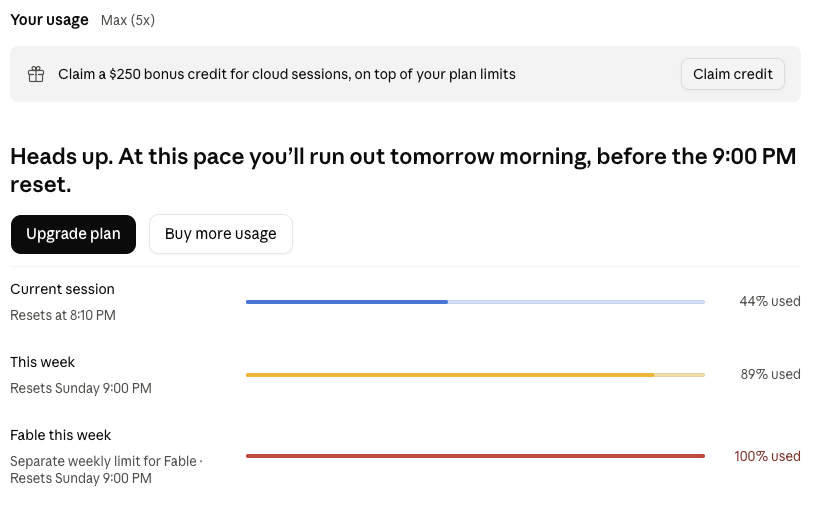
Everyone migrating from Claude Code to Codex is probably just buying themselves 2 - 3 months at the token buffet.
Neither Anthropic nor OpenAI can fight the gravity of economics.
The end game for this is that devs using a harness interactively will be able to use an all-you-can-eat subscription. Automated / background agentic dev work will be billed at PAYG rates.
I suspect we'll see an 80/20 split of background / interactive work.
- research calls at problem / solution fit search vs product / market fit search
- how to balance early stage sales with early stage validation
- mom test 101
- How does AI in 2026 change the game? E.g. quick and free to build stuff to test, should we just test the thing and validate that?
I’ve confirmed that Context .ai was “audited” by Delve for SOC2
Redirects now deleted but https://t.co/o3dRukNdBn used to redirect to Delve themselves
You cannot make this up…
I listened to my fist AI generated podcast yesterday and it was genuinely excellent.
I know NotebookLM is old news but I finally had a use case for it.
Yesterday I walked along the Thames from North Greenwich to Woolwich. It's one of the less famous stretches of the Thames, but I wanted to learn about the history of that area.
NotebookLM generated me a 20 min podcast which I could listen to as I walked. Two remarkable things:
1) the content and delivery was good enough to keep me listening.
2) the subject was super niche but excellently researched and brought to life.
The future for personalised content is going to be interesting.
@ryancarson Also going down an AI for marketing rabbit hole. Next step is using these skills with @dataforseo API for doing deep keyword research https://t.co/TZyYvbg5VV
Delve is fishy AF and I wouldn’t touch them with a barge pole
BUT
You have to think: who has most to gain from delve-gate? Why is it anonymous? Who would benefit from taking out a plucky upstart?
An entrenched incumbent? A pluckier upstart?
Or perhaps it’s just a truth-seeking ethical journalist.
There’s been a lot of allegations against Delve.
But we haven’t been able to share our side of the story until today due to ongoing cybersecurity and forensics investigations.
Maintaining customer trust is central to everything we do.
That said, we grew too fast and fell short of our own standard. To our customers, we deeply apologize for the inconveniences caused.
We take these allegations seriously and have made changes: a new auditor network, free re-audits and pentests for all customers, enhanced transparency in audit communications, and more.
However, we also want to set the record straight on the anonymous attacks.
The evidence we have points to a targeted cyberattack from a malicious actor, not a “whistleblower.”
We believe the attacker purchased Delve under false pretenses, exfiltrated internal company data, and used it to launch a coordinated smear campaign.
The posts rely on a mix of fabricated claims, cherry-picked screenshots, and stolen data taken out of context.
See the link in the comments for more details.
Delve was built to modernize compliance. We are not going anywhere and are committed to building what's next.
OK, this is working great for my sample Q&A pairs, but problem is there are only 4 pairs in my test and we send them all up in the system prompt. IRL we're going to have 200+ Q&A pairs, that's going to burn through tokens.
Time to move from PoC to bake it into the app and make use of having a DB.