@gro_tsen 5 is of the form 4n + 1, so there are primitive Pythagorean triples a² + b² = c² with c = 5ᵐ for every m (says Wikipedia). From one of these we get (2ᵐa/10ᵐ)² + (2ᵐb/10ᵐ)² = 1. It remains to show that we get different points for different values of m...
@sarah_zrf Yeah I'm not satisfied with this story. The idea is that P is in the image of the pullback functor π* because it's "well-behaved", so if we have colim(P) ≃ X we get P ≃ π*(X). In other words we can use descent for well-behaved things. This feels very roundabout.
@sarah_zrf I think so; my guess is that since a topos has a subobject classifier all colimits are (-1)-van Kampen, just like all colimits are van Kampen in an ∞-topos because it has object classifiers.
@sarah_zrf Yeah, the particular delooping I have in mind is the type of 2-element types (so, types merely equivalent to Fin 2). |I| is just the underlying type of I. See https://t.co/nNhNsiLK7U
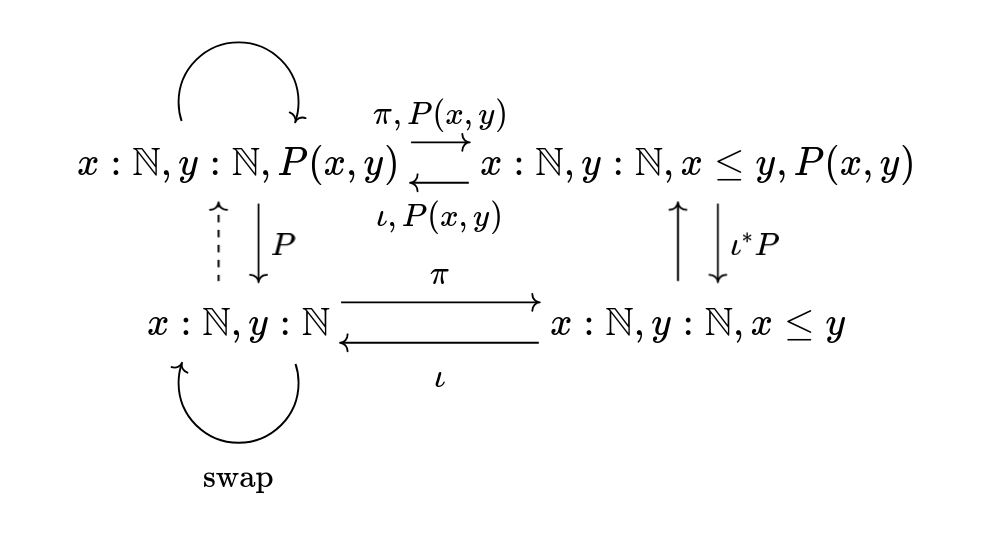
@sarah_zrf We get this by universality if we can show that the top diagram is a quotient, which I think is easy enough if P is well-behaved (there's probably a more abstract argument here...).
@sarah_zrf I think it looks like this: we have a section of ι^* P and we want to get a section of P, so it suffices to prove that the square formed by π is a pullback. /