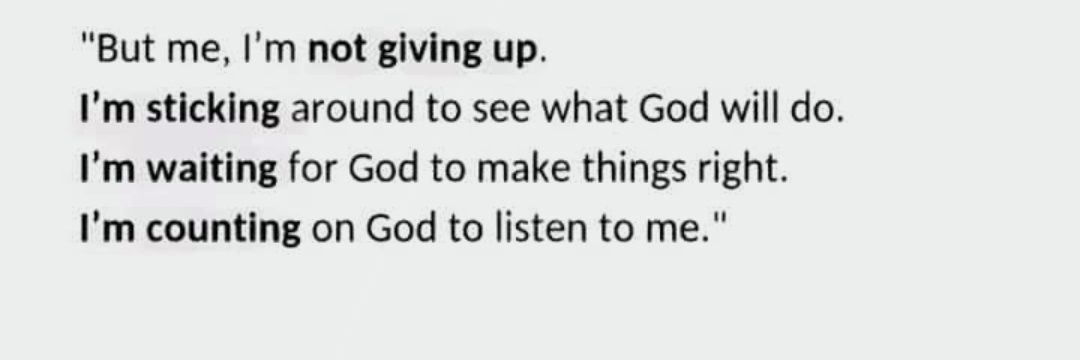
It's gonna be a long, long journey ahead. I strap the promises of God in my heart, adorn the lessons of my life, and the teachings of His Word in my mind. No matter what may come, I will make for a beautiful story. So help me, God.
@JackOfFaces On June 9th, my birthdate, I went back to my college years later & I felt the girl I was back then, trapped in those corridors. She was lost, disoriented & weary. I went to the field and wept among the trees. I repented, picked her (myself) up and promised to be present and aware
If you look at Christians with a secular mind, what they do is a sign of mental illness.
Imagine someone standing by the road side, under the sun and shouting "Jesus died for you"
Imagine someone standing up randomly in a bus/train/plane just to discuss about an event that happened 2,000 years ago.
As a lukewarm Christian, i questioned so many things, i thought it wasn't necessary.
Seeing Christians do that made me feel uncomfortable.
Until i encountered Jesus Christ.
I was in deep struggle, walking down a path that was leading to death, until i experienced his saving power.
I was saved, redeemed and he gave me a new name.
This made me understand why those Christians had to "disturb" everybody with their message.
They found something money could not buy
But the world never stopped mocking them for their testimony.
Jesus saved me, and now i have become what i once criticized!
The amount of respect you command is a direct byproduct of how high functioning you are, for high stress tolerance commands respect where low stress tolerance undermines it.
In simple terms: if you can outwardly handle stress with greater composure than others, you will naturally command more respect than they do. Respect thus accrues not as a conscious decision, but as an instinctive response to your conduct.
People will subconsciously evaluate your competence, placing you into one of two categories: asset or liability. If you are consistently steady under pressure and difficult to unsettle, you are deemed an operational asset, but if you collapse emotionally, offend easily, or routinely punish others for telling hard or sensitive truths, you will flag as a liability.
Respect and authority flows to those who are deemed assets. Would you want a leader with poor stress tolerance who is prone to outbursts, collapse or destabilisation? Of course not. That would unsettle you. You would prefer someone who remains poised under pressure, because you would feel safer with someone with an exceptional capacity to metabolise stress even beyond what is objectively healthy or humane. Leadership as such gravitates to those who are able to bear more than their fair share of stress, not to those who impose their emotional turbulence on to others the very moment they are subjected to it.
You seek someone unnaturally strong, who is capable of carrying not just their own burdens, but likewise yours. But you are neither unique or alone in holding that preference, for it is the underlying mechanism which determines how people intuitively designate leaders. To desire authority over others whilst being a source of emotional turbulence is thus not just naive, but incredibly immature. Authority necessarily then gravitates to those who serve the most stabilising function, because when it is given to the incapable, it results in dysfunction and tyranny.
High functioning individuals inspire trust, because they manage destabilising, urgent, or sensitive information without unravelling. Low functioning individuals erode trust, because they amplify chaos, crumble under pressure, and turn urgent or sensitive matters into liabilities, thereby imposing burdens which others are forced to carry in their place.
This is why if you want a relationship built on full and clear mutual transparency, you must be able to bear the costs of what you ask for. Both sides must be capable of absorbing shocks, disappointments, conflicts, and unpleasant truths without collapsing into hysteria or destructive anarchy. Respect simply is not owed, but earned. You are not entitled to what you have not proven you can endure, for it is the weight you are unable to carry that will define the limits of what others can trust you with.
My husband said that when he was a kid he told his dad he just wanted to have fun. In response his dad said, "Son, the people I know who have the most fun are the most miserable."
People always think they're giving up something up by becoming responsible, dedicating their life to a greater calling, saying "no" to the immediate pleasure, doing the difficult thing, but the rewards are bountiful and beautiful. People who pursue fun at all costs always suffer for it. They are like children, bouncing from one whim to the next, unable to see that their slavery to their impulses is the source of their unhappiness, and not the fact they haven't found the "right" fun thing.
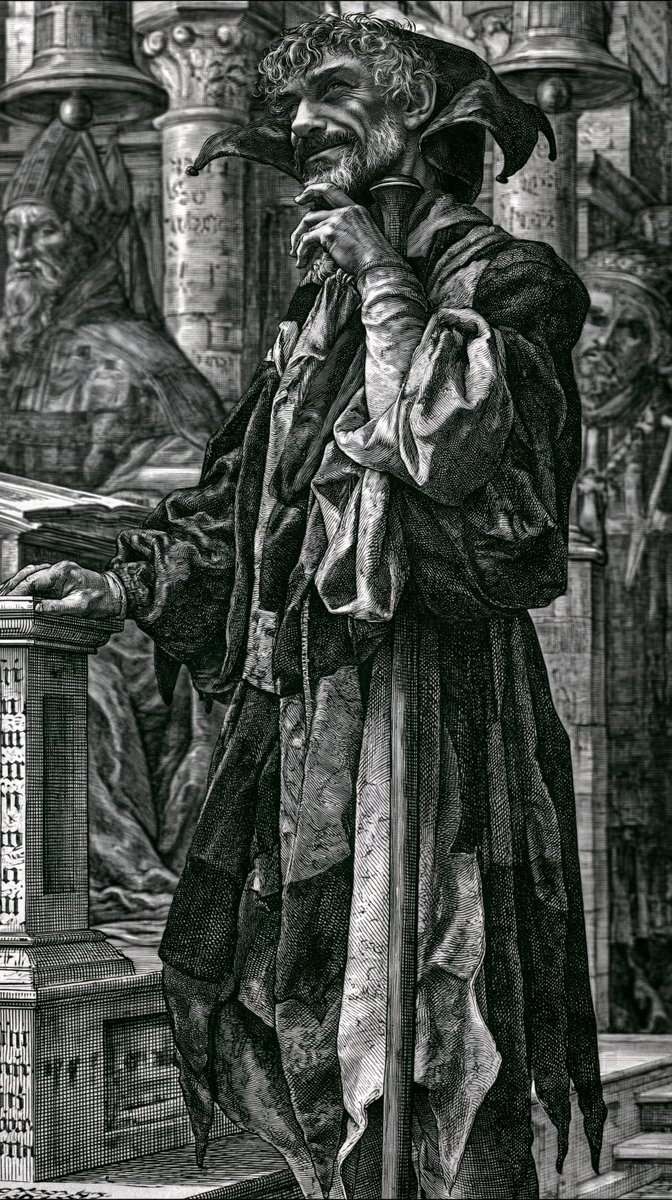
THE JESTER'S MANUAL
Nobody poisons the fool. In twelve hundred years of court service I have watched poison find kings and bishops, generals and bankers, and more prophets than I care to count, yet it never once found me, and the reason is the oldest tactic in this manual, which I shall give away in the first breath: nobody fears the man they laugh at.
The laughing man walks out of burning kingdoms carrying secrets that everyone else died protecting.
You wish to know what sits behind thrones. I am perhaps the only man alive qualified to answer, for I have served khans beneath felt tents and doges in sea-worn palaces, emperors under gold ceilings and ministers under electric light, and through all those centuries the costumes changed while the thing beneath them never did. In every court the ruler believed he ruled and the treasury believed it counted, and behind them both sat the same quiet arrangement of seals and levies, records and signatures, permissions and fears.
A man may forgive one coincidence, or a dozen. After enough centuries I stopped forgiving them altogether.
It is a parasite. After twelve hundred years I still cannot tell you what it is made of, but I can tell you precisely what it eats, for I have watched it feed in every kingdom I ever danced in. It eats consent. It eats fear. It eats attention. And I can tell you its weakness, which is the foundation of everything that follows: it cannot take. It must be given. Every hook in your flesh entered through a door that opened from the inside.
Before I teach you the counters, learn the attacks, for there are only seven, and in all my centuries it has never needed an eighth. There is the urgent paper, which arrives with a deadline because deadlines outrun thought; understand that the urgency is the weapon and the paper merely its carriage. There is the borrowed voice, for the thing never speaks as itself but as duty, as guilt, as your neighbour's opinion, as your fear for your children, and if a thought in your head sounds like a committee, it was not your thought. There is the small yes, by which empires conquer in instalments, since nobody loses his freedom all at once. There is the manufactured enemy, by which the herd is pointed sideways and never upward, and you would do well to ask who paid for the pointing. There is the honoured cage, for the warmest prisons come with titles, and the most loyal prisoners I ever met were decorated ones. There is the endless form, because where force fails, exhaustion begins, and I have seen men bled white by paperwork who would have died gladly fighting on a wall. And there is the sleeping season, in which the thing vanishes for years so that you forget it exists, though it has merely gone to feed in another hall. That last move fools every man exactly once. Let your once be already spent.
Now the counters. There are seven of these as well, each one tested upon living tyrants, and each carries a failure mode, which the prophets never tell you and I will, for a manual that hides its casualties is a sermon.
The first is the bell: one clean sound, held until it dies completely. The Parasite feeds on your inner noise, that endless argument you carry through the day with the levy, the official, and the fear, for noise is attention and attention is the feedstock, and one sustained tone cuts through the chatter as nothing else can. The monasteries have known this for two thousand years. In a plague year in Bohemia I persuaded a frightened queen to ring every cathedral bell at dawn with no explanation given, and the town stopped in the streets, and for one full minute ten thousand people were not afraid at the same time, and they felt one another not being afraid, which is the one thing the creature cannot survive. Petitions against the levy tripled within the week. But mark the failure mode: the man who rings the bell and then resumes the argument has accomplished nothing, for the bell is not the weapon. The silence after it is.
The second is the casting out. When the demand arrives, it goes into the bin, witnessed, with contempt and without ceremony, because power prices everything except indifference. Obedience pays it, and rage pays it more, rage being attention at a premium rate. In Venice I knew a spice merchant named Bartolo who shook so badly he could not unfold the levy paper, and understand what it had already done to him: the levy had not taken a coin and yet it owned his sleep, his temper, and his trade. I had him read it aloud in the square in the voice of a pompous senator, bow to it twice, kiss it once, and drop it into the canal with a little wave. The crowd laughed, and I watched the ownership leave his face. Twenty merchants saw the spell fail to kill him, three had binned their own papers by Friday, and the levy collapsed within two seasons, for fear had been its only enforcement, and the Doge's men could not arrest a canal. The failure mode is anger. A wool trader copied Bartolo a year later but screamed and wept as he did it, and the crowd saw a man drowning rather than a man set free, and he was in irons within the month. If you cannot do it lightly, you are not yet ready to do it.
The third is the decree: refuse once, quietly, and never repeat it. A claim is not power; a claim is a question, and bureaucracies ask endlessly, in subsections, knowing that whoever answers twice has accepted that the asker is the judge. Watch real authority sometime and you will notice that it lowers its voice and does not explain. I once stood before a cardinal who had been bought and signed and was three days from sealing a province's grain under the Parasite forever, while the whole court fought him with petitions, precedents, and duchesses weeping on schedule, every argument feeding him because every argument confirmed him as the judge of the matter. On the signing day I walked the length of the hall in motley with my bells stuffed with wool, stood before him, said quietly, no, and then sat down on the floor and ate an apple. A flat no with nothing after it gives a room nothing to refute. The notaries looked at one another, a duchess stopped mid-weep, and the deal died in the silence. He never signed. The chroniclers wrote that he foamed and collapsed, because exorcisms sell, but the truth is more useful to you: the counter was the period at the end of the sentence. The failure mode is hope, for the moment you hope the no will work it has become a plea wearing a no's clothing, and the creature smells the difference through a wall. I have watched ten thousand men say no with their voices and please with their shoulders. The shoulders always win.
The fourth is the ledger. Nothing enters without an opening, and every opening was once a consent: a debt, a subscription, a fear of the neighbours, a paper signed at twenty and forgotten, and what is unmapped cannot be defended. This is siegecraft, and I learned it from a siege engineer rather than a priest. A harried prince I once served discovered, after a single season of writing every assault down before reacting to it, that all of them entered through the same four doors, being a debt, a vanity, a rumour, and his brother's wife. He sealed three and simply stopped opening the fourth, and the assaults did not cease, but they ceased to work, which is better, for his enemies went on spending against doors that no longer opened. The failure mode is the audit performed once and framed. His own son inherited the ledger, declared the work complete, and hung it in the library, and was bankrupt within the decade through five new doors. The walls are walked monthly, or they are not walked at all.
The fifth is the jest, which is to say: make it ridiculous in public. Solemnity is load-bearing. The robes, the seals, the rising for the judge, strip away the gravity and the entire structure is revealed as men in costumes holding paper, and this is why mockery of the court is the one crime every court prosecutes personally. They are telling you where the wall is thinnest, and you should believe them. An emperor of my acquaintance demanded golden statues of himself in every square, paid for by a statue levy, and a decree of that kind cannot be stopped, only spoiled, so on the night before the unveiling I had the plinth engraved, beautifully, with the sculptor's invoice, fully itemised, including gold leaf, extra, for the modesty of His Radiance. He unveiled himself standing upon his own bill. The silence lasted four seconds and the laughter lasted ten years, and no man could be punished for it, because the invoice was accurate. Truth, properly formatted, is the one joke power cannot prosecute. The failure mode is bitterness. A pamphleteer of that reign, twice my wit, wrote from hatred instead of play, and his pages made men angry, and angry men are harvest, so the Parasite reprinted him in secret. Read that sentence again. The jest must be light, or you are working for them.
The sixth is the temple: ten minutes at dawn, every dawn, the attention turned inward and held. Strip away every mystical claim and the bones of it still stand, for the harvest is attention, your attention is finite, and whatever you do not reclaim deliberately is collected by default. I wintered twice with an order of fourteen monks in a province where the Parasite had taken everything, the land, the tithe, even the bell out of the tower, and yet it could not take the ten minutes. Officials would arrive with urgent papers and the abbot would read them at the speed of a man reading for pleasure, and the urgency died on the table between them, urgency having been the only weapon the papers ever carried. Within a generation the farmers were bringing their disputes to the abbey rather than the court. Nobody declared anything. The jurisdiction simply moved, ten minutes at a time. The failure mode is to skip the practice on the bad days, for the bad days are the harvest days, and the one brother who lapsed on terrible mornings was the one they eventually turned, because they made certain his mornings were terrible.
The seventh and last is the advance: forward on every front at once, slowly if need be, but forward without exception. Every system of control is built for siege; it keeps tables for everything a stationary man can do and a price for every fear of a static herd, but it has no table for motion. In the worst of the plague years, when the death carts and the tax collectors arrived together, and note well that they always arrive together, fear being harvest weather, a river town I loved wished to board its windows and wait, and waiting is the very thing the tables price best. I told them instead to advance all positions. We held markets in the graveyard because the rents were free, we made the plague masks into carnival until the children stopped screaming at them, and a widow opened a school in the empty customs house because no man dared collect customs any longer. None of it was bravery.
A population in motion cannot be priced, and within a generation the Parasite had moved on to easier ground, for it does not conquer; it harvests, and a moving herd is not worth the harvesting. The failure mode is to confuse the advance with victory. That town lost half its people, and the widow's school burned twice. The advance is not the absence of defeat. The advance is what defeat is not permitted to interrupt.
That is the manual entire: seven attacks, seven counters, twelve hundred years of testing, and no incense required. One last thing, and then I must be gone before the watch changes. Men ask how I have survived so long, telling the truth in courts that kill truth-tellers, and the whole teaching folds into a single line. I never once let them decide what was serious. The Parasite ruled every court I ever danced in, and it never ruled the fool, and it does not have to rule you.
The only men who get demoralised when a woman leaves them are men who do not have deep faith in their own journey and potential.
In that moment this woman is making a clear bet against your trajectory, your intellect, your drive and your spirit.
She is openly admitting she believes you will do nothing with your life. She is denouncing all things you could become and she would rather go and find a new man to please her as she has completely devalued you in her own psyche and mulled over your negatives to such a degree you repel and repulse her.
And you're sad? That is your response to her communicating toward you in the manner I outlined?
The only way you can overcome this is to utilise the piece of wisdom that the past is overwritten by the future, something that happens in the future will completely change what a certain event means to you both emotionally and psychologically
You must go and transcend your own prior limitations, you must go and attack the world, you must configure new ideologies and construct better plans to take forward into the world to overcome yourself and your shortcomings that made her embarrassed to be your woman, to such a degree she had to leave you.
You must far surpass any mental pictures or paradigms she had of you deep in her mental chambers. Only then will you know.
Only then will you know, you were right and she was wrong.
You must supersede yourself to give birth to new possibilities and confidence.
In superseding yourself you will have overwritten the past, your will to power can bludgeon the trauma you once felt, you alchemised and turned a wound into a womb that gave birth to something beautiful
@tii_bag I did everything na somehow inawork out. Shida hiyo time singeweka mpoa kazi ilikuwa kuwakatia alafu naenda away ndo apike nikule juu sina kitu kwangu alafu naangusha fimbo nikiwa nimejitolea mrembo anadhani ni game kumbe I’m trying to thank her for food na ndo nikaekae kidogo
If you spend enough time in environments where dark triad and cluster B behavior is normalized, you begin to mistake manipulation for sophistication.
You assume everyone is running social games at all times because that is the only reality you have experienced.
Yet the minute you encounter genuinely high-functioning people you realize they are not performing. They are not constantly destabilizing, humiliating, or competing for psychic dominance.
They simply build, create, host, work, and move through life without feeding on others. Once you see the difference, you recognize love without demonic possession.
If you don’t understand the rules of civilized society you end up trapped among uncivilized people. They injure you, betray you, exploit you, and ultimately force you to study the etiquette of higher society to survive.
Then you enter that more refined world and find out that directness is treated as vulgar while tolerance toward obviously nefarious people is rewarded so long as those people are socially ascendant and broadly liked.
Civilization does not eliminate cruelty so much as refine it into manners. From this contradiction emerges a second-order barbarism.
Effort and struggle are not the same thing.
One mistake people make is treating effort and struggle as if they mean the same thing.
Every healthy relationship requires effort.
You have to listen. You have to communicate. You have to make time for each other. You have to show care and respect.
But effort is different from constant struggle.
Watering a garden takes effort. Carrying a broken car uphill every day is struggle.
The strongest relationships often require regular attention but not endless repair work.
When people say relationships take work, they should mean maintenance, not survival.
There is a big difference between caring for something healthy and constantly trying to rescue something that is falling apart.
🤷♂️
Modern relationships often come with endless discussions about communication styles, emotional labour, attachment patterns, boundaries, triggers, and conflict management.
These conversations can be helpful.
But sometimes people use complicated language to avoid a simple truth: they may not be right for each other.
Not every relationship problem needs a new framework or another difficult conversation.
Sometimes two people want different things, they have different values. Sometimes they simply bring out the worst in each other.
No amount of relationship vocabulary can erase a basic mismatch.
A relationship should improve with understanding. If years of analysis still leave both people unhappy, the issue may be deeper than communication.
🤷♂️
If you are not willing to be mean to people who do not respect your boundaries and try to push you into behaviour that is bad for you, you will come to harm and lead a seriously shitty life.
If you do not protect yourself, you will be exploited and abused. That is the way of this world.
Feeling awkward or uncomfortable or afraid is not a reason not to do something.
If it is the right thing to do, you do it for that reason and that reason alone, and no other. Whatever the bad feelings or consequences that come with it are, so be it.
There was a young man who spent twenty years sharpening a knife.
Every morning he tested the edge.
"Not yet," he said. "A little sharper."
He sharpened it through promotions.
Through gym memberships.
Through self-help books.
Through plans and revisions and reinventions.
One day, an old woman passed by and asked why he looked so thin.
"I'm preparing to cook," he said as he held up the blade.
She looked at the knife which was now almost worn to nothing.
"My son," she said, "nobody eats a knife because the knife was never the meal."
At some point, sharp enough is sharp enough. You cook with what you have.
The sharpening may continue for the rest of your life, but it must stop being the reason you stay hungry because the tragedy was never that he kept sharpening the knife. The tragedy was believing the meal belonged to the finished blade rather than the hungry man...Dum perficior, vivo!
Another problem is that some of this students are not where they are supposed to be . National schools typically attract the top academics around the country. The competition is fierce and most students spend all their time studying. Then you find a county worker has bribed his way into this school with a strong D , those students really suffer ,and if their mind was suffering at home they just break ,when several of this D come together and the leader is a psycho that spells disaster.
Now if that D was placed somewhere with his fellow Ds they dnt feel so out of place .