The ANC had a once-in-a-lifetime opportunity to transform South Africa after Apartheid. Instead, they hesitated. They compromised. Now, three decades later, the damage is beyond repair, the markets rule with an iron fist, and wealth remains where it always was—untouched, unreachable. Sadly, the opportunity is lost—permanently.
(This post is quite long, so if you're too lazy to read, scroll to the last three paragraphs and then like and repost)
In the 1990s, the ANC believed it could dismantle the deep economic inequalities left by Apartheid while simultaneously ensuring economic growth and maintaining "investor confidence". If only they had looked around and seen what other kids were doing.
South Africa had the chance to pursue a different trajectory—one modelled on the success of post-1945 Europe, the Asian Tigers (Hong Kong, Singapore, South Korea, and Taiwan), China, and Russia under Vladimir Putin.
Had the ANC embraced a more state-led approach to development, strategic industrialisation, and financial reform, the country could have become what everyone dreams it could be.
There were many blunders, but the most significant missed opportunities were land and asset redistribution. The ANC’s adherence to the "willing-buyer, willing-seller" model resulted in a slow and useless land transfer, leaving wealth ownership patterns unchanged.
In contrast, Taiwan and South Korea didn't hope for miracles but instead implemented sweeping land reforms in the 1950s, breaking up large estates and redistributing land to citizens, which in turn laid the foundation for their rapid industrialisation. This is well-documented.
Similarly, Russia under Putin reasserted state control over key national resources, reversing previous chaotic privatisations. By reclaiming major industries—particularly in energy and mining—They ensured that national wealth was reinvested domestically rather than siphoned by foreign corporations.
South Africa could have taken a similar approach by redistributing land and assets through structured compensation models such as land swaps, government-backed bonds, and meaningful employee share ownership plans in key sectors, ensuring that Black South Africans gained tangible economic power without heavily destabilising White people's industries, something they evidently took seriously.
Black Economic Empowerment was meant to be a tool for redressing racial economic inequalities, but ultimately became a compromised attempt at transformation within the very neoliberal framework that ensured wealth remained in the same hands.
Instead of a radical restructuring of ownership and industrial power, BEE operated within existing market structures, reinforcing, rather than dismantling, entrenched patterns of economic control.
Basically, BEE made things worse, which makes sense since it was created by Harry Oppenheimer and his son, who had nothing to gain from economic transformation.
Industrialisation was another area where the ANC failed. Instead of prioritising manufacturing and high-value industries, the oldest liberation movement in Africa opted to rely on financial services and raw minerals exports, leaving it powerless against global market fluctuations.
This is why today the president cannot even fart without the financial markets giving him the go-ahead.
In contrast, China, South Korea, and Russia focused on state-driven industrialisation to stimulate domestic production and job creation. South Korea, under Park Chung-hee, and China, under Deng Xiaoping, both nurtured local industries through protectionist policies, government investment, and strategic trade liberalisation (N.B!).
Strategic trade liberalisation is crucial because it means these nations did not willy-nilly open up their countries, markets and industries to foreign competition until they were sure they were strong and mature enough to compete in the international markets.
On the other hand, the ANC and its capitalist advisors just flooded the country with foreign "investors" in the name of being "open for business".
In 2001, George Soros was clear, "South Africa is now in the hands of international capital."
South Africa could have established special economic zones offering specific benefits for Black business owners and then protecting these industries from international competition and using government purchasing policies to boost the demand for locally-made, especially Black business products. (President Jacob Zuma tried this, but, by then, it was way too late).
Education and skills were a primary catalyst in the economic success of countries like Germany, Singapore, and Russia. Yet, South Africa failed to implement the kind of large-scale educational reforms necessary to correct Apartheid’s legacy of unequal schooling.
President Cyril Ramaphosa was recently lampooned for saying they should have shut down schooling for two years to retrain teachers and reform the system. He wasn't just saying that. He knows it was another lost opportunity.
Meanwhile, immediately after WWII, while Germany lay in ruins, they implemented a robust vocational training system that linked education directly to industry needs, producing a highly skilled workforce. This is how they became an engineering powerhouse. It's not because Germans are somehow more intelligent than other people.
Similarly, Singapore, recognising its future depended on human capital, heavily invested in STEM education, aligning university curricula with economic demands. Meanwhile, South Africa embarked on a wide-reaching effort to grow spaza shop, car wash and hair salon entrepreneurs.
Beyond education, access to capital remained the greatest barrier to Black entrepreneurship and industrial development. While South Africa’s financial sector remained dominated by a few large institutions that primarily served established businesses, countries like Japan, South Korea, and Russia intervened actively in the finance sector.
For instance, Russia strengthened state-controlled banks, ensuring long-term industrial financing was available for strategic sectors. Similarly, Japan and South Korea directed credit through government-backed institutions, ensuring that small businesses and high-growth industries had the financial support necessary to expand.
Yes, South Africa did create the Industrial Development Corporation, but it was never that serious. The IDC is notorious for slow decision-making and excessive bureaucracy, making it difficult for businesses, especially SMEs, to access funding quickly and efficiently.
While it's meant to finance high-impact industrial projects, the IDC often behaves more like a commercial bank, demanding stringent collateral requirements and avoiding high-risk ventures that could drive real industrial transformation. It might as well not exist at this point.
Instead of this window-dressing, South Africa should have mandated commercial banks to allocate a sizeable portion of their lending to Black-owned businesses. But we all know that would have disrupted the rainbow nation and reconciliation vibes.
South Africa, still wrestling with Apartheid-era spatial inequalities, needed an ambitious infrastructure strategy to expand rail networks, modernise ports, and invest in broadband access. But this would have unlocked economic potential in rural and township areas and integrated marginalised communities into the broader economy, things the ANC has worked really hard to prevent.
Instead of taking a bold, state-led approach to infrastructure-driven economic transformation like Russia, South Africa chose a different path—half-baked policies and a spectacular ability to snatch defeat from the jaws of progress.
Speaking of half-baked projects, while millions of RDP houses were built, the quality was subpar, with tiny, poorly located developments that did little to integrate cities or stimulate industrial demand. Meanwhile, spatial Apartheid remained intact just how CODESA envisioned it.
Had South Africa pursued a state-led development strategy like post-war Europe, the country could have achieved a radical transformation of Black wealth and industrial power without sacrificing economic growth or stability, in other words, without inconveniencing White people too much.
Instead, the ANC elites were determined to entrench a neoliberal system prioritising elite wealth over mass prosperity. Neoliberals like Trevor Manuel embraced market-driven policies at the expense of the social economy because their highest aspiration was distancing themselves from the realities of being a Third-World country. As John Pilger put it, "They inhaled the hot air of corporate-speak".
Another one of the ANC's multitude of errors was doing nothing about the media industry, which has worked tirelessly against not only the ANC itself but the South African state in general for the benefit of the capitalist class.
From the 1990s onward, South Africa’s corporate media decided that economic policy should revolve entirely around the holy trinity of "market confidence," "investor certainty," and "fiscal discipline." They drilled into the public's consciousness that nothing else matters.
Sure, South Africa technically has a free press—if by "free" you mean free to parrot the same narrow, business-friendly economic takes. Because nothing says "diversity of thought" like giving neoliberal economists a 24/7 megaphone while treating anyone advocating for radical change like they’re handing out conspiracy pamphlets.
Want to talk about nationalisation? Too radical. Wealth redistribution? Economically illiterate. Better to stick to the safe topics, like how cutting corporate taxes and privatising everything will definitely trickle down this time.
Economic policies—such as nationalisation, land redistribution without compensation, and state-driven industrialisation—were shamelessly dismissed as "populist," "unrealistic," or "detrimental to growth" by the mainstream. The ANC just stood by twiddling its thumbs.
Another way the media helped lock in neoliberalism was by promoting the idea that political reconciliation was enough—that South Africa had "moved on" from its past, while the narrative of a "miraculous transition" downplayed the fact that economic power remained unchanged.
By focusing on national unity and social cohesion, the media avoided difficult discussions about structural economic reform. Political critiques of anti-Black economic policies were often framed as "anti-reconciliation" rather than legitimate concerns about policy choices.
To be clear, most of the damage was done under President Thabo Mbeki. He might act like some dumb intellectual today, but he knows. Consider that in the late 1990s, the United Nations Development Programme described Mbeki's GEAR pet project as basically "no different" from the economic strategy of the Apartheid regime in the 1980s.
People might think, well, as much as the ANC has failed, another political party can just swoop in and do the right things, problem solved.
OK. Except, no!
The reason this is improbable is that fundamental transformations require favourable conditions.
For instance, Europe had just come out of WWII, China had the Civil War, and the Asian Tigers did it at liberation from colonialism. Even the United States became the world's hegemon upon the ruins of WWII. The ANC’s fumbling at the end of Apartheid means South Africa missed its only real window for radical change.
There are other factors too that indicate that the window of opportunity is firmly shut.
For instance, instead of expanding industrial capacity, the economy has seen a decline, rendering it overly reliant on financial services and raw commodities, while the banking sector remains dominated by a few large institutions, offering no meaningful financial support for Black entrepreneurship, and they've become so powerful that the government can't make them do anything. Just ask President Zuma.
The country, its judiciary and ordinary citizens included, remains committed to neoliberalism, prioritising the financial markets over structural change, and any attempts at reform would disrupt powerful business and financial institutions. So even if political will emerged, the state lacks the capacity and institutional coherence to execute meaningful change.
Lastly, unlike the Asian Tigers in the 1970s, South Africa finds itself in a globalised world where late industrialisation is far more difficult. The country simply lacks the protectionist policies and internal economic strength that allowed others to industrialise successfully.
In conclusion, because South Africa failed to implement the necessary structural reforms when it had the chance, it now lacks the economic conditions, political will, and institutional capacity to change course.
The country is gridlocked into a vicious cycle of low growth, high inequality, and weak government—making meaningful reform impossible. South Africa is not just failing but has lost the ability to succeed.
It will take a world-altering geopolitical inflexion point for South Africa to have the opportunity to reset its course. No, the next scheduled election is not a world-altering geopolitical inflexion point. Of course, the people still have hope in their respective political leaders, but hope is the bread of the unfortunate; it feeds but never satisfies.
1/24 Ziyanda vs Fieldbar: A case study for entrepreneurs on turning ideas into businesses.
In 2018, two companies set out to create fresh African luxury products.
Both had great ideas, but only one succeeded.
Why did Fieldbar succeed, but Ziyanda disappoint?
🧵 from the archives.
Many pple will see a post or poster & scroll past. No comment, no reaction. Then there are those who will see & then comment, like or share. This post is about the later. Thank you to those who commented, liked or reposted.
According to Jioge Jamwanda @Jamwanda2 this is not National Problem Framing. It is Tribalism according to Him. National Problem Framing is when we talk about Harare and his services as a Deputy Chief Secretary!
@Mashstartup Stop trying to be a celebrity business person. Let the people fall in love with your product not you. Also the "Support me ,I grew up ko kasi" card is fast expiring. We all did bra, show us excellence..
Hey gin lovers! 🍸 The Matobo Gin Festival is almost here! Enjoy a day of amazing craft gins from Swaziland, UK, Zimbabwe, South Africa & Malawi. Plus, dance the day away with House in CBD's curated house music experience. Don't miss out! Let's make some unforgettable memories.
Eddison Zvobgo complained about mass graves at the Lancaster House talks in 1979, but was only too happy to see the people of Matabeleland and Midlands buried in mass graves in Gukurahundi in 1983.
1.#Zanufication
2.#Shonalisation
3.#Genocide
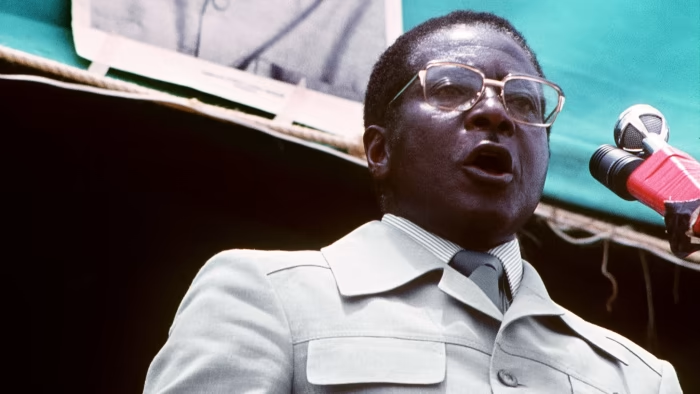
Mugabe told a thousand lies to justify a crackdown on ZAPU and launch Gukurahundi in Matabeleland and Midlands:
Addressing a crowd of 40,000 at a rally at Fort Victoria, Mugabe made reference to Zapu's 'Zero Hour' strategy, but giving the military plan a different meaning than Zapu's. Mugabe explained that he had received reports during the liberation war that Zapu was withholding its crack forces and best weaponry for a final struggle to overthrow a Zanu government if it came to power.
“That is why they were hiding and hoarding weapons. It is also why some weapons unearthed on their properties were never used during the war. They were to be used against a black government other than Zapu in order to seize power by force”.
Meanwhile supporters in the crowd held up placards stating, "Traitors must be guillotined" and "We grow crops, not guns”.
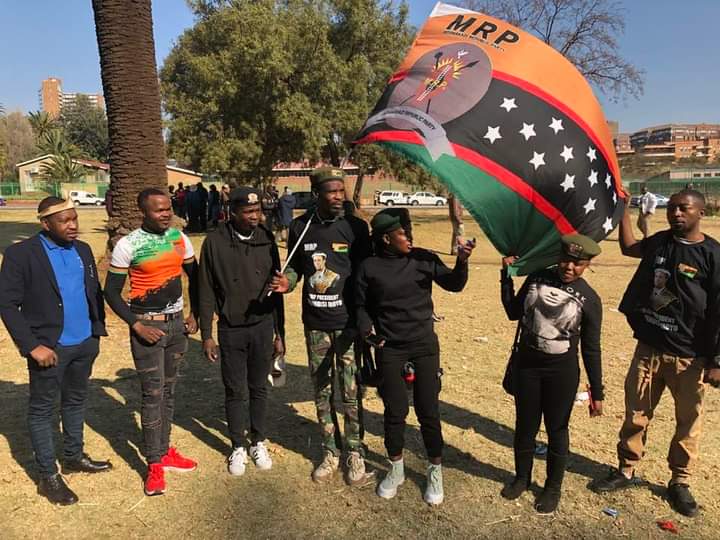
MRP flag. 13 Stars in this flag represents 13 tribes that makes Mthwakazi Nation. Mthwakazi self determination Agenda phambili comrades. Nothing for us without us.