We, the people of Kenya, 16 years on…
As we mark 16 years of the 2010 Constitution, pause to reflect on how far we have come and how far we still have to go.
Has the 2010 Constitution delivered on its promise?
#KatibaAt16
The racist, dehumanising remarks against @KMbappe by Paraguayan Sen. Celeste Amarilla are despicable, regrettably not isolated.
States & sports organisations must prevent acts of racism & discrimination, and ensure independent and effective accountability. Social media must also prevent and address racial discrimination on their platforms.
https://t.co/TVawwmw3Qo
.@kwsKenya pls take action. If anyone can identify these people please inbox me -we will pursue arrests. These Mt Kenya Giant Lovelias are endangered.
If you see mature vandals please take action!!!
12. So this is what happened. Colonialism broke the knowledge chain. Post-independence leadership chose concrete over continuity. A generation of ordinary people inherited a broken aesthetic and called it normal. And the people with the skills to fix it left, because leaving made sense.
The thing about the marathon record is it’s been broken by a Kenyan.
Before that, it was held by another Kenyan (Kiptum, RIP), who broke another Kenyan’s record (Kipchoge) who broke his own record but not before breaking another Kenyan’s record (Kimetto)
Etc. 😂
BREAKING VIDEO: Kenya’s Sabastian Sawe becomes the first person ever to win a regular marathon in under two hours, setting a new world record at the London Marathon in 1:59:30!
Kenyans invented running™
2 months postpartum and exclusively nursing twins vs 8 months postpartum and supplementing.
So, before you clown a woman deep in postpartum trenches, think twice.
On the International Day of Remembrance of the Victims of Slavery & the Transatlantic Slave Trade, @UNHumanRights highlights the need for reparatory justice to tackle systemic racism against Africans & people of African descent
➡️ See our explainers https://t.co/oc1RQaa2UT
2️⃣5️⃣ March is set aside to remember the victims of slavery and the transatlantic slave trade. But remembrance has never been the difficult part. The difficulty has always been in how the world chooses to recognize what happened.
More than 12 million Africans were taken across the Atlantic between the 16th and 19th centuries. Many died before they reached land. Those who survived were absorbed into systems that treated human beings as property, and the consequences of that system did not end with abolition. They continued through economic structures, racial hierarchies, and inequalities that are still visible.
This year, the date is also tied to a live discussion at the @UN.
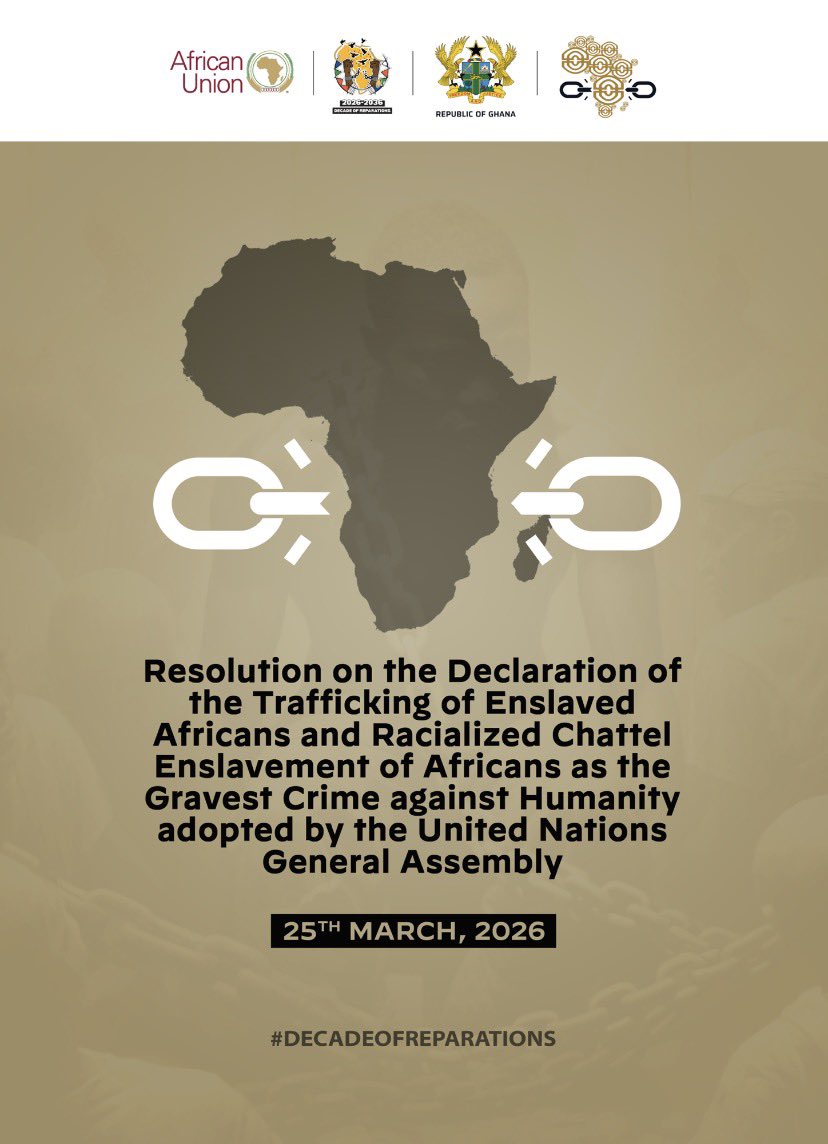
#Ghana 🇬🇭, led by President H.E. @JDMahama (who is also the @_AfricanUnion Champion for reparatory justice for Africans and people of African descent), is introducing a draft resolution to the UN General Assembly that calls for the transatlantic slave trade and slavery to be formally recognized as the gravest crime against humanity.
In other words, the resolution seeks to define slavery and the transatlantic slave trade in legal and political terms.
The classification strengthens ongoing calls for reparatory justice, including formal acknowledgment, redress, and the return of cultural heritage. The proposal has support from the African Union and @CARICOMorg.
So 25 March, this year, holds two realities.
It remains a day of remembrance for those who were taken, and it is also placing that history inside a live international process where the question is no longer only what happened, but how it is recognized and what follows from that recognition.
#Reparations #Justice #HumanRights #ReparationsNow #DecadeOfReparations
Breaking news: WE WON!
The Kenya Seed and Plants Varieties Act, which threatened to fine and jail farmers for sharing uncertified seeds, has been declared unconstitutional!
Farmers break into celebration at the offices of Greenpeace Africa, which sponsored the case