Cognitive biases shape the way we think about nutrition more than we realize.
Availability heuristic is one of them.
In nutrition, it’s why fad diets and trends spread faster than sound advice. We remember what our friend swears by, not what the data shows.
Recognizing these mental shortcuts is the first step toward clearer thinking—and better nutrition decisions.
Last weekend was the 4th edition of the UTMB Ultra Trail Métropole Nice Côte d’Azur. In just 4 short years, you can see how far the sport has exploded: 100M finishers jumped from 197 to 583!
These are distances which seemed "impossible" not that long ago. And, thanks to better training and nutrition strategies, they now they are regularly being accomplished by amateurs and elites alike.
And while difficult to compare because race-day conditions vary, the finish times are also dropping. This year's winner—Paul Cornut Chauvinc—finished in 18:52:37. The women's winner-Michaela Lishakova—did it in 25:16:07, earning her 34th place overall.
Huge congrats to all the finishers!
#UTMB #UTMBNice #TrailRunning #UltraTrail #PassionTrail
🚨New Blog: What Is Mouth Rinsing—And How Can It Boost Performance?
We delve into the science of how to do it, why it works, and when to mouth rinse vs. fuel. Read the full blog ➡️https://t.co/ndt8YsLDuR
🚨 Study: Delaying carbohydrates after exercise harms performance.
The study found that delaying post-exercise carbohydrate intake by 3 hours vs. immediate intake caused:
⚠️~30% fewer high-intensity intervals completed the next day
⚠️Higher perceived exertion
⚠️Impaired recovery despite similar muscle glycogen levels
Athletes who refueled immediately with 1.2 g/kg CHO were able to maintain next-day performance.
👉 Take-home: Carbohydrate timing post-exercise matters for recovery and sustaining peak performance in consecutive training sessions.
📊A new review highlights why protein quality is more than just grams on a label. EAA density (%EAAs/kcal) and digestibility determine how well protein supports recovery and adaptation. Whey consistently ranks high, which is why it remains such a reliable option for endurance athletes.
https://t.co/grWNeR2am6
A new study comparing V̇O₂max estimated by Garmin Forerunner smartwatch ⌚️ vs criterion gas exchange 🫀🫁
How accurate is your smartwatch at estimating your V̇O₂max? It might depend how fit you are 🧵/15
full article🔗👇
@BillySperlich@PeterDuking@EJAP_official
It took 7 years to put in place all the necessary ingredients for this study which is the first RCT that specifically tested whether carbohydrates improve exercise performance (which they unquestionably do) by either increasing pre-exercise muscle glycogen content (in which case muscle glycogen is an obligatory fuel for human exercise performance) or by preventing depletion of the small glucose pool in the liver and blood stream leading to hypoglycemia (in which case blood glucose serves an obligatory role during exercise in preventing glycopenic brain dysfunction).
Because of the design of the experiment, the results are unambiguous.
Muscle glycogen is NOT an obligatory fuel during prolonged exercise; but blood glucose IS.
This has real significance for what we teach about the role of nutrition in human exercise performance.
15 min vs. 30 min: Does fueling frequency matter?
📊 A new study by @Robyn_OwenJones et al. tackled this question. They tested fueling at 90 g/h during 180 minutes of cycling, but at different frequencies:
22.5 g CHO every 15 minutes vs. 45 g CHO every 30 minutes
🔑 Key Findings
Exercise capacity was NOT affected by fueling frequency.
There was no difference in heart rate or RPE, similar CHO & fat oxidation, and minimal GI discomfort in both strategies.
🎯 The Takeaway
Timing doesn’t matter as much as total carbohydrate intake. Athletes don’t need to obsess about timing their fuel.
❓ Participants were healthy and trained 3–4 times per week. It’s not clear whether results apply to elite endurance-trained athletes.
Milk Chocolate Regen is back!
Your favorite flavor of Regen has returned. And, yes, it also has the updated formula with DigeZyme® for easier digestion and better absorption.
Don't worry—Hazelnut and Salted Caramel are still here too, because recovery shouldn't be boring. 🍫🌰🧂
🚴♂️Nduranz just got back from Eurobike 2025—and honestly, it exceeded all expectations.
Thousands of visitors. A few celeb moments. Probably a world record for the most times saying “carbs” in one day. 😅
We went expecting to teach the public about sports nutrition. But it turns out that we learned a lot from you.
👇 Here’s what stood out:
1️⃣ Athletes worldwide want science, not hype.
We met partners from Europe, NZ, Mexico, Taiwan. The demand for real, evidence-based products is global—and growing. 🌍
2️⃣ Nutrition isn’t just for elites anymore.
Our stand was packed all weekend. It wasn’t just elites. The amateurs also came ready to talk CHO ratios, gut training, and fueling calculators. 🔬
3️⃣ Personalized nutrition is the future.
Athletes are tired of generic nutrition advice. We helped create fueling plans and explained how to mix-and-match products based on training goals.
4️⃣ The basics still matter.
Chris Froome drew a huge crowd with stories from his career and THAT Finestre attack at the 2018 Giro. But the best question? From a 6-year-old who asked, “What does protein taste like?” 😄 A perfect reminder—It doesn’t matter how good a product is if it tastes bad!
The entire Eurobike experience made us more motivated than ever to make Nduranz products available to athletes worldwide, simplify fueling, and build a community that values science over hype.
If you stopped by the stand—thank you.
If you missed us—stay tuned. We’ve got a lot more coming.
👇
P.S. Froome fever is real!
His meet & greet blocked the hallway. Sorry, Eurobike—but can you blame fans for wanting a signed bottle from a legend?
(Oh, and you might get your chance to get one soon 👀)
@BenjiNaesen@timpodlogar@chrisfroome #eurobike2025
Nduranz is at Eurobike 2025🚴♂️and we've been having a blast meeting all of you and talking sports nutrition and fueling science. 🔬⚡️
Eurobike runs until Sunday June 29th, so there's still time to swing by. If you do, we've love it if you stopped by to say hello!👋
From the start of a ride to recovering from a big day on the bike, @nduranz has you covered.
Welcome to a world where science meets nutrition 🤝
Discover Nduranz today 👉 https://t.co/XAKqfbeW2O
#YallaIPT#FuelTheJourney#NduranzNutrition
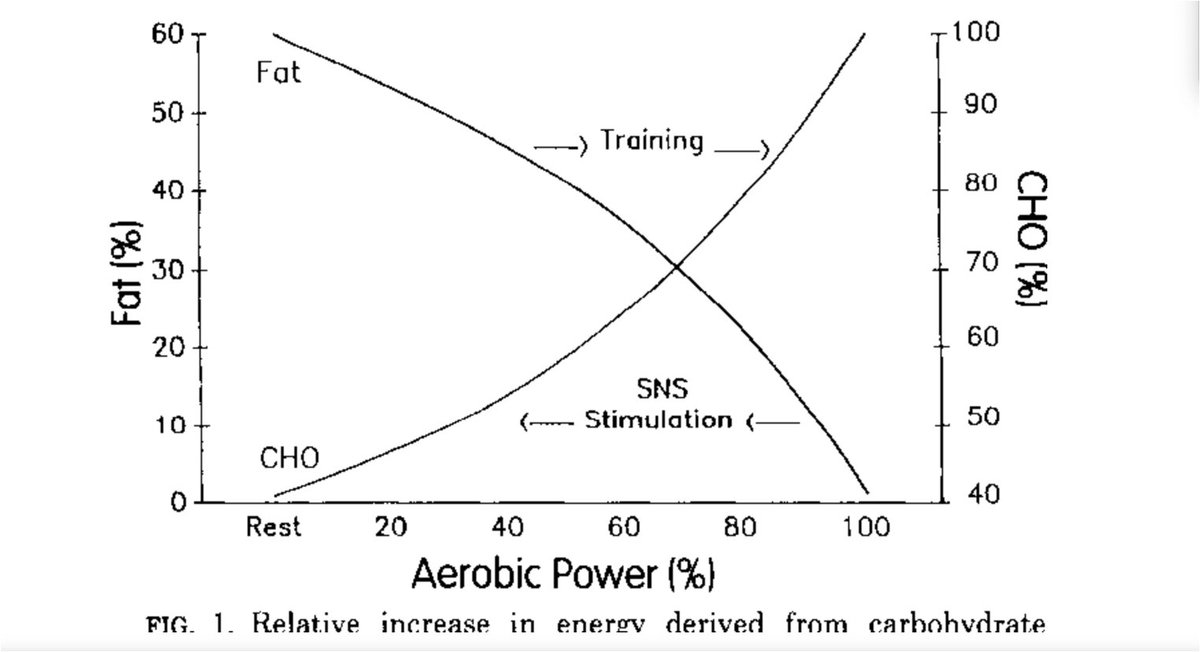
One important misconception around Substrate utilization during exercise is that during low exercise intensities you don’t use CHO as your energy is derived from fat...
When I started performing fat and CHO oxidation assessments in 2005, I was quite surprised by the amount of CHO oxidized (“burned”) even at low exercise intensities.
During rest, CHO contribution to total energy expenditure is ~40% while FAT is ~60%.
As exercise intensity increases, CHO contribution increases as well and by your Zone2 intensity, you are normally already burning slightly more CHO than FAT. At your Zone 3, your fat oxidation declines significantly and at your Zone 4, fat oxidation normally disappears (see picture 2- "the metabolic map").
Picture 1 is data that we presented at ACSM back in 2008. Check that at even low exercise intensities, you oxidize CHO and that at FATmax point you can oxidize ~2-2.5g/min. This is one of the reasons why if we ride at our zone 2 for 4h and don’t eat, you can eventually bonk.
When I started to see these numbers in 2005, I perceived that the current guidelines those days calling for 35-55g/h of CHO were quite low and then I proposed and started to use 80-100g/h, although I was highly criticized by most back then…
Picture 2 shows what I called “the metabolic map” trying to describe different metabolic “events” at different exercise intensities in relation also with muscle fiber recruitment. It is a very simplified version of exercise metabolism but I found through many talks and conferences over the years, that it is useful to many.
Picture 3 is the original figure of the “Crossover Concept” by George Brooks and Mercier where Fat and CHO oxidations are expressed in % of VO2max. You can also see that even at low exercise intensities (50-60% of VO2max), CHO is significantly utilized by muscle.
As an important point for this misconception, graphs haven’t helped as the visual seems that there is more FAT oxidation than CHO at low exercise intensities. At FATmax point, FAT oxidation can be generally ~0.3-0.7 (depending on fitness level). However, CHO oxidation at FATmax can be 2-2.5g/min which is still higher than FAToxidation although in the graphs it sits below…
Hope this helps 😉