The Prophet (ﷺ) said:
"He has found the taste of faith (iman) who is content with Allah as his Lord, with Islam as his religion (code of life) and with Muhammad (ﷺ) as his Prophet."
[Sahih Muslim 34]
The Prophet (ﷺ) said:
"There is an hour on Friday and if a Muslim gets it while praying and asks something from Allah, then Allah will definitely meet his demand."
And he pointed out the shortness of that time with his hands.
📚 Sahih al-Bukhari 935
"He created the heavens without pillars that you see and has cast into the earth firmly set mountains, lest it should shift with you, and dispersed therein from every creature. And We sent down rain from the sky and made grow therein [plants] of every noble kind."
Luqman 31:10
Al-Fudayl ibn ‘Iyad رحمه الله:
Glad tidings to the one who feels estranged from the people, and Allah becomes his companion, and he weeps over his sin.
[Hilyat al-Awliya’ (108/8)]
Thread on the ancient Yadava Kshatriyas, that I am also covering on other platforms. It will be concerned with the real Yadavas that form today's Rajput clans.
#RealYadavas
"And [warn of] the Day when We will remove the mountains and you will see the earth exposed, and We will gather them and not leave behind from them anyone."
Al-Kahf 18:47
Ibn Taymiyyah رحمه الله said,
“All the thoughts of disbelief and hypocrisy which cross the heart of a believer and which he hates and casts aside increase his iman and certainty."
[Al Fatawa Vl. 10 Pg. 767]
Ibn Rajab al-Hanbali (رحمه الله) said:
“Whoever sets out on a worldly journey without provisions will regret it when he comes to need them. His regret will be of no benefit to him, and he may even perish. So what, then, of someone who sets out on the ...👇
1/2
There are moments when the heart becomes so weighed down that even raising one's hands to ask Allah for help feels beyond one's strength. Life can drain a person until even that small act seems to require more energy than they possess, and it becomes easy to interpret such exhaustion as failing faith or even abandonment.
But Imām al-Ghazālī and Imām al-Qushayrī preserve a remarkably gentle way of understanding such moments. They speak of the breaking of the heart, of qabḍ, spiritual contraction, and even of futūr, the loss of vigor and strength in worship. What they describe is not a heart necessarily abandoned by Allah, but a heart passing through a state in which it can no longer carry what it ordinarily carries.
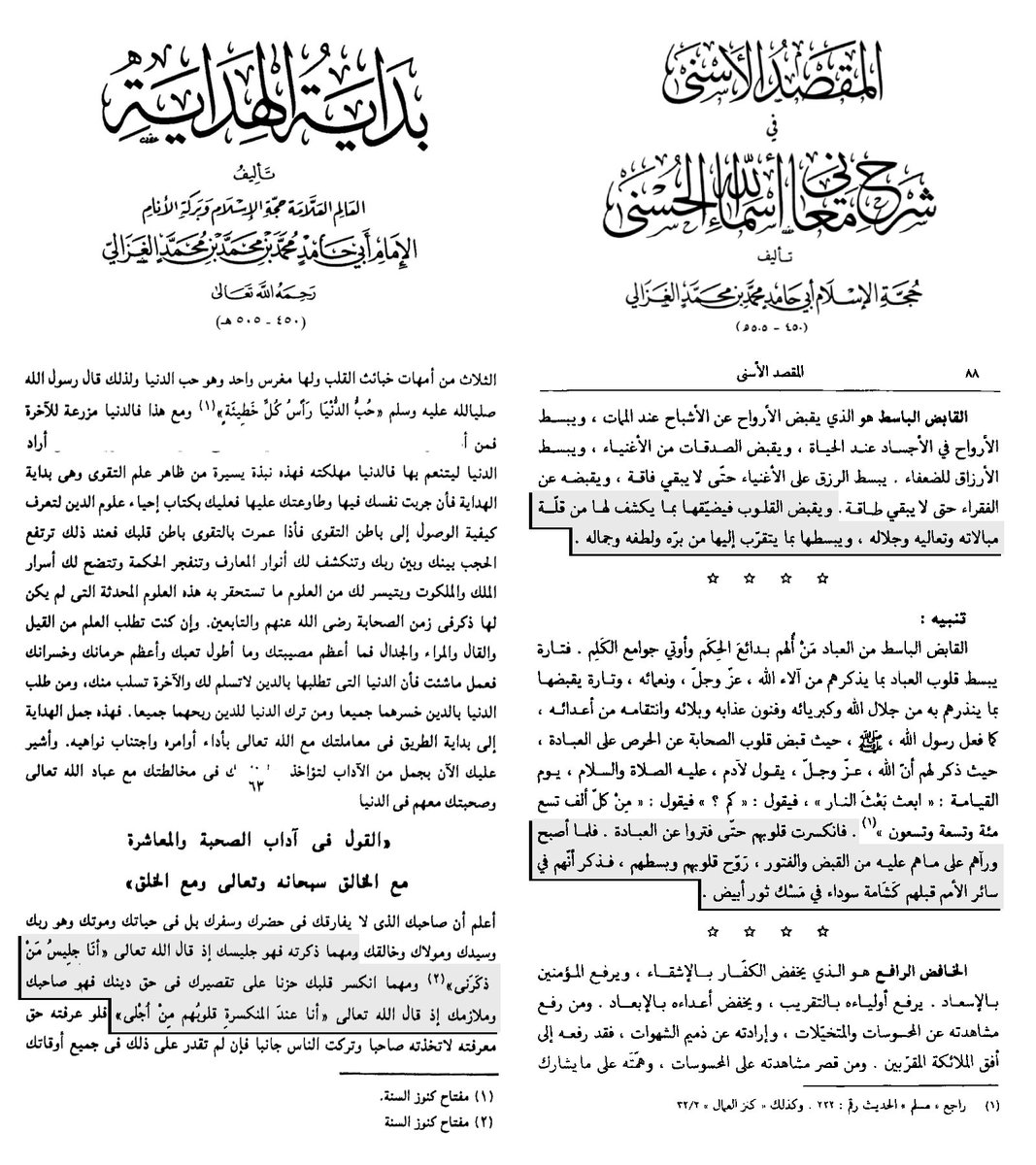
In Bidāyat al-Hidāya, al-Ghazālī reminds the servant that Allah is his Lord, Master, Patron, Creator, and true Companion. He then speaks specifically about the heart broken by its own religious shortcomings:
“Whenever your heart is broken with grief over your shortcomings in what you owe to your religion, He is your Companion and the One who remains constantly with you.”
Al-Ghazālī then cites the report: “I am with those whose hearts are broken for My sake.”
The heart that grieves because it cannot turn to Allah as it wishes is not described as a heart from which Allah has withdrawn. Al-Ghazālī says instead:
“He is your Companion and the One who remains constantly with you.”
That grief is therefore not necessarily proof that faith has disappeared. A person can feel distant from Allah while still aching precisely because they long for Him.
The masters of the spiritual path called one form of this inward heaviness qabḍ, contraction. Al-Qushayrī explains in his Risāla that, unlike fear, which concerns something anticipated in the future, qabḍ is an immediate condition overtaking the heart in the present:
“Contraction is a state occurring in the present moment; and expansion is likewise.”
Sometimes it becomes so encompassing that the person feels inwardly blocked, with little room for anything else. More importantly, al-Qushayrī explicitly recognizes that this contraction may arrive without the person understanding why:
“He finds contraction within his heart while knowing neither what occasioned it nor what caused it.”
When the cause is hidden, it is easy to interpret the heaviness itself as evidence that something has gone wrong between the servant and Allah. Al-Qushayrī leaves room for another possibility: sometimes the heart is simply in contraction, and the person experiencing it does not know why.
Al-Ghazālī develops this further in al-Maqṣad al-Asnā while explaining the Divine Names al-Qābiḍ and al-Bāsiṭ, the Constrictor and the Expander:
“He contracts the hearts, making them constricted through what He unveils to them of His utter independence, His exaltedness, and His majesty; and He expands them through what He brings near to them of His goodness, His gentleness, and His beauty.”
He then gives an example from the Companions. After the Prophet ﷺ warned them of the terrors of the Last Day, the weight of what they heard affected them so deeply that al-Ghazālī writes:
“Their hearts were broken, until they became languid in worship.”
The word futūr here is stronger than ordinary laziness. It is a loss of vigor after strength, a slackening of spiritual energy and capacity. Their hearts had become overwhelmed.
When the Prophet ﷺ saw them in this state of qabḍ and futūr, he did not leave them there. Al-Ghazālī says:
“When morning came and he saw them in the state of contraction and spiritual weariness in which they had remained, he brought relief to their hearts and expanded them.”
Their hearts were given basṭ: expansion, relief, room to breathe again.
This is where al-Qushayrī's practical counsel becomes especially beautiful. When a person experiences a contraction whose cause they do not understand, he writes:
“The way for the person undergoing such a contraction is surrender until that moment has passed.”
And then he warns:
“For if he were to strain himself to drive the contraction away … he would only increase his contraction.”
He is not telling the servant to abandon worship or obligations. He is warning against trying to manufacture a spiritual state by force, compelling the heart toward warmth, tears, sweetness, or energy simply because one is afraid of what its present numbness might mean.
Sometimes the proper adab of the moment is not to pretend that the heart possesses an expansion it does not presently have. It is to remain with Allah as one is, to fulfill what one is able to fulfill, and not to interpret every moment of spiritual exhaustion as rejection.
Because the same verse al-Qushayrī invokes does not say only:
“Allah contracts.” Q 2:245
It continues:
“and He expands.” Q 2:245
These texts do not treat such constriction, by itself, as proof that Allah has abandoned the servant. A heart can be broken and still have Him as its Companion. It can become contracted without understanding why. It can even lose its ordinary vigor for worship.
And the One who contracts the heart is also the One who can expand it again.




![yasir_00X's tweet photo. "When He decrees a matter, He simply tells it, “Be!” And it is!"
-Al Qur'aan [2:117] https://t.co/H5EpaGC8PD](https://pbs.twimg.com/media/HRS48q0a8AAWqKc.jpg)