Instead of watching an hour of Netflix, watch this 2 hour hour Stanford lecture will teach you more about how LLMs like ChatGPT and Claude are built than most people working at top AI companies learn in their entire careers.
Instead of watching an hour of Netflix, watch this 2 hour hour Stanford lecture will teach you more about how LLMs like ChatGPT and Claude are built than most people working at top AI companies learn in their entire careers.
R.I.P Google Scholar.
I'm going to share the 10 Perplexity prompts that turn research from a chore into a superpower.
Copy & paste these into Perplexity right now:
7 Sci-Hub Alternative Websites
Paper you need to ask for payment & can't use sci-hub?
You don't have to pay to read academic papers.
These are 7 sci-hub alternative websites to download papers for free.
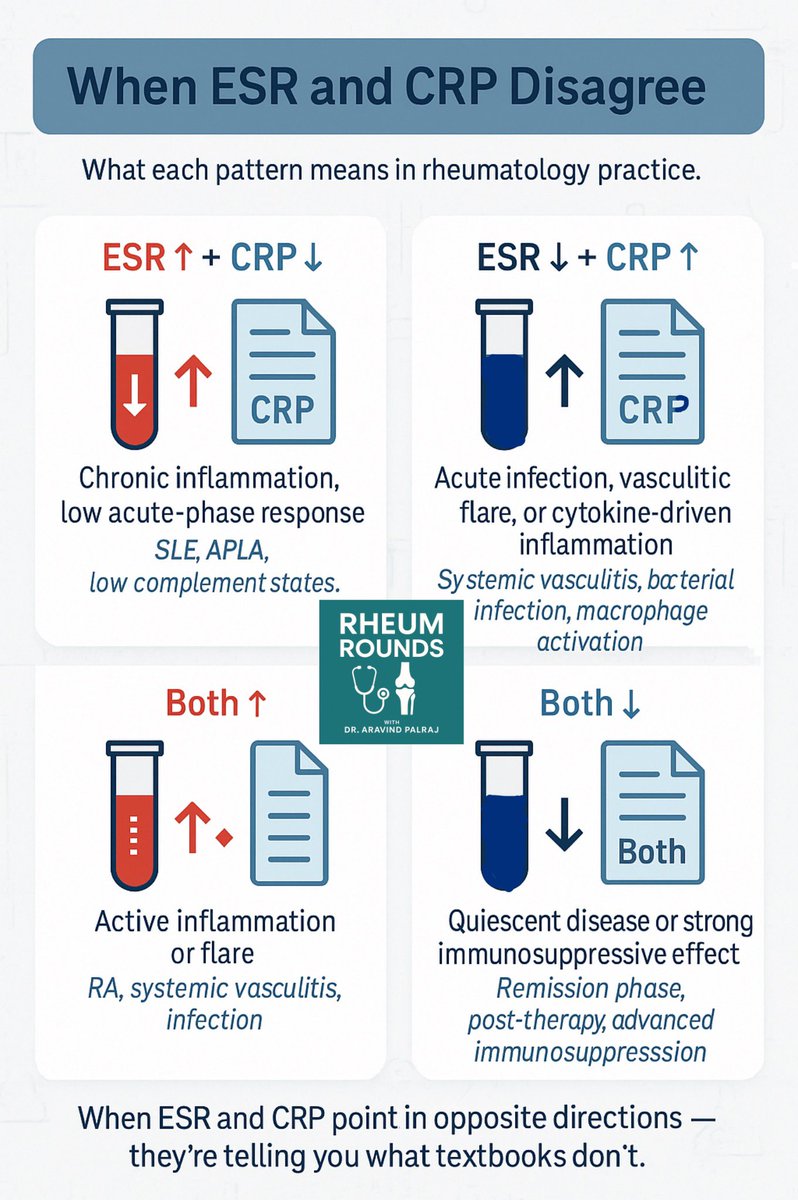
When ESR and CRP disagree, your job isn’t just to record numbers —
it’s to interpret what the body’s really saying.
🧪 ESR ↑ + CRP ↓ → SLE, APLA
🧪 ESR ↓ + CRP ↑ → Infection, Vasculitis
🧪 Both ↑ → Flare
🧪 Both ↓ → Remission
They don’t lie — they whisper clues.
👇 Save this infographic.
#Rheumatology #MedTwitter #FOAMed #ClinicalPearls #MedEd @DrAkhilX @IhabFathiSulima@CelestinoGutirr@ArunInamadar@Janetbirdope
Your immune system doesn't only defend, it remembers
This diagram maps how the body’s innate and adaptive immune systems work together to identify, attack, and remember pathogens. It shows how different immune cells, antibodies, and signaling molecules coordinate to protect against infection while maintaining balance.
1️⃣ Innate immunity: the immediate response
The innate system acts within minutes, providing broad defense through physical, chemical, and cellular barriers.
🟢 Example: Skin, mucus, and stomach acid block pathogens, while macrophages, neutrophils, and natural killer cells identify and destroy invaders using pattern-recognition receptors.
🟢 Example: The complement cascade amplifies inflammation and flags pathogens for destruction by immune cells.
2️⃣ Adaptive immunity: the targeted response
The adaptive system learns to recognize specific antigens and produces lasting protection through specialized B and T cells.
🟢 Example: B cells release antibodies (IgM, IgG, IgA, IgE, IgD) that neutralize toxins and tag microbes for clearance.
🟢 Example: T cells coordinate and execute defense—helper T cells activate macrophages and B cells, while cytotoxic T cells trigger apoptosis in infected cells.
3️⃣ Antibody specialization and immune memory
Each antibody class has a unique role in defense and long-term immunity.
🟢 Example: IgM is the first antibody made in infection, IgG provides long-term protection and crosses the placenta, IgA guards mucosal surfaces, and IgE mediates allergic reactions.
🟢 Example: Memory B and T cells remain after infection or vaccination, allowing faster and stronger immune responses upon re-exposure.
4️⃣ Active and passive protection
Immunity can be acquired through natural infection, vaccination, or temporary antibody transfer.
🟢 Example: maternal antibodies passed through breast milk provide short-term passive defense.
The immune system’s strength lies in its coordination—an instant, non-specific response that buys time for a targeted, adaptive defense that remembers what it has seen.