@BuildWatchNEWS A clarification that was long overdue. State land authorities claiming secured-creditor status on the basis of statutory charges alone created real uncertainty in the resolution proceedings. This amendment brings the position in line with how IBC was always meant to operate.
The DHC has ruled NSE is a public authority under RTI. The reasoning is precise: you cannot claim private opacity when a government order is the condition of your existence. BSE, CDSL, NSDL are built on the same foundation. Shared my thoughts with @moneycontrol
A secured creditor relinquishes its security & is paid on the rules as they then stood. In '26, an amendment clarified those rules & an NCLT bench now applies it to the very distribution. We call it clarificatory,but for the people affected,certainty quietly shifts after the fact
Too many interim hearings get argued as if they were the trial. Whether specific performance is finally granted is not the question at the threshold. It's whether there is something left to fight over once it is. Mere objections to enforceability shouldn't & now don't decide that
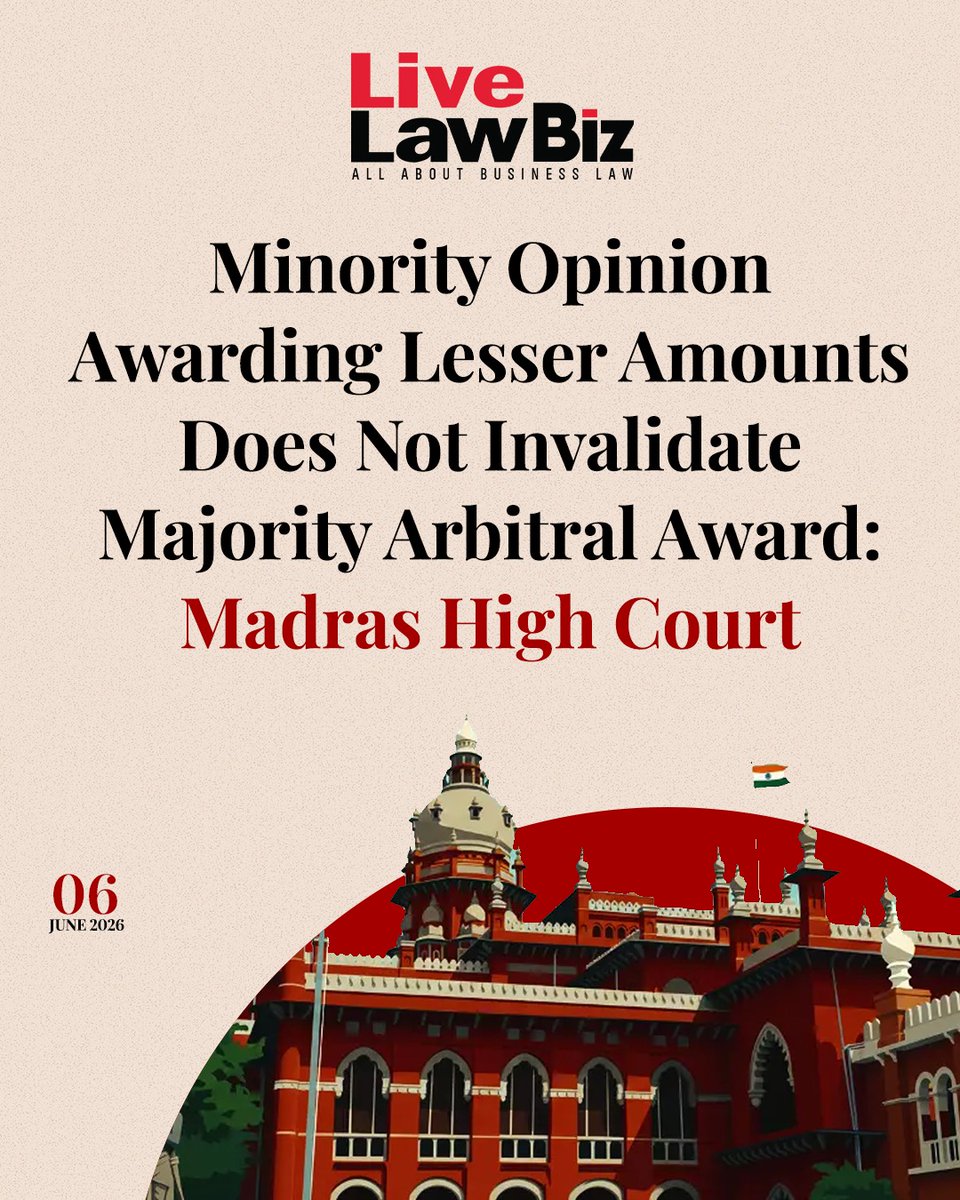
The majority view is the award. A minority opinion awarding less is not a competing decision and is not a basis for a Section 34 challenge. A welcome restatement of a settled principle that is argued against more often than it should be.
The seat of arbitration isn't a logistical detail. Treating the seat as interchangeable with the venue risks blurring a distinction that arbitration law has consistently sought to preserve. Convenience cannot rewrite the parties' juridical choices.
Statutory timelines are a good push. But without NCLT capacity and consistent judicial follow-through, they stay on paper. My thoughts on the IBC Amendment Act, 2026 with @timesofindia
https://t.co/lyG7MpkvPs
@tanmoyofc@AnindyaDas1@muralitwit@ShrutiDhore@taj_india007@VijaySingh_law The draft lets any private body register as "self-regulatory organisation" with takedown authority over individual creators. No eligibility criteria, transparency requirements. We're not just handing the state a censorship tool; we're letting unnamed private parties wield it, too
16% of #CCI's merger approvals since September 2024 weren't actually approved. They were deemed approved because the regulator ran out of time. A deadline doing the regulator's job isn't the same as the regulator doing it. Spoke to @livemint about this https://t.co/dowFIh11hU
@FabianSani8 Practising at the SC, investing in startups, advising on insolvency, white collar matters-none of this felt like a pivot. It felt like the same skill applied in a different room. This is exactly right! The courtroom is where you learn to think. What you do with that is up to you.
We now have #DPDP Act for data, IT Rules for content & BNS for criminal liability, with no clarity on where one ends & other begins. A creator posting a news reel could be liable under 3 frameworks. We keep adding layers of regulation & there's no single consolidated digital law.
This is important. Once you settle and withdraw a Section 9 petition, you can't walk back in because the settlement failed. Breach of settlement ≠ revival of IBC proceedings. Build your enforcement mechanisms into the settlement. The IBC won't save you later.
Settlement withdrawal bars restoration of a concluded insolvency petition absent express liberty in the withdrawal order - Withdrawal of a Section 9 insolvency petition on the basis of... https://t.co/yzGaN9oqX0 #Insolvencyresolution#Settlementwithdrawal#Restorationjurisdiction
Cross-border insolvency finally gets a statutory framework. Prepackaged resolution for large companies. Mandatory CIRP admission timelines. The #IBC got the upgrade practitioners have been asking for. But does the NCLT have the infrastructure to keep up with the ambition?
The #DPDP Act penalty framework is already live. Consent manager registration opens in 8 months. Full compliance deadline (May 2027), & most companies are still treating data privacy like a checkbox. The 18-month runway the govt gave is generous. The question is, who's using it?
@barandbench A religious orator from Vrindavan now needs the DHC to stop someone from using his face in an AI ad. The personality rights queue at the DHC now has actors, cricketers, yoga gurus, and spiritual leaders. How many more petitions before the legislature realises this needs a statute
People spend years building wealth and five minutes setting up their bank accounts. That mismatch is where disputes happen. ‘Either or Survivor’ gives you access to the FD. Not ownership. Your Will does that. @ET_Wealth https://t.co/uzFtJpbgUb
Was thinking about RERA and realised that SC's frustration with it isn't just a homebuyer problem. Compliant builders are stuck in this broken system, competing against defaulters who face no real consequences. When enforcement is weak, those who play by rules pay highest price.
Courts are granting personality-rights injunctions faster than the legislature can draft a law to that effect. The Delhi HC is building this framework case by case, with Jackie Shroff, Arijit Singh, and now Sonakshi Sinha. At some point, we need a statute, not just precedent.
The law finally acknowledges what families already know—motherhood doesn’t begin at birth, and bonding doesn’t wait for paperwork. Extending maternity leave to adoptive mothers, irrespective of age, is long overdue.
#BREAKING#SupremeCourt strikes down Section 60(4) of the Social Security Code which allowed maternity leave to adoptive mothers only if the adopted child is aged above 3 months of age.
SC holds that adopted mothers are entitled to maternity leave irrespective of the age of the child.
A bench comprising Justice JB Pardiwala and Justice R Mahadevan pronounced the verdict.