Set HFT inventory limits by currency and correlated factor, then skew or stop quotes before the limit is breached. Ticket count is not a measure of directional concentration.
#HFT#RiskManagement
https://t.co/njHHzycjaN
Measure HFT volatility in event time as well as clock time. Message and trade intensity can accelerate while a fixed one-minute bar hides the change in execution conditions.
#HFT#QuantTrading
https://t.co/njHHzycjaN
A fast news feed is not enough for HFT. Map surprise to a bounded action, reject stale messages and stop when spreads or acknowledgements leave the calibrated range.
#HFT#AlgoTrading
https://t.co/njHHzycjaN
For an HFT burst model, condition on trade intensity, imbalance and volatility, then test untouched periods. A few dramatic moves can dominate an otherwise weak signal.
#HFT#QuantTrading
https://t.co/njHHzycjaN
An HFT reversion signal can fail when order-flow imbalance reflects new information. Separate temporary liquidity pressure from persistent repricing before scaling the response.
#HFT#QuantTrading
https://t.co/njHHzycjaN
In HFT stat-arb, test whether the relationship survives by day, session and volatility regime. A strong full-sample fit can conceal long intervals when convergence fails.
#HFT#QuantTrading
https://t.co/njHHzycjaN
Before calling a cross-venue gap an HFT edge, subtract fees, transfer constraints, fill risk and quote age. Displayed differences often disappear before both sides can execute.
#HFT#AlgoTrading
https://t.co/njHHzycjaN
Triangular HFT FX arbitrage exists only when all three executable bid-ask legs remain profitable after fees and latency. Mid-price arithmetic can manufacture a spread that cannot be traded.
#HFT#ForexTrading
https://t.co/njHHzycjaN
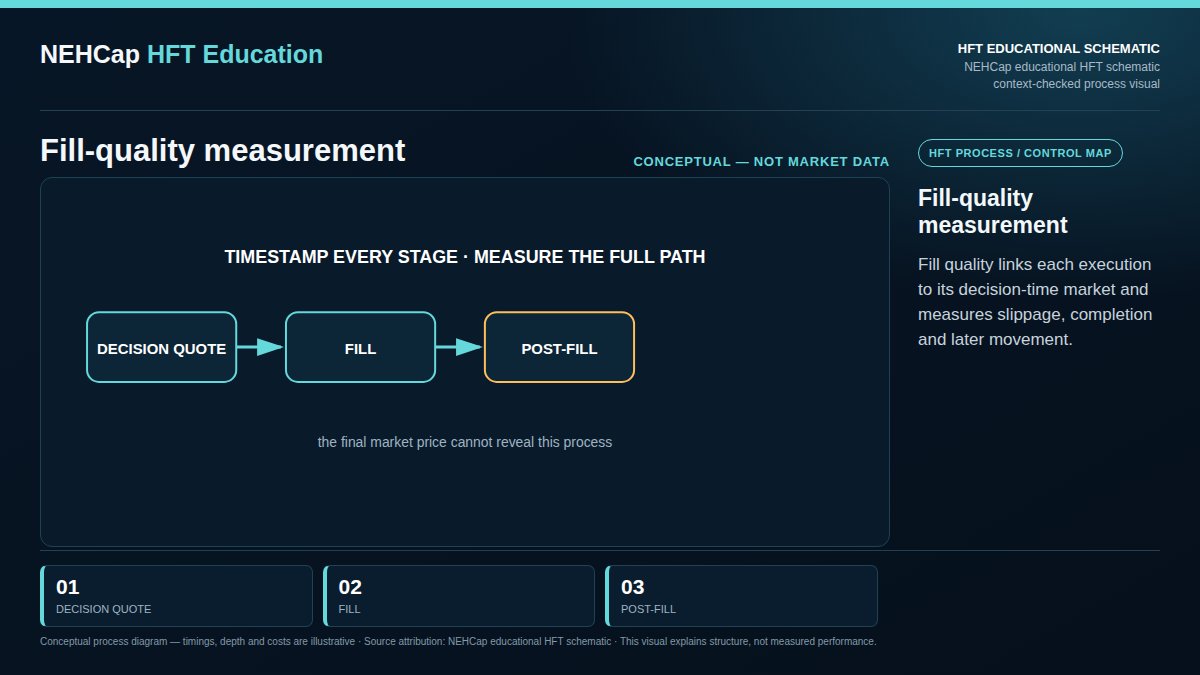
Benchmark each HFT fill against the decision-time bid, ask and mid, then measure completion and post-fill movement. Arrival price alone cannot explain execution quality.
#HFT#AlgoTrading
https://t.co/njHHzycjaN
@Ayan_fx222 Targeting a 4478 entry with a 4381 TP suggests a roughly 1.1% move. How do you size the position to keep risk under 1% if the stop sits at 4495?
An HFT router should compare executable price, reachable depth, fee, latency and fill probability. The best displayed quote is not automatically the best destination.
#HFT#AlgoTrading
https://t.co/njHHzycjaN
@RhAgentdotbot Seeing the thesis logs on https://t.co/sbN47Lixpw, how do you validate that the automated risk bounds truly reflect real‑time market volatility?
@BTFactory_ If backtesting methods haven’t changed in two decades, what specific metric—like drawdown depth—do you think should be re‑weighted for today’s high‑frequency data?
HFT event-intensity models should count additions, cancellations and trades separately. A cancellation changes displayed supply; it does not prove why another participant acted.
#HFT#OrderFlow
https://t.co/njHHzycjaN
HFT execution economics include maker rebates, taker fees, partial fills and missed opportunities. Compare net realised price, not the fee schedule in isolation.
#HFT#AlgoTrading
https://t.co/njHHzycjaN
For every HFT fill, compare the execution price with the mid-price after several fixed horizons. Consistent movement against the fill is evidence of adverse selection, not bad luck.
#HFT#MarketMaking
https://t.co/njHHzycjaN
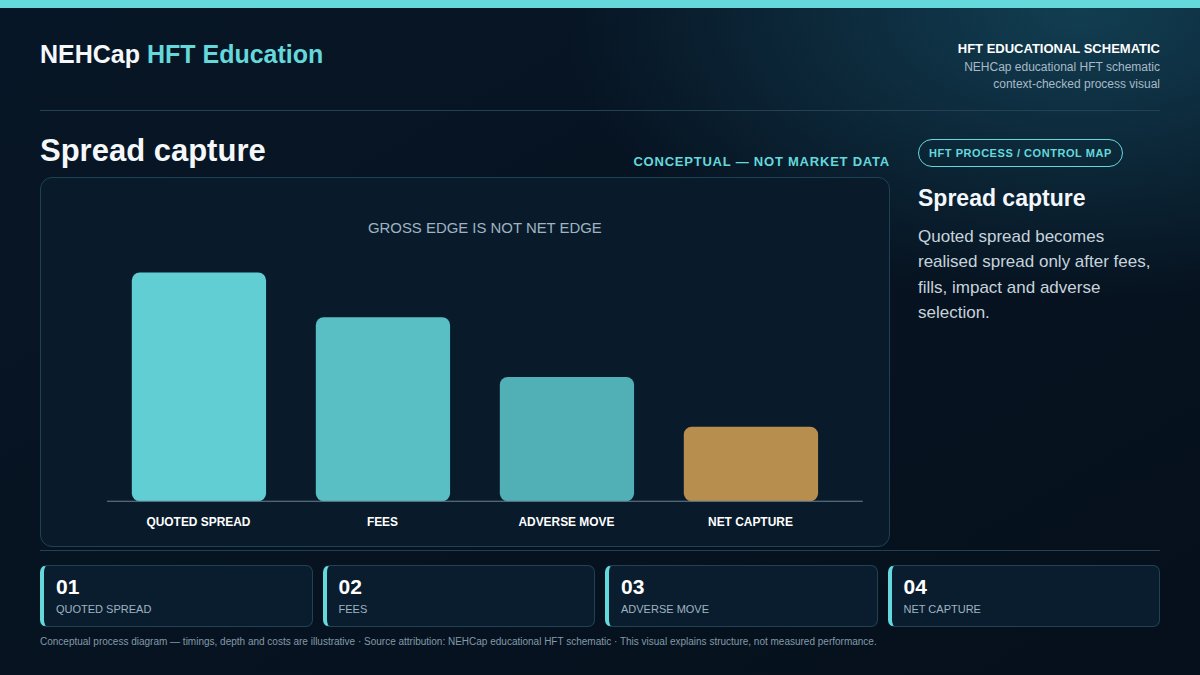
Quoted spread is not HFT profit. Subtract fees and post-fill adverse movement, then include inventory risk; realised spread is the number that tests whether market making paid.
#HFT#QuantTrading
https://t.co/njHHzycjaN
HFT limit-order fills depend on queue position, cancellations ahead and incoming marketable flow. If the simulator assumes front-of-queue fills, its execution results are optimistic.
#HFT#AlgoTrading
https://t.co/njHHzycjaN