Bitcoin - Getting close now to the end of a natural counter trend move in a bear market. $85-$88k area.
However, there is a difference to this move. Counter trend moves are typically stronger (impulse) and shorter duration, this move is more consistent with base building over a longer period. For example, it has been 88 days since the low, no counter trend move to a local high took anywhere near this long.
It means we could be looking at more of a time based Cycle Low developing over 2026. In that scenario, the next big pullback could be more of a retest of the bear range. We shall have to see.
Most people will go to bed tonight the same way they woke up this morning.
Spend 1 hour with this.
A MIT lecture on generational wealth that teaches you more about money, compounding, and building something that outlasts you than 20 years inside any hedge fund, investment bank, or financial institution ever could.
Wall Street teaches you how to make money for someone else.
This teaches you how to build something for yourself.
The people who watch this tonight will make one decision differently this week.
That one decision will compound for the next 20 years.
The people who skip it will keep taking financial advice from people who profit when they stay confused.
Completely free.
Bookmark this before you open Netflix 👇
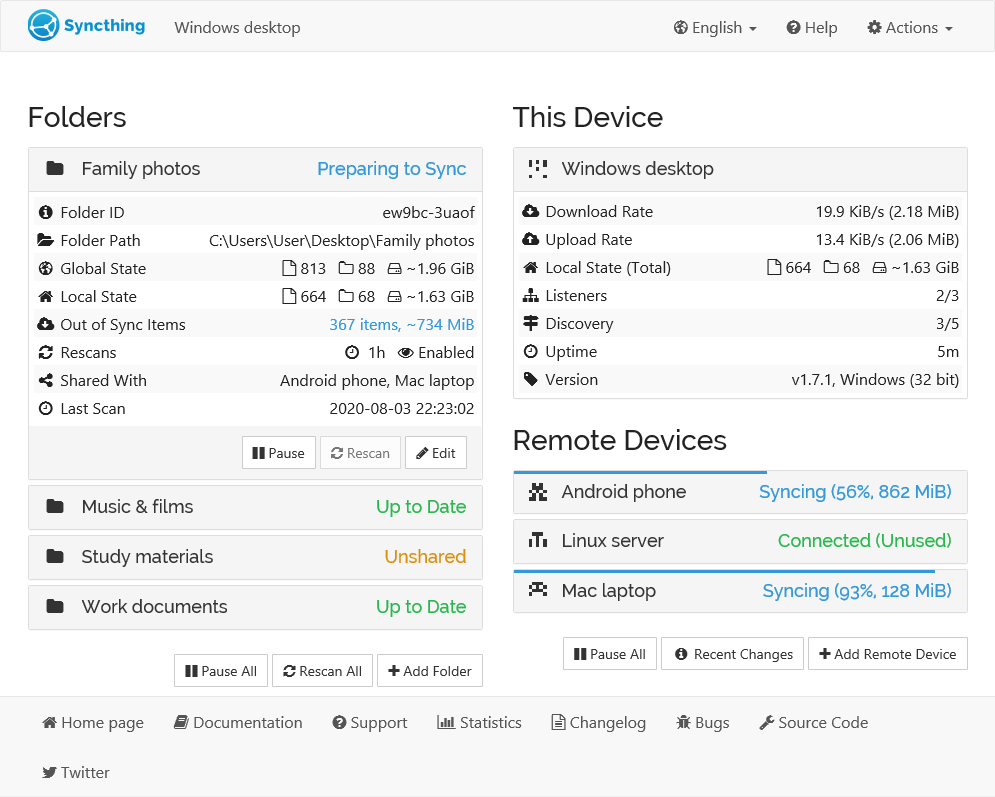
Say goodbye to Dropbox, iCloud, and OneDrive subscriptions.
Someone open-sourced a sync tool that replaces all three for $0. And no company can shut it down.
It's called Syncthing.
Here's how it works:
Every cloud storage company on earth routes your files through their own servers. That's not a technical requirement. That's a business model.
Syncthing skips the server entirely.
→ Your devices connect directly to each other
→ Every transfer is TLS encrypted with perfect forward secrecy
→ Every device is authenticated by a cryptographic certificate
→ Nothing moves without your explicit permission
→ Works on Windows, macOS, Linux, Android, FreeBSD
No account. No subscription. No company holding a copy of your files.
Dropbox can raise prices. iCloud can change its terms. Google Drive can shut down tomorrow.
Syncthing runs on your own machines. There's no server to breach. No company to pressure. No subscription to cancel.
One install. Your devices. Your files. Your rules.
100% Opensource.
https://t.co/zXSEvtiX0a
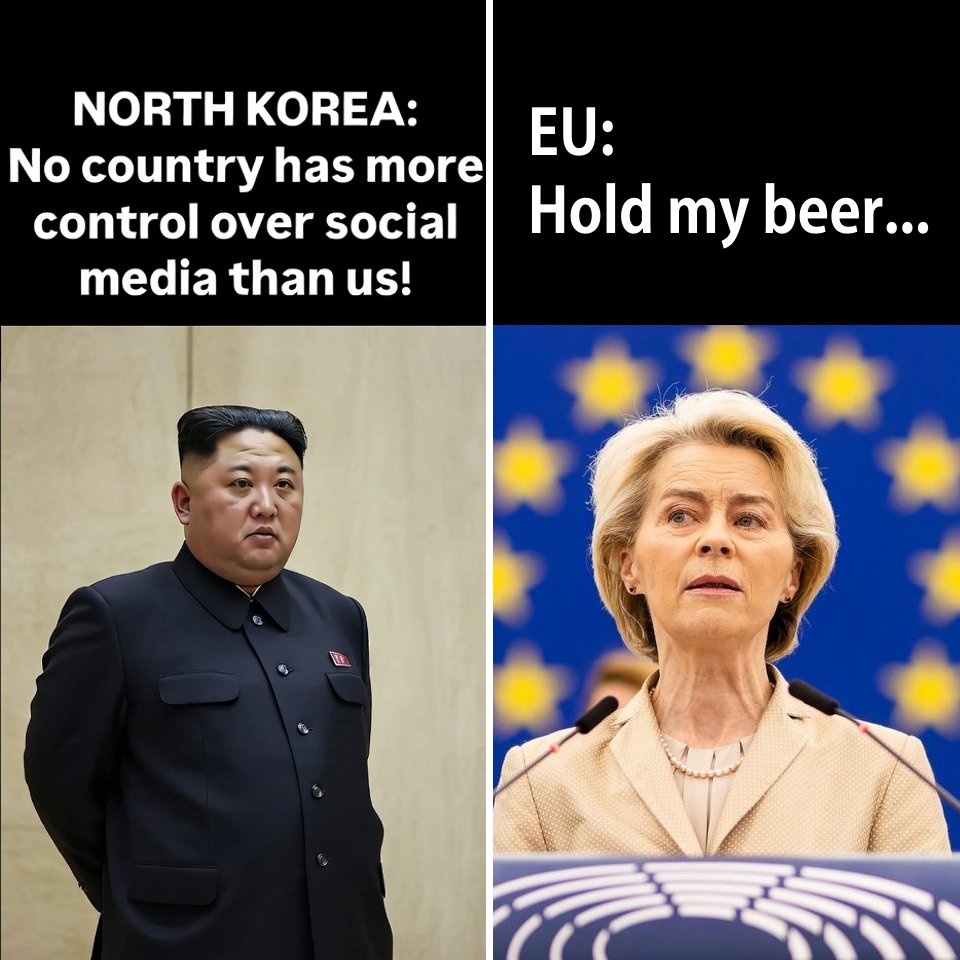
🚨🇪🇺 The European Commission is about to steal your search history in one of the largest forced data grabs in the history of the open internet, and almost nobody is talking about it.
The scope is staggering:
🔴 Every query you type
🔴 Every voice and photo search
🔴 Every autocomplete you accept
🔴 Your language, your device
🔴 Your country pinned to a ~3km² grid
🔴 Every result you saw, every link you hovered
🔴 Every click and scroll
🔴 The full chronological order of your search sessions
Meaning the European Union now knows your:
🔴 Health symptoms
🔴 Pregnancy
🔴 Sexual orientation
🔴 Political views
🔴 Religious beliefs
🔴 Financial distress
🔴 Legal trouble
🔴 Addictions
🔴 Affairs
Under the proposed measures for DMA Article 6(11), Google would be ordered to ship the daily search behaviour of hundreds of millions of Europeans to multiple third parties through a daily API feed. Any approved "online search engine," AI chatbots included, would get five years of access.
The things people only ever type when they think no one is watching. All of it now scheduled to flow daily into an open-ended list of third parties scattered across the European Union.
Brussels promises "anonymisation." The reality is a thin technical veneer that has been broken in academic literature again and again for over a decade. Search behaviour is a fingerprint. Stripping a name does not change that.
Mass data leaks become inevitable. Every new beneficiary is a new attack surface, and every annual audit is a year of silent exposure between checks. The 2025 Discord vendor breach already showed how fast 70,000 government IDs can leak through a single weak link. Now imagine that link holding Europe's search history.
Surveillance without consent becomes the default. Hundreds of millions of EU citizens never agreed to have their queries packaged and shipped to companies they have never heard of. The legal fiction of "anonymisation" cannot manufacture consent that was never given.
Behavioural search data is a goldmine for phishing, blackmail, social engineering, and corporate espionage.
Foreign intelligence services get a back door without effort. They do not need to breach Google. They only need to compromise the weakest name on the beneficiary list. One insolvent startup. One compromised contractor. One approved entity quietly acquired by a hostile state.
In the name of "competition," the EU is about to manufacture a permanent, distributed, daily-refreshed copy of Europe's collective search history. A surveillance dataset Brussels itself would never approve if any other government tried to build it.
The public consultation closes Friday, May 1, 2026 at 23:59 CEST. The final binding decision lands July 27, 2026.
After that, the door does not close again.
Tag your MEPs! File a response! Make noise!
Ripple pays its bills by dumping 300 MILLION XRP on its own holders
When XRP launched in 2012, 100 BILLION tokens were created at once, all at genesis
The founders kept 20 billion for themselves and gave the other 80 billion to the company
In December 2017, Ripple locked 55 billion XRP into smart contracts so they couldn't just dump the supply whenever they wanted
That escrow releases 1 billion XRP every single month on the 1st, automatically, with zero human intervention required
Ripple typically relocks 70 to 80% back into new escrow contracts and they keep the rest, which is roughly 200 to 300 million XRP, to fund the entire company
At XRP's current price, 300 million tokens is $400 million, every single month
Ripple's CEO Brad Garlinghouse told the Financial Times directly that the company "would not be profitable or cash flow positive without selling XRP." The CEO himself admitted the entire company runs on dumping its own token
Ripple paid MoneyGram over 61 million dollars in "market development fees" to use XRP
MoneyGram then told reporters: "We sell XRP as soon as we receive it because we don't hold any XRP"
Ripple pays partners in XRP, the partners dump it on the market immediately, and Ripple announces it as adoption
The SEC called this out in their own complaint
They wrote that MoneyGram "became yet another conduit for Ripple's unregistered XRP sales into the market, with Ripple receiving the added benefit that it could tout its inorganic XRP use and trading volume"
The co founder who left, Jed McCaleb, kept 9 billion XRP on his way out, spent 8 years dumping from a wallet the community named 'Tacostand,' and walked away with 3.2 billion dollars. Ripple had to sue him just to slow the sales down
The bull case for the last decade has been "banks are coming"
Bank of America, Santander, PNC, American Express, and JPMorgan all partnered with Ripple. None of them actually use XRP
They use Ripple's messaging software without ever touching the token
Ripple still holds around 39 billion XRP in escrow, roughly 39% of total supply
Every holder of XRP is being slowly diluted by the company itself, by design, on a monthly schedule that's written into the blockchain
XRP is now down 6 consecutive months
A big reason is that every month, a new batch of supply hits the market from the same wallet, and everyone knows it's coming
The company that fought the SEC for 5 years and won is funded almost entirely by printing its own token and selling it to the people who believe in it
⚠️ DIE KOMPLETTE TRUMP-LISTE - HIER SIND DIE MILLIARDEN, DIE WIRKLICH GEFLOSSEN SIND!
Ich habe zwei Tage gebraucht, um sie zusammenzutragen, weil die Beträge an zwanzig verschiedenen Stellen versteckt sind. Nebeneinander gelegt versteht ihr, warum das Weiße Haus auf jede Frage mit Schweigen antwortet.
Die Quellen sind SEC-Filings, Blockchain-Daten, BBC-Recherchen, Reuters und Bloomberg. Jede einzelne Zahl ist öffentlich nachlesbar.
⚠️ 17. Januar 2025. Drei Tage vor der Amtseinführung launcht Trump seinen eigenen Memecoin. Zwei Entitäten der Familie (CIC Digital LLC und Fight Fight Fight LLC) halten 80 Prozent der Token. Am zweiten Handelstag steht die Market Cap bei 14,5 Milliarden Dollar. Allein in den ersten zwei Wochen fließen laut Blockchain-Analyse über 350 Millionen Dollar an Trading-Fees an die Trump-Entitäten. Retail sitzt heute auf über 85 Prozent Verlust. Die Familie behält die Fees.
⚠️ 19. Januar. Zwei Tage später kommt der Melania-Token. Peak 13 Dollar, heute 15 Cent. 99 Prozent Crash. Insider, die vor dem Launch positioniert waren, haben zweistellige Millionenbeträge abgezogen. Wer das war, weiß wieder mal niemand.
⚠️ World Liberty Financial. Das DeFi-Projekt der Trump-Familie. 550 Millionen Dollar im Token-Sale eingesammelt, rund 300 Millionen davon aus dem Ausland. Die Familie kassiert 75 Prozent der Revenues. Justin Sun investiert 75 Millionen und kurz darauf pausiert die SEC die Untersuchung gegen ihn. Eric Trump sagt wörtlich in einem Interview: WLFI hat hunderte Millionen für die Familie generiert.
⚠️ März 2025. WLFI launcht den USD1 Stablecoin. Innerhalb weniger Wochen springt die Marktkapitalisierung auf 2,2 Milliarden Dollar. MGX aus Abu Dhabi wickelt ein 2-Milliarden-Dollar-Investment in Binance über USD1 ab. Zufall natürlich. Die Zinsen auf die hinterlegten Tresauries fließen an, richtig, die Trump-Familie.
⚠️ Eric und Don Jr. gründen American Bitcoin, eine Mining-Firma. Über SPAC an die Börse gebracht, Bewertung im Milliardenbereich. Parallel unterschreibt Trump eine Executive Order für die Strategic Bitcoin Reserve. Mining-Aktien rallen sofort. #Bitcoin läuft auf neue Allzeithochs. Die Familie hält Mining-Bestände, Treasury-Positionen und Policy-Hebel gleichzeitig.
⚠️ Trump Media & Technology. Trump hält 53 Prozent. Im Herbst 2025 verkündet DJT eine Krypto-Strategie über 2 Milliarden Dollar Bitcoin-Treasury. $BTC steht über 100.000 Dollar, die Aktie pumpt um zweistellige Prozent, Trumps Papier-Vermögen springt um hunderte Millionen nach oben. Niemand außer der Familie wusste vor der Ankündigung Bescheid.
⚠️ Die BBC hat fünf Pre-Announcement-Patterns dokumentiert. Öl-Futures 580 Millionen vor der Iran-Pause. S&P-Futures 1,5 Milliarden vor dem Iran-Post. Ceasefire-Trades 950 Millionen. Hormuz-Öffnung 760 Millionen. Tariff-Pause im April über 900 Millionen an Vortages-Wetten. Aufaddiert sind das über 4 Milliarden Dollar an Positionen, die Minuten vor Trump-Tweets platziert wurden. 100 Prozent Trefferquote.
⚠️ Don Jr. sitzt im Advisory Board von Polymarket. Gleichzeitig strategischer Berater bei Kalshi. Die zwei Plattformen, auf denen die anomalen Wetten laufen. Die Familie verdient an den Plattform-Gebühren, während Wallets zehn von zehn Treffer landen.
⚠️ SEC stoppt die Binance-Klage, kurz danach nutzt Binance USD1. Der Genius Act legalisiert Stablecoin-Yields, direkt zugunsten von USD1. Die Crypto Task Force wird von David Sacks geführt, einem Trump-Donor. Jede Policy-Entscheidung seit Januar 2025 landet als Cashflow irgendwo in der Familie.
Die Gesamtrechnung. Mindestens 1 bis 2 Milliarden realisierte Cash-Einnahmen über Memecoin-Fees, WLFI-Sale und Plattform-Beteiligungen. Dazu 4 bis 5 Milliarden in anomalen Pre-Event-Trades, die formal niemandem zugeordnet werden, aber auf Konten landen, die jedes Mal im richtigen Moment Bescheid wissen. Dazu zweistellige Milliarden an Papier-Vermögen über DJT und Krypto-Bestände. Alles öffentlich dokumentiert, alles mit Deal-Kette und Zeitstempel belegbar.
Wenn du in Frankfurt einen Tipp von deinem Cousin kriegst und 2.000 Euro auf BASF setzt, stehst du vor Gericht. Wenn aus dem Oval Office Milliarden vor Kriegsentscheidungen verschoben werden, wird daraus eine BBC-Reportage mit dem Wort auffällig.
Der STOCK Act verbietet exakt diese Geschäfte seit 2012. Null Verfahren. Null Verurteilungen. Das System funktioniert wie designed, nur nicht für dich.
Sechs Milliarden Dollar Cash und Paper-Gains innerhalb von 15 Monaten. Und niemand wird in den Knast gehen. Merkt euch diese Zahl, wenn euch das nächste Mal jemand erklärt, wie die Regulierung in diesem Land ungerechten Reichtum verhindert.
https://t.co/e75vL3qcNS
I am NOT HOLDING it and NOT BUYING either one of them
- but finally for the first time in MONTHS we see $ETH winning a PvP (at least for now)..
While I have no interest in it (Because I slept an missed it ffs), it just shows us how much more funds and liquidity the ETH chain has
It's a shame that we barely see any runners there for so long
Ich bin gerade in Hong Kong und ich muss euch das hier erzählen weil es mich selbst geflasht hat:
Ich hatte die Ehre bei einem Market Maker über die Schulter zu blicken und wurde eingeladen mir verschiedene Abteilungen von innen anzuschauen. Alles andere als selbstverständlich und ich bin ehrlich dankbar für diese Chance. Was ich dort gesehen und gehört habe gibt mir eine Zuversicht die ich so schon lange nicht mehr hatte.
Kurz hört mir zu weil das hier ist für alle die gerade zweifeln ob sie im richtigen Space unterwegs sind.
Vor einer Woche hat Hong Kong die allerersten Stablecoin Lizenzen der Geschichte vergeben. An HSBC und an ein Joint Venture von Standard Chartered mit Animoca Brands. Zwei der drei Banken die hier seit über 100 Jahren den Hong Kong Dollar drucken. Diese Banken gehen jetzt auf die Blockchain. HSBC plant einen vollständig gedeckten HKD Stablecoin noch dieses Jahr. 36 Bewerber und die HKMA hat bewusst die größten zuerst reingeholt.
Broker dürfen hier mittlerweile Finanzierungen anbieten die mit Bitcoin und Ethereum besichert sind. Beide.
Und die Frameworks die gerade aufgebaut werden sind so angelegt dass später weitere Assets reinkommen. Was heute bei BTC und ETH anfängt wird breiter. Die Tür ist auf und sie geht nicht wieder zu.
Banken halten über 14 Milliarden HKD an digitalen Assets in Verwahrung. Tokenisierte Einlagen bei 29 Milliarden. Die SFC arbeitet an Perpetual Contracts.
Das erste börsennotierte Unternehmen in Greater China hat Bitcoin als Treasury Strategie übernommen. In Hong Kong. Eine der wichtigsten Finanzstädte der Welt.
Ja ich weiß. Klingt nicht so sexy wie ein 50 Prozent Pump über Nacht. Keine Raketen kein YouTube Thumbnail mit aufgerissenem Mund😅😮. Deswegen bekommt es auch kaum jemand mit. Aber was hier passiert ist der eigentliche Gamechanger. Banken beantragen Lizenzen. Regulierer bauen Frameworks. Institutionen setzen Infrastruktur auf. Still und leise. Genau so fängt es jedes Mal an bevor es richtig groß wird.
Für alle die gerade frustriert rumsitzen weil der Preis seitwärts geht und scheinbar nichts passiert: Es passiert unfassbar viel. Ihr seht es nur nicht weil es in Büros und Behörden stattfindet und nicht auf eurer Timeline. Wenn diese Infrastruktur steht und das institutionelle Geld anfängt zu fließen dann werdet ihr froh sein dass ihr jetzt schon hier wart.
Ich weiss, man schaut sich das Portfolio an und denkt sich: Was zur Hölle?
Bald werden wir aber auch sagen: Was zur Hölle, aber positiv.
Interagiert und folgt für weiteren Mehrwert. Vor allem dieses Wissen geht sonst unter.
#Krypto #Bitcoin #Aktien
🚨🇪🇺 EVER GOT A €2,500 RAISE JUST LIKE THAT?
EU bureaucrats just did. 8.5% PAY BUMP while everyone else struggles.
Ursula von der Leyen now gets +€2,500 MONTHLY.
They tell YOU save energy, stay home, don’t drive.
THEY GET RICHER. YOU PAY THE BILL.
This is a summary and timeline of the entire $WLFI scam and the dirty entanglements surrounding it that I have been tweeting about since the very beginning.
Money flows, pardons, all of it.
It also includes my investigation into Binance and CZ involvement, which went viral in September and October 2025.
It is long, but some of you will read it and understand the full scale of it.
Let's start:
World Liberty Financial, or WLFI, is presented as a DeFi and stablecoin project.
In reality, the documented structure looks far more like a centralized political extraction machine than a normal crypto protocol.
This is a blunt reading of the project’s own paperwork, its insider economics, its freeze powers, its selective liquidity, its foreign dealmaking, and its later decision to use its own token as collateral to pull tens of millions from a linked lending venue.
The first red flag is in WLFI’s own documents.
The Gold Paper says the token’s sole utility is governance, that it gives holders no right to returns, dividends, or distributions, that the tokens were initially nontransferable, and that World Liberty Financial is not controlled by WLFI token holders.
It also says proposals are screened by WLF before reaching a vote, that implementation runs through multisigs, and that WLF can decide in its own discretion whether proposals proceed. That is not the structure most people picture when they hear the word decentralization.
The second red flag is the revenue split and founder allocation.
The same document says DT Marks DEFI LLC received 22.5 billion WLFI tokens and the right to 75% of net protocol revenues.
It also says Axiom Management Group and WC Digital Fi LLC together received 7.5 billion WLFI and rights to the remaining 25% of net protocol revenue. Total supply was set at 100 billion WLFI, with 30% allocated to the co founders and related entities. So from the start, the public got governance theater while the core economics were overwhelmingly tilted toward insiders.
The third red flag is how much money was raised before a real product existed.
By 30 October 2024, token sales had reportedly brought in only about $2.7 million.
After Trump’s election win and @justinsuntron Justin Sun’s $30 million purchase, the project accelerated sharply.
By March 2025, the venture said it had raised more than $550 million, even as the long promised DeFi platform still had not properly launched. In other words, political branding and insider access worked far better than product delivery.
Timeline:
-September 2024:
WLFI is unveiled as a Trump linked crypto venture wrapped in the language of DeFi, governance, and support for the U.S. dollar. From the beginning, the branding leaned heavily on Trump’s name while the legal structure ensured that token holders were not actually buying into the business itself.
-October 2024:
The token sale begins. The formal setup is already deeply asymmetric: governance only for buyers, no economic rights, insider allocations locked in, and a structure where public holders can vote on limited matters but do not control the company. That is one reason many critics immediately saw WLFI less as a protocol and more as a monetized political brand.
-November 2024 to March 2025:
After the election, the project’s fundraising explodes. Justin Sun becomes a major public backer. The Trump family takes control of a 60% stake in the business, while the revenue structure leaves them entitled to most of the money flowing through the token side of the operation. By early 2025, the family had already generated more than $460 million from the venture, even though the DeFi app itself still had not really arrived.
-March 2025:
WLFI announces and launches USD1, a dollar pegged stablecoin backed by U.S. Treasuries, dollars, and cash equivalents. This is where the story stops being just a Trump meme finance project and starts becoming a serious influence and infrastructure story. Stablecoins are not just symbols. They are distribution rails, yield machines, and political leverage when linked to state connected money.
-April and May 2025:
The project deepens ties with larger power centers. DWF Labs buys $25 million of WLFI. Even more importantly, USD1 is selected for MGX’s $2 billion investment into Binance.
That is not a side note. It means a Trump linked stablecoin was inserted directly into one of the largest and most politically sensitive crypto transactions of the year, involving Abu Dhabi backed capital and the world’s largest exchange.
The Binance angle matters even more because Binance was reportedly not just adjacent to WLFI. Bloomberg reported that Binance helped around the project’s stablecoin effort as a technical and promotional partner before its founder sought a pardon.
Later, concentration around Binance became extreme. By February 2026, my reporting indicated that Binance controlled about 87% of circulating USD1, counting both its own wallets and customer balances. For a politically connected stablecoin, that level of concentration is extraordinary and dangerous.
-July to September 2025:
Holders vote to make WLFI tradable. But even here the system favors insiders. Early investors were allowed to sell only up to 20% of their holdings when trading opened. The token briefly traded above $0.30, then fell, while still giving the project a multi billion dollar valuation. Retail got limited exit access. Insiders got price discovery, paper wealth, and continued control over future unlocks.
This is also where the blacklist and freeze issue becomes impossible to ignore. On chain data showed that the project’s guardian address blacklisted a wallet linked to Justin Sun holding roughly 545 million WLFI.
The project has acknowledged that it can freeze wallets tied to allegedly illegal activity, and public statements linked to the project later said 272 wallets had been blacklisted during a security intervention.
Even if one accepts the stated anti phishing rationale, the underlying fact remains brutal: this was sold with DeFi language, yet the team retained the power to freeze holdings.
-October and November 2025:
The Binance conflict darkens further. Trump grants a pardon to Changpeng Zhao, the founder of Binance, after Zhao had pleaded guilty in the U.S. anti money laundering case. Around the same period, critics and lawmakers highlighted the overlap between Binance’s growing relationship with WLFI and Zhao’s push for clemency.
The issue is not just optics. It is the appearance of a giant exchange helping a presidential family crypto venture while its founder later benefits from presidential mercy. That is exactly the kind of overlap that turns an already dirty story into a corruption story.
At the same time, foreign state linked money moves closer. Reporting later said the Trump family sold nearly half of WLFI to a UAE linked entity for $500 million shortly before the inauguration.
Separately, a Wall Street Journal report tied a 49% stake to a UAE royal connected figure. Whether one looks at this through the lens of ethics, influence, or constitutional conflict, the core point is the same: a presidential family venture was taking massive foreign linked money while public policy shifted around some of the same players.
-January to February 2026:
The sovereign angle expands again. Pakistan signs an agreement with a WLFI affiliate to explore using USD1 for cross border payments and integration with digital financial infrastructure. That is one of the most revealing parts of the whole story. A project born as a Trump branded crypto venture starts moving into state facing payment discussions abroad, while still carrying all of the centralization, conflict, and insider baggage it had from the start.
-April 2026:
The project enters open revolt. Justin Sun publicly accuses WLFI of secretly installing a blacklist backdoor. WLFI denies the accusation and challenges him to prove it. Sun’s specific claim remains an allegation, not an established fact. But the broader problem is already documented: the project does have freeze capacity, it did freeze major holdings, and it was already operating with centralized controls inconsistent with its marketing. That alone is enough to destroy the clean DeFi narrative.
Then comes the most abusive looking move of all.
WLFI deposits 5 billion of its own tokens into Dolomite as collateral and borrows more than $75 million in stablecoins, including $65.4 million in USD1 and $10.3 million in USDT.
This was not a neutral financing operation. It was a project using its own token, on a linked DeFi venue, to extract liquidity while much of the community still faced restricted exits and governance without real power. Analysts warned that the size of the position created liquidation risk and could intensify downward pressure on the token. That is why so many observers called it circular, self dealing, and deeply predatory.
The market reaction was ugly and deserved. WLFI fell to around $0.08, with a live market cap around $2.5 billion and an all time low recorded in April 2026. Even after the collapse, the market cap still looked absurdly high relative to the project’s delivery, governance reality, and growing scandal load. That is another hallmark of politically inflated crypto structures: the valuation can remain detached from fundamentals for a long time because the real fuel is branding, access, and narrative, not utility.
Why so many people call WLFI a scam? Oh well...
Because the pattern is too consistent to ignore.
The token gives buyers no claim on the real economics.
The insiders took the economics anyway.
The project sold decentralization while keeping centralized control.
It marketed governance while retaining screening power, multisig implementation, and freeze authority. It raised hundreds of millions before the core platform properly launched. It tied itself to foreign linked capital, Binance, and state facing stablecoin arrangements.
It restricted public exit while preserving insider optionality. Then it used its own token as collateral to borrow tens of millions in a structure that looked like value extraction, not user alignment. Put all of that together and it stops looking like a serious DeFi protocol. It looks like a political finance machine built to enrich the inner circle first and explain the rest later.
It is the full architecture: insider heavy tokenomics, no real holder rights, centralized override powers, selective liquidity, foreign money, exchange entanglements, pardon politics, and circular borrowing against its own token. That is not what healthy crypto infrastructure looks like. That is what a system looks like when power, access, and extraction are the product.
Thanks for reading.
Please like and repost.
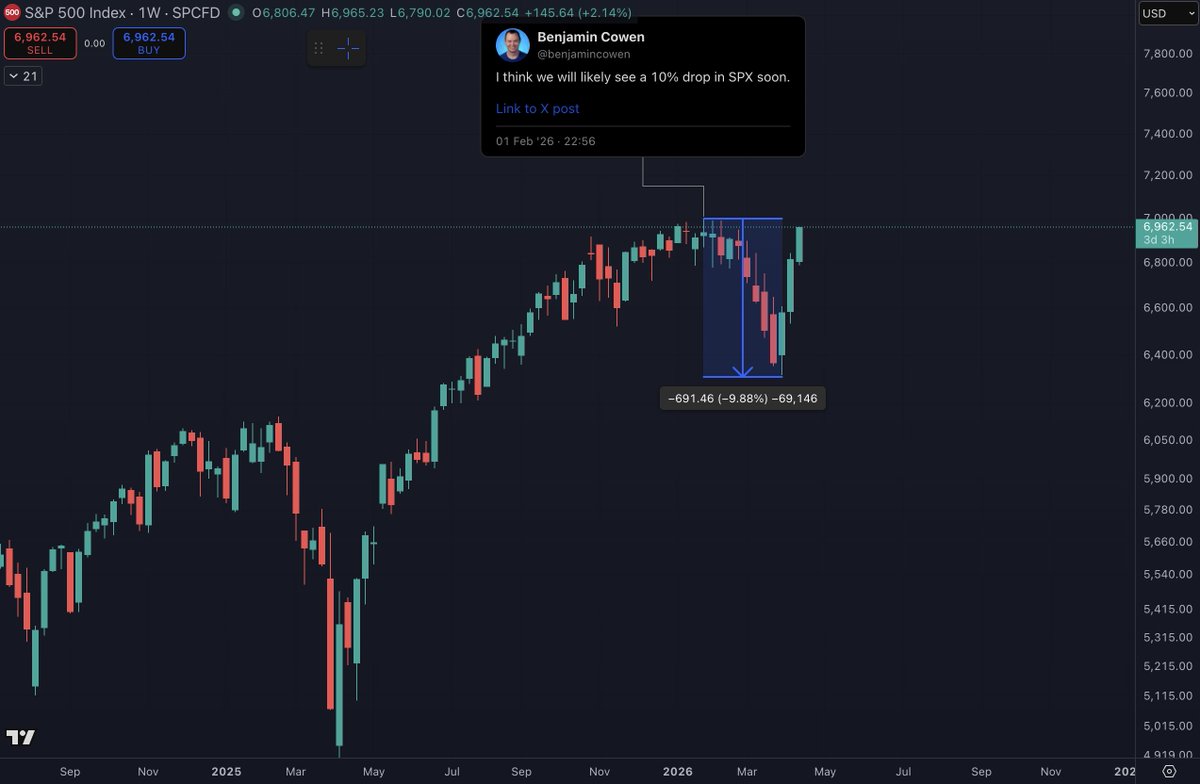
SPX had its 10% drop.
Now in the rally back near the highs.
Topping is a long process that takes a long time to play out. It can frequently even involve going back to new highs for a while before dropping again.
Think about how BTC topped at $109K in January 2025, then went marginally higher for a few months later on (to $126k), before a larger drop occurred.
I think SPX is likely in a similar pattern.
Because Bitcoin is further up the risk curve, the process played out for BTC sooner.
But as the business cycle continues, the lower risk stuff likely can go through a similar pattern.