@chingos Love this analysis Matt. Has your team ever looked at controlling for these demographic measures over time in a particular state? For example, how would MA's 2024 performance compare to MA in 2013 with those controls?
@HKorbey Guess it depends on specifics of what is being practiced by whom. MJ practicing unguarded 12 ft shots facing the basket won't add much for him. But it was hugely valuable to master 12 ft turn around/fade over a defender. Open 12 ft practice would be valuable for me though.
@chingos@ari_meltzer Fascinating work! On top of space & enrollment effects, can't ignore fed fiscal rules. If school Title I eligibility & $ is driver of more low-income students being in 'small' classes today, marginal (& total) state/local $ to comply w/ limits has to go to all schools.
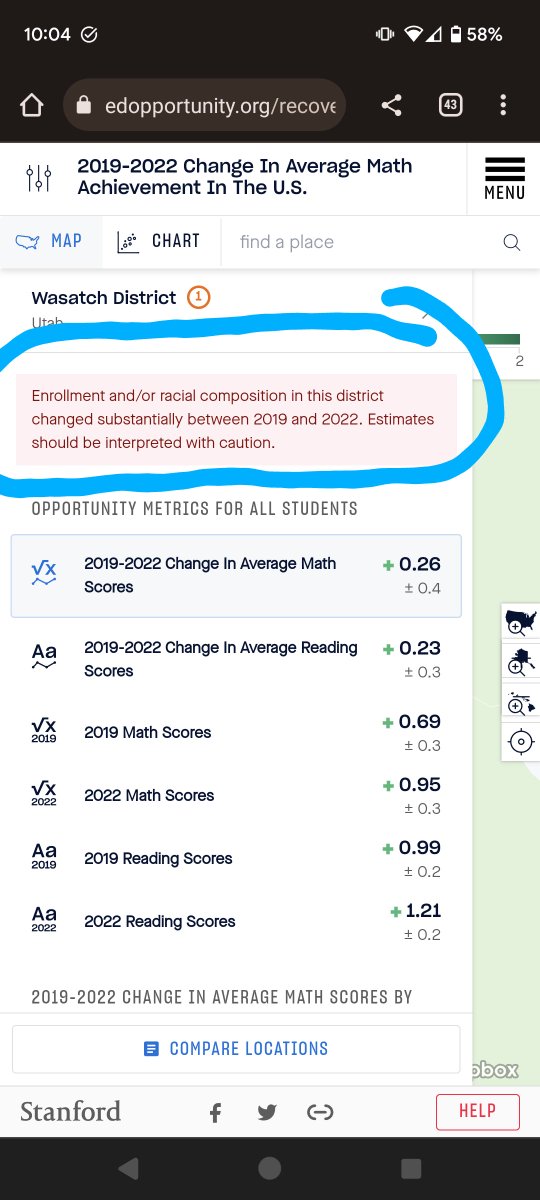
@alexanderrusso These are great, but require care. Talks about Juab's huge turnover (Sup't + 3 of 5 principals & "nearly half" of staff) but not comp district. The study flagged big changes in Wasatch (higher enrollment+ a new online program) that weren't mentioned.
https://t.co/nihsjkmEs7
IMO this framing that teaching got worse is likely to be used as ammunition to cut budgets and funding, making pandemic recovery harder. Just like the framing of ESSER mismanagement folks like @jessgartner and @RebeccaSibilia critiqued earlier this week.
https://t.co/SByRylUT10
It is wonderful that @CRPE_edu has followed a panel of school system leaders over a few years to get a sense of big issues and challenges. I've learned a lot, but the narrative framing of this report seems out over its skis based on the methodology. 🧵
https://t.co/XonU7MmeKp
I don't doubt that educators need feedback, PD, and strong curricular resources to improve instruction - especially given the increased stress, behavior challenges, lower student attendance, and wider dispersion of readiness/achievement they have encountered.
@mattyglesias I don't agree with the theory, but there is one behind the push. This piece was a heck of a deep dive on the controversy - where this one study plays a big role.
https://t.co/9djtD5lUPw
School systems really need to step up their game as buyers and negotiators. Don't take vendors' descriptions or evidence claims at face value. And don't sign contracts unless they have protection allowing for early exit or lower costs if usage is low.
This is great reporting but maddening to see the traction this company has had in the marketplace. The model they tout is not even tutoring. It is homework help and conflicts with so much of the research on effective tutoring. 🧵
NEW: Paper tells schools it offers expert 1:1 virtual tutoring. In reality, tutors are often juggling multiple kids at once & are told to help students w/ subjects they don't know. The pace is so demanding some tutors have worked on the toilet to keep up https://t.co/MNtp6MJ52K
(1) Their model is not high dosage & scheduled 2-3x per week for an extended period, it is not aligned to classroom curriculum (6) or how kids are doing with that content (5), does not have a consistent tutor kids know and can come to trust (7).
@territaylor@SecSmithEllis@EdWriters Feel for y'all, that is tough timing. Had that happen a week before pandemic shut down, also a bad time to lose contain. But it brings a smile now as I just rewatched the video wanting to tell Santa he moved to a big boy bed.
Big part of what changed is that after decades of increasing investments, funding declined.
Nationwide current expenditures:
89-99 = real per pupil expenditures +11.7%
99-09 = real per pupil expenditures +20.2%
09-19 = real per pupil expenditures -1.7%
https://t.co/Smsa5wILU7
This is a chart folks concerned w/ US public education ought to study closely. Whatever your views, our most disadvantaged kids, who were improving a lot before a decade ago, have fallen badly. What did we change? What are no longer doing, or as much or as well? Why this drop?