@SayantikaSays I passed out from school in Delhi in 98. This was a decade old tradition then. Everything is not a Gen Z invention. I still have that shirt somewhere and loads of memories. How much anti-fun can you be. Phones and cameras are the bane of this country.
Evolution produced many wondrous things - especially human minds - but it did not produce the F-22. And likely could not produce it, even in ten trillion years.
And it’s not because it’s complex. It’s actually much, much simpler than a cell.
It’s because reaching this point in design space is probably unreachable by:
1. Changing only a few genes at a time
2. Requiring every individual to meet strict criteria of survival and reproduction
It might be possible for *humans* to design a strand of DNA that constructs an advanced fighter jet.
And that would be partly because, unlike evolution, we wouldn’t destroy our failed attempts along the way, but save and learn from them.
Humans can make arbitrarily sophisticated changes to a genome - things which never happened in evolution. And we don’t require every step in our problem-solving process to meet any fixed criteria. However bad the idea, we can keep it and learn from it.
In other words, evolution does variation and selection, but humans do it better. Our variations, our steps in design space, are more sophisticated. Our selection criteria are richer and more flexible, less restrictive.
In other words, a raptor can evolve, but a Raptor must be designed.
An Ode to Stainless Steel
Our pediatrician held up the glass bottle and shook her head. "Chipping hazard," she said. Then she picked up the plastic one. "Microplastics. And see how the milk film sticks to the surface? Bacteria loves that."
She handed us a steel bottle. Plain, unremarkable, the kind that's been manufactured in Thane and Coimbatore for decades. "Use this."
I looked at the bottle in my hand. The most boring object in the room.
You see, stainless steel is the wallpaper of Indian middle-class life. We don't see it because it's everywhere. The tumbler you drank from this morning. The pressure cooker hissing on your mother's stove. The railing you grabbed without thinking on the Metro. The sink, the spoon, the lunchbox, the filter, the roof tank, the hospital tray, the train pantry, the street vendor's dosa pan.
The material that holds our lives together. Invisible through ubiquity.
For most of human history, this didn't exist. And life was significantly harder because of it.
Before 1913, storing food was a civilization-level crisis.
Iron rusted. Your water container would leach rust into your drinking supply, turning it orange and metallic. You'd watch your pots decay in real-time, the metal eating itself from the inside out.
Silver tarnished. Copper poisoned. Brass needed constant polishing or it turned green and toxic. Tin was soft and expensive. Gold was a joke for anything practical.
Every metal object in your house was slowly dying. And you had to either accept it or spend hours maintaining it.
The labor cost alone was staggering. Someone's entire job, in large households, was to polish brass and copper vessels. Weekly. Sometimes daily. You couldn't just cook and store food—you had to fight a war against chemistry itself.
Water storage? A nightmare. Clay pots were porous. Metal ones corroded. Glass was fragile and couldn't handle heat. You couldn't boil water and store it safely. Disease spread through contaminated containers. The simple act of keeping water clean killed millions.
Food preservation was even worse. Milk spoiled in hours. Meat was a luxury because refrigeration didn't exist yet, and even when it did, the containers you'd store it in were part of the problem. Anything acidic—tomatoes, citrus, pickles—would react with the metal, poisoning the food and destroying the container.
This wasn't just another inconvenience.
It was....a bottleneck on human progress.
Then a frustrated metallurgist in Sheffield accidentally changed everything.
Harry Brearley wasn't trying to invent stainless steel. He was trying to solve gun barrel erosion.
It's 1913. World War I is around the corner. The British Empire needs better weapons, and gun barrels are wearing out too quickly from the heat and friction of repeated firing. Brearley, working for a steel manufacturer, is testing alloy after alloy, trying to find something harder, something that lasts longer.
He's adding chromium to steel. Lots of it. 12%, 13%, 14%. The samples keep failing his tests—too brittle, wrong properties, not what the military needs. He tosses them into the scrap heap.
Weeks later, he walks past that heap.
Everything has rusted. The Sheffield rain and industrial smog have turned the rejected samples into corroded junk. Everything except the high-chromium samples. They're sitting there, gleaming. Untouched.
This is the moment. Not the invention—the recognition.
Brearley didn't set out to make rust-proof steel. He stumbled upon it while failing at something else entirely. But he was paying attention. He saw what others would have ignored.
He picks up the sample. Tests it. Discovers that above 10.5% chromium content, steel forms an invisible barrier—a chromium oxide layer, nanometers thin, that seals itself off from oxygen and water. Scratch it, and it heals itself within seconds. The material had learned to protect itself.
The British military wasn't interested. "We need harder barrels, not rust-proof ones."
But Brearley saw something bigger. He saw cutlery that wouldn't stain. He saw surgical instruments that could be boiled repeatedly. He saw kitchens that could finally win the war against contamination.
He tried to patent it. Legal battles erupted. Other metallurgists claimed they'd discovered similar alloys. The Americans said they'd done it first. The credit got messy, as these things do when money enters the picture.
But the invention escaped the lab anyway. By the 1920s, stainless steel cutlery was in production. By the 1930s, it was in industrial kitchens. By the 1950s, it was everywhere.
From rejected gun barrel to the material civilization runs on.
All because someone looked at a scrap heap twice.
The chromium oxide layer is a self-healing force field. Imagine if every time you scratched your phone screen, it instantly repaired itself at the molecular level. That's what's happening, constantly, on every stainless steel surface.
It doesn't rust. Not "rusts slowly"—doesn't rust. You can leave it in the rain for a decade, pull it out, wipe it down, and it's fine.
It doesn't react. Acidic foods, alkaline cleaners, saltwater, milk, tomatoes, lemon juice—stainless steel doesn't care. It just sits there, inert, refusing to participate in chemistry. This is why you can store anything in it without worrying about contamination or weird metallic tastes.
It doesn't harbor bacteria. The smooth, non-porous surface gives microbes nowhere to hide. This is why every hospital in the world uses stainless steel for surgical instruments, trays, and surfaces. It's why your pediatrician recommended it for feeding bottles.
You can sterilize it infinitely. Boil it, autoclave it, blast it with UV, soak it in disinfectant—it doesn't degrade. A steel surgical scalpel can be used, sterilized, and reused hundreds of times. Try that with anything else.
It's formable. You can bend it, stamp it, weld it, spin it into complex shapes. This is why we have steel sinks, railings, and pressure cookers—you can't make a pressure cooker out of iron; it would rust from the inside out within months.
It's recyclable forever. Melt it down, reform it, and it's as good as new. There's stainless steel in circulation today that was first smelted in the 1950s, recycled four times, and is currently part of a Mumbai high-rise.
The Goldilocks material. Not too reactive, not too fragile, not too expensive. Just right for the ten thousand small problems civilization needs solved.
Getting from "this is incredible" to "everyone has this" is its own nightmare.
In the 1920s, stainless steel was expensive. Chromium was rare and hard to refine. The manufacturing process was finicky—get the alloy percentages slightly wrong, and you'd end up with brittle, useless metal. Early stainless steel cost more than silver.
It was a luxury material. High-end cutlery. Fancy restaurant equipment. The kind of thing rich people used to signal wealth.
Then came the post-war industrial boom. Two things happened simultaneously:
First, chromium mining scaled. South Africa, India, Kazakhstan—new deposits were found and exploited. Supply increased. Prices dropped.
Second, the manufacturing process got standardized. The electric arc furnace, invented in the early 20th century, became the dominant way to produce steel. You could control temperature and composition precisely. Factories could now make consistent, high-quality stainless steel at scale.
In India, this coincided with post-independence industrialization. Bhilai Steel Plant. Rourkela. Bokaro. The government was pouring money into steel cities, trying to build an industrial base from scratch. Stainless steel production was part of that vision—India couldn't be a modern nation without it.
By the 1960s and 70s, stainless steel had crossed the luxury threshold. It was now cheaper to use than to not use. The long-term savings—no replacement costs, no maintenance, no poisoning, no rust—made it the economically rational choice.
And once it became cheap, it became invisible. The dabbawala system in Mumbai—those 200,000 lunch boxes moving through the city every day—runs on stainless steel. The entire operation would collapse if those containers rusted or contaminated food.
Indian Railways serves 23 million meals a day. The pantry system, the utensils, the storage—all stainless steel. You can't run that volume through any other material without a public health catastrophe.
Street food vendors switched from brass and copper to steel. Faster cleaning, no maintenance, no poisoning. The chai tapri, the dosa cart, the pani puri stand—stainless steel made them economically viable.
It went from luxury to necessity in a single generation. And we stopped noticing.
Walk into an operating theater. Every instrument, every tray, every surface—stainless steel.
The surgeon's scalpel will be used, sterilized, and reused twenty times this month. The tray holding it has been autoclaved daily for five years. The steel operating table has supported a thousand surgeries without degrading.
Modern surgery is possible because we have a material that can be infinitely sterilized. Before stainless steel, surgical instruments were a contamination risk. Infections killed patients even when the surgery went perfectly. The steel revolution was as important to medicine as antibiotics.
The food system runs on it too.
Industrial kitchens in hospitals, hotels, schools—they run on stainless steel. The vats, the counters, the storage, the piping. You can't cook for thousands without it. The economics don't work. The health codes don't allow it.
Indian food processing—dairy, spices, packaged goods—relies on stainless steel equipment. The fermentation tanks for dahi, the pressure systems for packaged masalas, the cold storage units. All stainless. Because nothing else can handle the combination of moisture, temperature swings, and food contact without contaminating or degrading.
Look up. Literally.
The buildings around you—the façades, the railings, the structural elements—many of them use stainless steel. The Gateway of India has stainless steel restoration work. The Mumbai Metro has stainless steel panels and railings. Modern architecture depends on materials that don't decay.
The Burj Khalifa, the tallest building in the world, uses 31,400 tons of stainless steel rebar. In a desert climate where regular steel would corrode, stainless is the only option.
Satellites. The International Space Station. SpaceX rockets. The James Webb Space Telescope. Every single one uses stainless steel in critical components. It doesn't rust in the vacuum of space. It doesn't degrade from radiation. It's one of the few materials we can trust when there's no atmosphere to protect it.
SpaceX's Starship—the rocket that's supposed to take humans to Mars—is built almost entirely from stainless steel. Not carbon fiber. Not aluminum. Steel. Because Elon Musk did the math and realized that at cryogenic temperatures and under extreme stress, stainless steel outperforms everything else. Cheaper, stronger, easier to work with.
The same material in your kitchen is going to Mars.
I'm holding the steel feeding bottle again. Same object. Different eyes.
This unremarkable thing in my hand represents a century of metallurgy, industrial scaling, and economic transformation. The chromium was probably mined in Odisha. The steel was smelted in a Jamshedpur plant. The bottle was manufactured in a Thane factory, stamped and polished by machines that didn't exist fifty years ago.
My pediatrician's casual advice—"use steel"—rests on a century of materials science. She didn't explain chromium oxide layers or bacterial resistance. She didn't need to. The technology has disappeared into competence.
And that's the marker of truly revolutionary technology: it solves its problem so completely that we forget there ever was a problem.
We don't think about rust anymore. We don't worry about metal poisoning our water. We don't spend hours polishing brass. We don't watch our containers decay. We just... live. And stainless steel quietly holds that life together.
The best technology is the technology you don't notice. The infrastructure that disappears.
Stainless steel didn't just solve rust. It solved a thousand daily problems so completely that we stopped thinking of them as problems at all.
And somewhere, right now, someone is discovering the next material that will become invisible. The next technology that will be so successful, future generations won't even know what life was like without it.
They'll pick it up, hold it in their hands, and see nothing special.
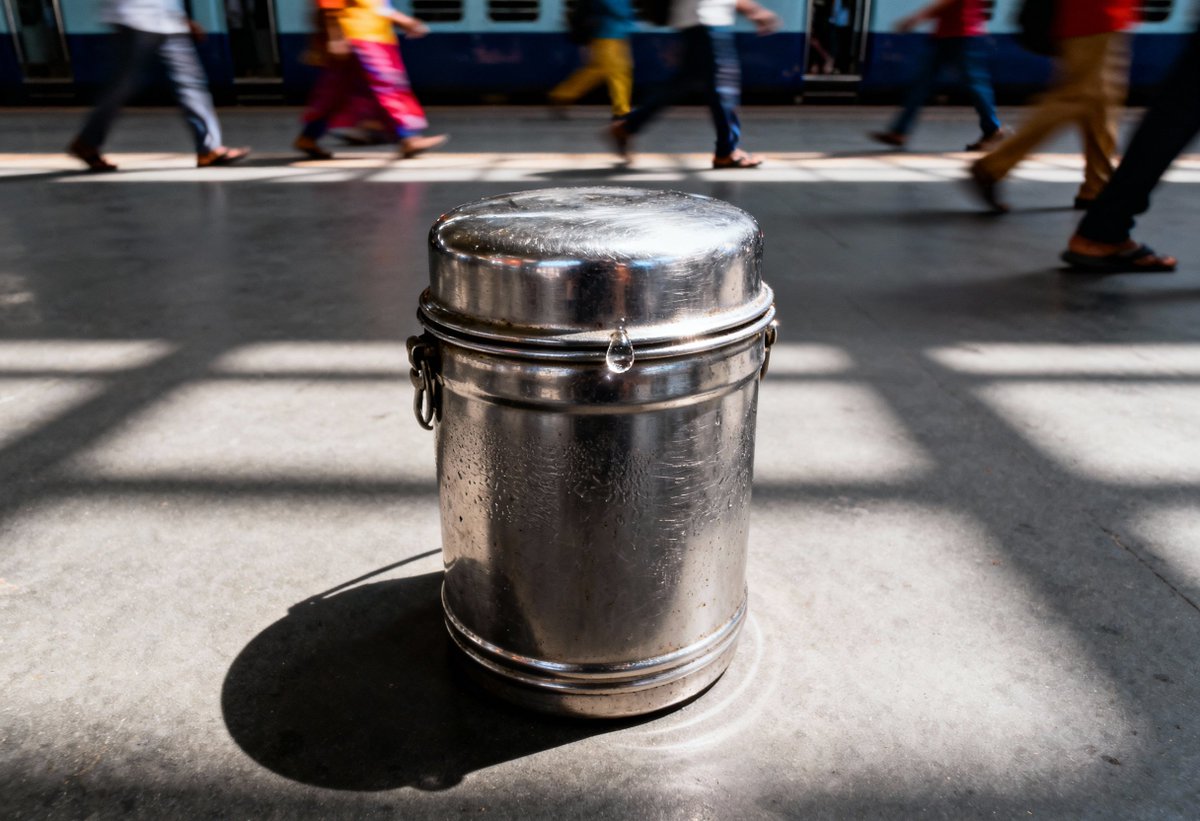
Just like we do with this steel dabba.
@sidin My father had the same comment. He was an air force pilot earlier. It was uptil now not in the uniform. Unless they are guarding the ground or drone systems. @AnchitGupta9 would know some history of air force uniforms.
“My whole life people have said to me: ‘You are too kind, too sensitive.’ When I interviewed for a schoolteacher position, the principal told me: ‘You will never be able to control the students.’ Because of this I built in my mind that I’m not a very strong person, you know? I decided to focus on my house, my family, my children. When the war started I was working as a data encoder; I spent all day on the laptop. But Doctors Without Borders said to me: ‘Kholoud, there is no one left to ask. We need you to help organize our operations in the North.’ And I’ve done it. I organized a network of people on the ground. Everyone in the organization knows me now, respects me. And I’ve done all of this while raising four children, and another four children who lost their parents. In December we spent fifteen days on the street because there were too many bombs. Nobody could sleep safely inside. I ate nothing during this time, zero. I just drank some water every two days. We were sheltering in a small corridor inside a school yard. My husband left us to look for food, and that’s when the bomb fell. When it falls close to you, you don’t hear anything. You just see the body parts flying through the air: the hand of someone, the leg of someone, the head of someone. My son comes to me and his face is blood. My daughter comes to me and she is clutching her chest. My other two children are holding their legs; I can’t tell how they are injured. There was no hospital left in Gaza City, so I brought them back to our house. Our neighbor is a doctor, so I asked him to come over. We discovered that one of my children had shrapnel in the head. The other three in the leg. There was no anesthesia, no stitches. We put something in the children’s mouth, and I held them down while he removed the shrapnel with the kitchen knife. You cannot imagine how the children were screaming. But we removed the shrapnel. And when we finished, I took the knife, and removed the shrapnel from my own leg. ‘Too kind, too sensitive.’ I heard this my entire life. But I can tell you: another person lives inside you. And if the world forces you, you will find her.”
----------------------------------------------------
Kholoud’s story is part of a series of stories I am currently doing on the Palestinian Staff of Doctors Without Borders in Gaza. I will be sharing these stories over the next several days.
From @MSF_USA : Kholoud Al-Sedawi has been with MSF (Doctors Without Borders) since 2019, progressing from Data Entry Operator to her current coordination support role. When most humanitarian workers withdrew from northern Gaza, Kholoud stayed and helped restart MSF's operations amid some of the genocide's most severe conditions. Her work focuses on restoring basic healthcare services where hospitals have been damaged or destroyed and organizing mobile clinics. While the situation remains dire, Kholoud's persistence has enabled MSF to maintain a presence in northern Gaza when most organizations could not.
@pranaykotas@BlrLitFest Me and my 11 year daughter have a plan to read a chapter a day and discuss over dinner. Super book and making this knowledge accessible to the younger crowd. Love it.
@Paperclip_In Nice story. Maybe the only ace but not the only indian pilot in the Royal Air Force. He also flew the sopwith camel if I am not mistaken. The Hawker Hurricane came in the 2nd world war.
@dharmeshba@sajithpai Aa somebody who does a lot of demos and presentations. She is a great stock character for it :) I always wondered how she must be looking at her face everywhere. The number of ads, she is in. She might as well be the unknown celebrity.
To anyone considering ordering from @Saraffurniture , think twice. Still waiting on an order for 5 months. No updates, no bookcase, just a whole lot of disappointment. #BuyerBeware#SarafFurniture#insaraf
@Saraffurniture Was informed there was a quality issue in April and the product needed to be remade. Expected delays, but was promised a delivery by May 15. It's now well past that, and still no bookcase! #SarafFurniture#insaraf#WaitingGame
This isn't just about a delayed furniture delivery. It's about trust and respect for customers. @Saraffurniture , how do you plan to resolve this? Looking for a real update or a full refund now. #ResolveThis#SarafFurniture#insaraf
@Twelvisten That was why Adobe built firefly to allow enterprise customers to generate content which doesn't get them sued aka within copyright. Also provides indemnity clause.
So if Air India brings forward a flight by 12 hours- for a 2 Jan flight back from thailand to mumbai. What is the procedure. They have not mailed me, but i saw it when i logged in the website. @outofofficedaku