The 70th Anniversary of the 1956 Women’s March National Symposium continued with powerful conversations as women shared their wisdom, experiences and reflections on the enduring power of activism.
Through thought-provoking dialogue, the event highlighted the vital role of women in advancing leadership, transformation and inclusive societies, while honouring the courage of those who paved the way.
The legacy continues , inspiring new generations to turn historic commitments into meaningful action.
@TMFoundation_
#WomensMarch70 #FerozaAdamMemorialLecture #Unisa150andBeyond
Seventy years later, the legacy of the 1956 Women’s March continues to inspire South Africa.
Unisa’s Thabo Mbeki African School of Public and International Affairs, in collaboration with the Department of Leadership and Transformation and the Chief Albert Luthuli Research Chair, is commemorating this historic milestone through a national symposium held under the theme, “Translating Historic Commitments into Resilient Institutions and Inclusive Societies.”
@TMFoundation_
#WomensMarch70| #FerozaAdamMemorialLecture |
#Unisa150andBeyond
Vice-Principal: ICT and Chief Information Officer, Mathabo Nakene-Mginqi, delivered the welcome address, reflecting on the enduring legacy of the 1956 Women's March. She noted that the women's call for freedom, justice and security was more than a protest—it was a visionary framework for governance and social transformation that remains relevant 70 years later.
Linking this legacy to the symposium's theme, she emphasised the continued commitment to advancing these ideals for future generations and welcomed the keynote speaker, recognising her leadership as Chairperson of the South African Women in Dialogue (SAWID) and her contribution to advancing women's empowerment and inclusive development.
#WomensMarch70 | #FerozaAdamMemorialLecture | #Unisa150andBeyond
Unisa's Thabo Mbeki African School of Public and International Affairs, in collaboration with the Department of Leadership and Transformation (DLT) and the Chief Albert Luthuli Research Chair, is set to host a national symposium commemorating the 70th anniversary of the 1956 Women's March.
Held under the theme, "Translating Historic Commitments into Resilient Institutions and Inclusive Societies," the symposium, "Remembering, Reclaiming Solidarity and Charting Futures," will honour the legacy of the women who marched against apartheid pass laws in 1956 and reflect on their enduring vision of freedom, justice and equality.
YouTube Link: https://t.co/cVQfQACGxF
#WomensMarch70 | #FerozaAdamMemorialLecture | #Unisa150andBeyond
Vice-Principal: ICT and Chief Information Officer, Mathabo Nakene-Mginqi, said the symposium seeks to bridge the historic legacy of women-led resistance with contemporary policy and governance challenges, placing resilience, inclusion and justice at the heart of Africa's development agenda.
#WomensMarch70 | #FerozaAdamMemorialLecture | #Unisa150andBeyond
Delivering the keynote address, Ms Thoko Mpumlwana, Chairperson of the South African Women in Dialogue (SAWID), reflected on the enduring legacy of the women of the 1956 Women's March, describing their courage and vision as a lasting source of inspiration for South Africa's constitutional democracy.
She emphasised the importance of remembering the pioneers who gave ethical meaning to the struggle for freedom, justice and equality, urging society to uphold their legacy by advancing inclusive leadership, solidarity and social transformation for future generations.
#WomensMarch70 | #FerozaAdamMemorialLecture | #Unisa150andBeyond
She noted that the gathering brings together academics, researchers, policymakers, civil society, government representatives, gender and governance practitioners, and youth leaders to foster dialogue, knowledge sharing, and critical engagement. Panel discussions will examine women's resilience and political transformation in Africa, peacebuilding, and strengthening solidarity, with insights from distinguished experts and practitioners.
#WomensMarch70 | #FerozaAdamMemorialLecture | #Unisa150andBeyond
The colloquium is underway with welcoming remarks by the Speaker of Parliament.
Honourable Thoko Didiza reflected on the importance of the South African Constitution as the foundation of our democracy and a guide towards justice, dignity, and equality. She acknowledged that while the past 30 years have brought meaningful progress and important gains, there have also been moments of regression that require honest engagement and accountability.
She welcomed the colloquium as an important first step towards sincere reflection on what is required to transform our society, strengthen democratic institutions, and uphold the ideals and promises of the Constitution.
@unisa@MbekiSchool@ParliamentofRSA
Opening the colloquium, is the Vice-Chancellor of @unisa@LenkaBula
"In 1996, on 8 May, the Constitutional Assembly adopted the final text of South Africa’s Constitution. On that same day, the then-Deputy President Thabo Mbeki delivered a speech that would become sacred scripture in our democratic canon: “I Am an African.”
That oration was not merely a poem of belonging. It was a constitutional act in its own right! A performative declaration that wove together the wounded and triumphant threads of our identity and our past.”
@MbekiSchool@ParliamentofRSA
NEW BOOK ALERT🚨🚨🚨
Research Methods in Military Science: A South African Multidisciplinary Approach gives a detailed and in-depth analysis of research methods and ethical issues to be considered when a researcher conducts research in a military context.
The book presents a novel and timely research methodology that is driven by military issues. Using a plethora of perspectives from geography, economics, public administration, accounting, industrial psychology, political science, the book foregrounds and dissects paradigms, procedures, techniques and methods that are applicable and relevant in a military setting.
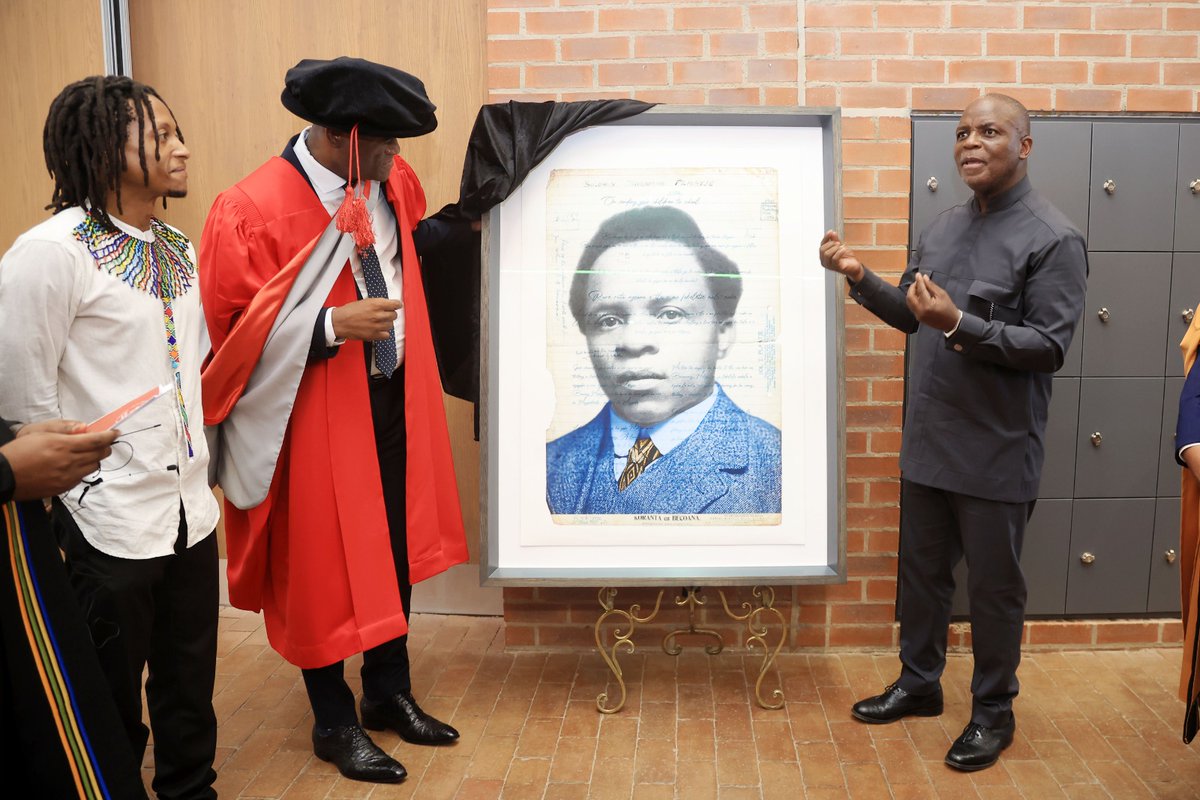
On the day of his inauguration, Chancellor Thebe Ikalafeng gifted SPU a commissioned portrait of Solomon T. Plaatje, inspired by Plaatje’s own writings on the importance of education.
The Robe. The History. The Legacy.
The ceremonial robe placed on Chancellor Ikalafeng’s shoulders tonight was designed by Kimberley’s own @_ThebeMagugu_ , Africa’s first LVMH Prize winner.
My African Family who watched Marco Rubio's disturbing speech, did you not notice anything worrisome?
Did you not notice that the only time the European delegation at the so called "Security Conference" were electrified and gave Rubio a standing ovation, was when Rubio praised Western imperialist success in the Global South and called upon them to not allow these *ungodly Communist takeovers and uprising " to succeed .
European imperialists have not changed one bit, they are the same yesterday, today and possibly forever.
We must show they that we the Africans of the 21 Century are have changed in a deadly way, otherwise there can be no realistic path forward for us.
US Secretary of State, Marco Rubio calls for Western Civilisation to reclaim its place in the world. He was speaking at the 62nd Munich Security Conference, Germany.
He argued that the West’s Christian and Capitalist driven colonial expansion must never be a mark of guilt. This is a “noble” heritage of the West & must be reclaimed and used to reassert Western global dominance.
He say the US/EU alliance must be “one that does not maintain the polite pretence that our way of life is just one among many and that asks for permission before it acts.”
He told Europe that the US wants allies who embrace their colonial history as a strength! He added that:
“… the alliance that we want is one that is not paralyzed into inaction by fear – fear of climate change, fear of war, fear of technology. Instead, we want an alliance that boldly races into the future. And the only fear we have is the fear of the shame of not leaving our nations prouder, stronger, and wealthier for our children. An alliance ready to defend our people… not one that exists to operate a global welfare state and atone for the purported sins of past generations”.
Rubio even reminisces about a glorious colonial past, indicating that:
“For five centuries, before the end of the Second World War, the West had been expanding – its missionaries, its pilgrims, its soldiers, its explorers pouring out from its shores to cross oceans, settle new continents, build vast empires extending out across the globe. But in 1945, for the first time since the age of Columbus, it was contracting. Europe was in ruins. Half of it lived behind an Iron Curtain and the rest looked like it would soon follow. The great Western empires had entered into terminal decline, accelerated by godless communist revolutions and by anti-colonial uprisings that would transform the world and drape the red hammer and sickle across vast swaths of the map in the years to come.”
Many of you need to understand what this means for us here in Africa: Europe, not Russia, not China, built whatever is left since independence. Africa, in the spirit of what Rubio states, is part of the heritage of Western Civilisation. They are actually telling Europe, Africa is yours and don’t be polite about it!
At the center of African domination is a base called South Africa: this is their base. The ground on which they planted a white settle community to safeguard their interests. It will be the first target to ensure the return of Western dominance. Because South Africa has a strategic power to drive African Unity. And a United African continent will not be desirable. To break Africa from acting as one: they need to obliterate whatever the ANC represented in the past 100 years, and hand over control of South Africa’s political system to potentates willing to work with the West in restoration of its colonial Power in the world.
Whether such forces exist already in the ANC or are converging outside of it remain to be seen. Fact is: South Africa in the next decade will be on an axis of contestations by brutal global forces.
What did ANC represent, amongst others, it stood for:
1. Anti-Black Racism anchored on Universal Human Rights
2. Native Republic: United, democratic, non-racial, non-sexist developmental state
3. African Unity and Pan-African global movement
4. Global System of Peace, Stability & cooperation
Those who seek to revise/reverse these values today are looking for, amongst other things:
1. Federalism & lean state
2. Parliamentary & Traditional Leadership Supremacy
3. Disengagement from Pan-African Unity
4. Market driven development
5. Alliance with the West & Israel
https://t.co/JBs9Y56d3T
Minister Leon Schreiber invites public comment on the Draft Revised White Paper on Citizenship, Immigration and Refugee Protection
Following approval by Cabinet, the Minister of Home Affairs, Dr Leon Schreiber, has today published the Draft Revised White Paper on Citizenship, Immigration and Refugee Protection in the Government Gazette for public comment.
In keeping with a directive by Cabinet to maximise public participation beyond the festive season, the period for public comment will be open until 31 January 2026.
Read further here: https://t.co/XpPdZP4ihh #ServiceDeliveryZA #TeamHomeAffairs






![TMFoundation_'s tweet photo. Restoring The Creator Economy: Building Local Wealth & Global Influence
YouTube [https://t.co/bemlBjyuVn]
#CTC2025 #CapeTownConversation https://t.co/ZBzW8ooOhV](https://pbs.twimg.com/media/G6mmv3mWcAA7Mkw.jpg)


