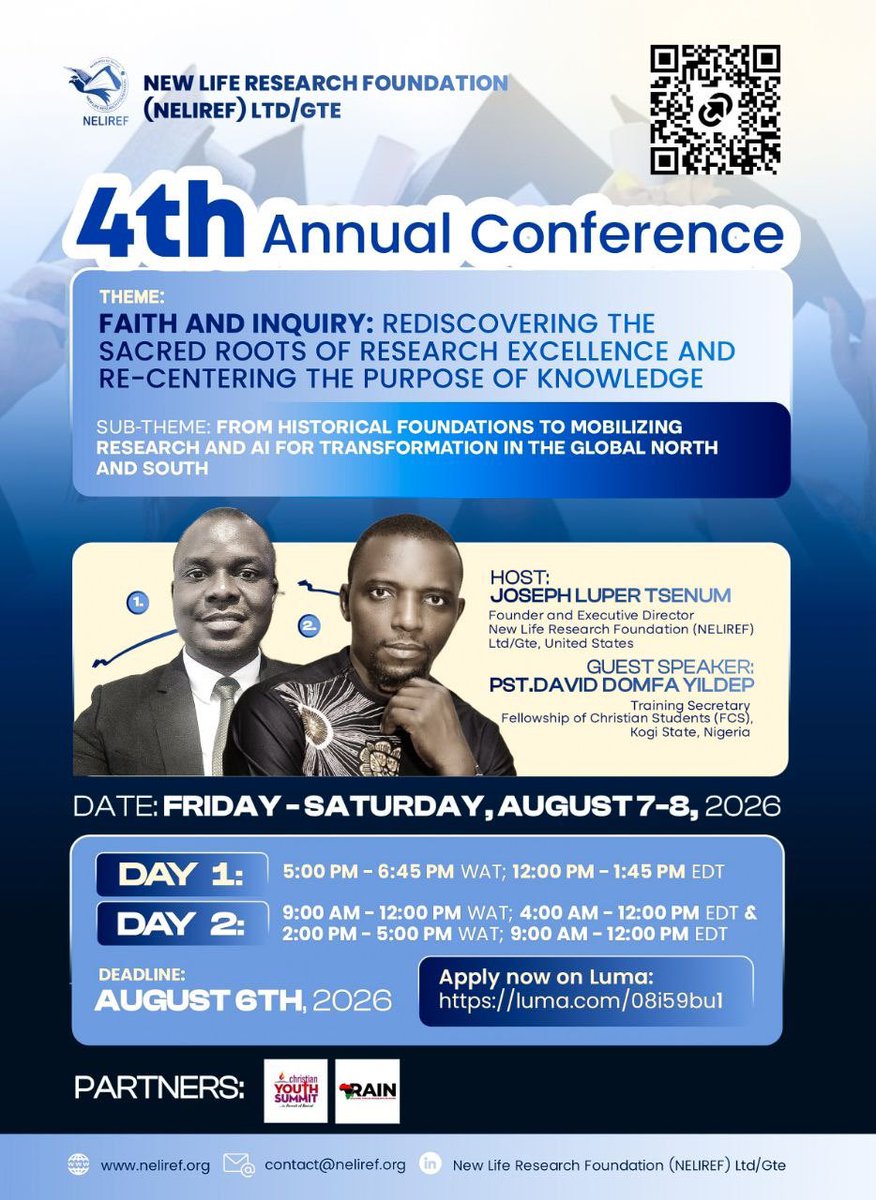
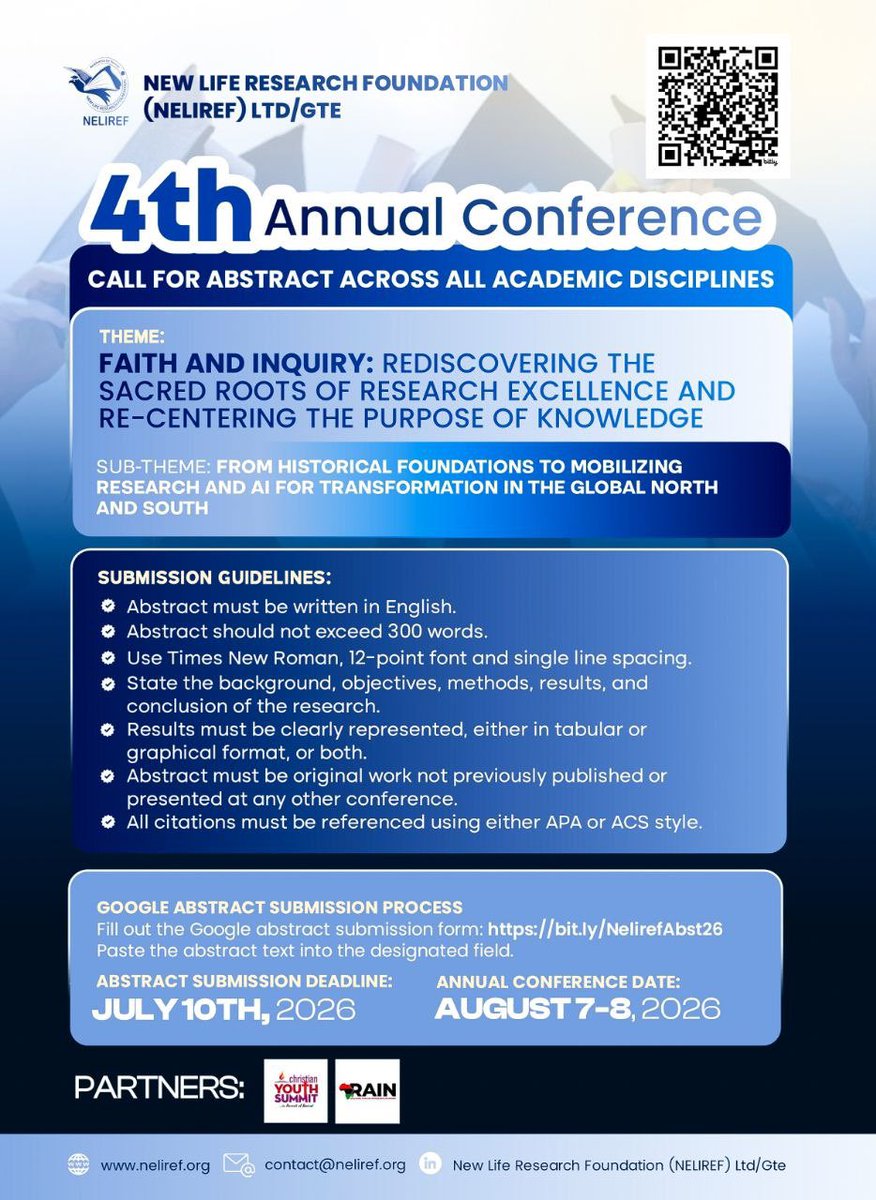
NEW LIFE RESEARCH FOUNDATION PLATFORM LINKS
Website: https://t.co/LIqACXtgYP
Facebook: https://t.co/j2vc2UnJhu
https://t.co/vLgzEqp6i3
Telegram: https://t.co/Kxf3CAXjh5
Youtube: https://t.co/K3HTOXb4d3
LinkedIn: https://t.co/edvwwyLexw
IG: https://t.co/ZeDtUtKHqc
DeepRank-Ab: A scoring function for antibody-antigen complexes based on geometric deep learning
1. DeepRank-Ab targets a key failure mode in antibody–antigen modeling: good poses are often sampled but not ranked correctly. The paper shows an example where AlphaFold3 generates a DockQ 0.6 model yet ranks it 498th, illustrating that scoring (not only sampling) is a central bottleneck.
2. The authors introduce a rigorously curated benchmark tailored to antibody–antigen interfaces: ~2.3 million decoys from 1,442 complexes (from SAbDab), generated under four HADDOCK3 protocols (bound/unbound docking and refinement). Complexes are clustered with Foldseek-Multimer and split at the cluster level to reduce data leakage.
3. DeepRank-Ab is trained as a regression model to predict continuous DockQ (pDockQ), rather than a binary “acceptable/not acceptable” label. This preserves the full spectrum of model quality and directly supports ranking.
4. A major design finding: atom-level interface graphs outperform residue-level graphs for antibody–antigen scoring, consistent with the importance of fine-grained CDR loop geometry. The best-performing formulations combine atom-level nodes with interface-focused edges.
5. The interface representation is strengthened using Voronoi-based surface decomposition: edges can encode either simple interatomic distances or Voronoi contact areas. Across cross-validation, Voronoi contact area provides a consistent edge over distance-only encoding for predicting and classifying near-native poses.
6. Antibody-specific and physics-inspired features matter. Adding IMGT-derived region labels (e.g., CDR annotations) and geometric/energetic descriptors improves performance and stability; ablations show large error increases when removing region labels, atom type, covalent interactions, orientation, or Voronoi contact area. In contrast, raw ESM-2 embeddings are partly redundant, and antibody-specific fine-tuning (AbTune) yields only marginal gains relative to added complexity.
7. Training data sampling is treated as a first-class modeling choice. Besides “balanced” sampling across DockQ bins, they test targeted upsampling of low-quality decoys (DockQ < 0.23) to increase structural diversity in failure modes; this slightly improves overall learning and robustness.
8. Architecture: an E(n)-equivariant GNN with a two-branch design that processes interface edges and internal edges separately, then pools with global attention and predicts pDockQ. This keeps rotational/translational symmetry while learning local interface geometry.
9. On the hardest docking benchmark setting (unbound–unbound docking; n=215), DeepRank-Ab variants outperform HADDOCK EMscoring and VoroIF-jury in Top-k success. Atom-distance edges do best at Top1, while Voronoi-area edges become strongest at higher k (e.g., Top10), reflecting tradeoffs between sharp early ranking and broader enrichment.
10. Generalization beyond docking decoys: on an AF3-focused external test set (59 complexes released after AF3’s training cutoff), DeepRank-Ab improves AF3 Top1 success by 35.5% and more than doubles mean Top1 DockQ. A notable practical tweak is removing the electrostatics term to better handle unrelaxed AF3 structures (distribution shift from clashes/packing), boosting Top1 success to 54.24%.
11. External CAPRI/MassiveFold evaluation (5 antibody–antigen targets) suggests strong out-of-distribution performance: DeepRank-Ab reaches 100% Top5 success, with especially strong results on peptide antigens. The paper also analyzes why: peptide interfaces tend to be more locally driven and compatible with the model’s 5 Å heavy-atom cutoff graph construction.
12. The work argues that “consensus scoring” is not automatically beneficial: combining DeepRank-Ab with AF3 via averaging or jury voting reduces performance, implying DeepRank-Ab already captures much of the useful ranking signal for these systems.
💻Code: https://t.co/qfHjbNkCGs
📜Paper: https://t.co/RWdeEu450N
#ComputationalBiology #StructuralBioinformatics #Antibodies #ProteinDocking #GeometricDeepLearning #GNN #AlphaFold3 #HADDOCK #CAPRI #BenchmarkDatasets
We're hiring for MINT-Zürich 🇨🇭 @Apple , interns + full-time to build multimodal foundation models, with research across pre-training, post-training, agents, and world models!
Email us at [email protected] with CV + relevant work, and apply to https://t.co/a3VfBt8G7R
At #CVPR2026 in Denver this week btw, feel free to say hi 👋
Good experimental design is the foundation of research that holds up. ABI and the African Plant Breeders Association are hosting a free, open Agri-Informatics Lecture Series from June 2026. Register for each session separately.
https://t.co/I1Riw8rIa1 👇
A highlight from the ABI Annual General Meeting. Founding member Prof. Nicky Mulder reflects on what ABI is building and why it matters, from the science to the community to the long-term vision for bioinformatics across Africa.
#AfricanScience#Bioinformatics#ABI
Now accepting applications for our Synthetic Plant Biology program, which supports research that applies engineering principles and techniques to advance our understanding of how plants function. More details: https://t.co/yGs1MJacrt
#science#biology#funding#lifesciences
I am looking to hire 1-2 interns to work with me in Tokyo at RIKEN, starting October 2026. Topics are in intersection of optimization, DL and Bayesian methods. The internships are fully funded.
More details here, please share with interested students: https://t.co/iyX27ZZ03K
We’re hiring a biology postdoc in the Tambar Lab at UT Southwestern!
Interested in chemical biology, protein-small molecule interactions, target engagement, and targeted protein degradation? We’d love to hear from you.
PhD required. @utswpda
Apply here:
https://t.co/ZYcujmSP0N