Natural language processing accurately triages patient-initiated #EHR messages reporting positive #COVID19 home test results, enabling faster treatment access by reducing physician response time and improving EHR efficiency. https://t.co/uhtv8HekFU @nellmmb
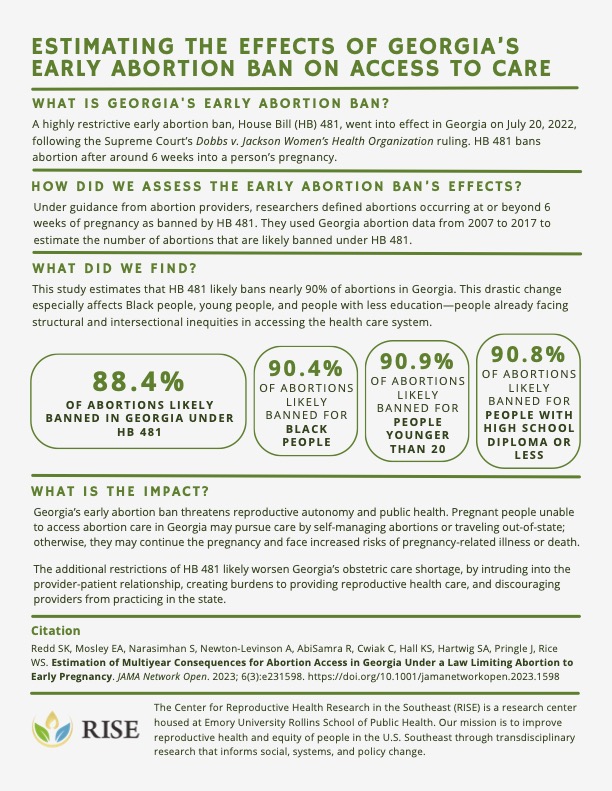
Excellent writing and crucial research about Georgia’s early abortion ban by an incredible team! @EmoryRISE @DrCarrieOBGYN @WhitneyS_Rice
Read the full article here: https://t.co/uE6KWW3Cz6
Bodily autonomy is linked to economic concerns. “Taking away access to an abortion means people have kids before they have the resources to do it, and then are less likely to have children later under better circumstances." - @Dianagfoster in @HuffPost. https://t.co/Ma9x3srSXN
We post a lot about people who have to travel thousands of miles to get abortion care, but they aren’t the only people getting displaced.
Abortion bans in southern and midwestern states are causing surges of demand in states like Illinois, Colorado, and Kansas 🧵
This state-by-state @FiveThirtyEight graphic shows how some abortion rates plummeted due to bans and regulations [deep purple] while other states saw increases [green].
BREAKING: A new report released by the #WeCount Project shows that in the two months after Roe v. Wade was overturned, state bans pushed abortion care out of reach for more than 10,000 people. https://t.co/cNzgAG8L8A
My incredible colleague and @GA4RJustice co-founder, Ariana Traub (who is Twitter-less), discussed our research in this excellent @nytimes piece today. Thank you @JanHoffmanNYT! https://t.co/1XJ8oDQaDI
In Brian Kemp’s Georgia, 18 counties don’t have a general doctor. 82 of 159 counties do not have an OB/GYN. 6 hospitals have closed in 4 years. Brian Kemp has shown us his priorities.
Enough is enough.
The impact of restrictive legislation on fertility treatment - please listen https://t.co/Ciyk5mjsr1 and vote! @ReprodMed @GA4RJustice@NPR@jessicamador
"I expect the ban to increase maternal mortality and morbidity in Georgia and to continue and exacerbate the racial disparities in material mortality and morbidity in the state." - Dr. Rice
Dr. Rice clarifies reasons that people may be delayed in seeking abortion care:
- Health conditions for which detection of pregnancy may be later than for other people
- Difficulty obtaining funds for travel/lodging/services
- Difficulty getting time off of work
Dr. Rice shares that in Georgia, there is a shortage of physicians, including a shortage of OBGYNs and pediatricians. Nearly half of Georgia's counties lack an OBGYN in that county.
Dr. Rice also shares that Black Georgians are over twice as likely to be affected; systemic racism means that Black folks experience difficulty with accessing pregnancy care, bias and discrimination in the healthcare system, and higher rates of poverty.
Dr Cwiak says the criminalization of abortion services is decreasing the number of OGBYN fellows applying to her program and thus will likely decrease the number of practicing OBGYNs in Georgia. 50% of counties in Georgia already do not have a practicing OBGYN at all.
Dr. Cwiak states the reality for many people - doctors are often unsure of what they can legally do in the case of medical emergencies related to pregnancy because of the risk of criminalization. #HB481 doesn't include clear information to guide medical professionals.




![ANSIRH's tweet photo. This state-by-state @FiveThirtyEight graphic shows how some abortion rates plummeted due to bans and regulations [deep purple] while other states saw increases [green]. https://t.co/EzZfHaU3B9](https://pbs.twimg.com/media/Fg_Cc-cVUAAvyH0.jpg)