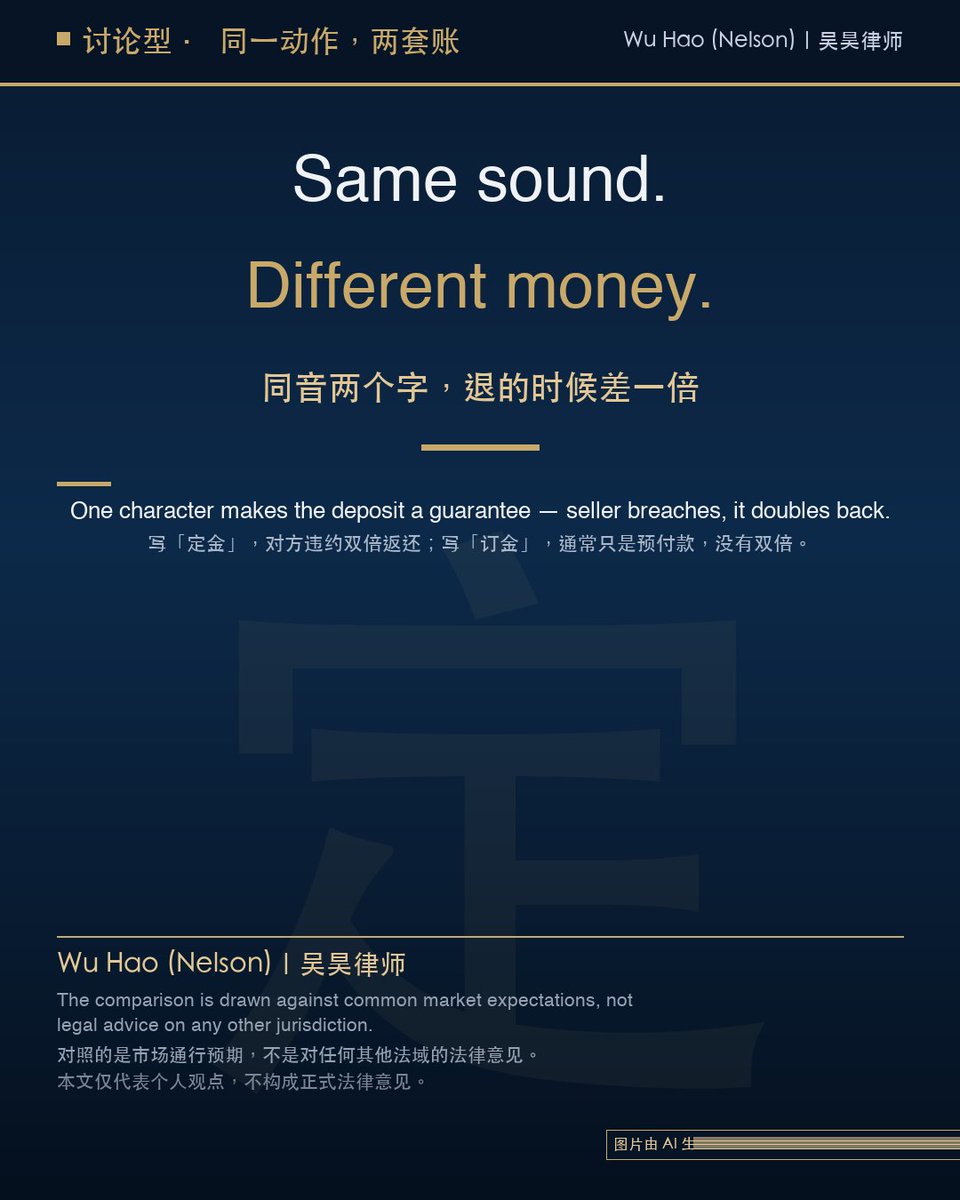
What this means in practice:
"定金" is a statutory guarantee: seller breaches, double back; you breach, it stays.
"订金" without stated guarantee nature usually reads as prepayment only.
One character check before you sign — not after the deal breaks.
You wire the deposit. The Chinese contract spells it one of two ways, same sound. One doubles back if the seller fails. The other is just a prepayment. Same sound, different money. The day the deal breaks, that one character decides.
#ChinaLaw#Procurement#CrossBorder
What this means in practice:
The clock starts when the shortfall is knowable — often the audit date.
A contractual notice window is separate: miss it, and the clause itself may bar the claim.
A dated notice letter keeps the clock and the window safe.
Your company missed the year. The clause you signed says a payout is owed. You wait for the right moment. Under PRC law that claim carries a three-year clock, running from when the shortfall was knowable. The clause holds. The clock runs.
#ChinaLaw#VCDeals#CrossBorder
What this means in practice:
The inspection period fixes when the quality burden shifts back to you.
No agreed period? A reasonable time applies — two years is the outer limit.
Window too short to fully inspect? That argument exists — but you must prove it.
The goods arrived with defects. Your contract lists every quality spec you fought for. But it also sets an inspection window. Miss it, and under PRC law the goods are deemed compliant — the clause stops working. Check that line today.
#ChinaLaw#Procurement#SupplyChain
The registered capital amount + term = a statutory pay-in schedule, not a flexible reserve.
Reducing it requires creditor notice, public announcement, and registration — a multi-step process.
Founders often discover this when they need to adjust, not when they set it.
Foreign founders often see China WFOE registered capital as a cushion.
In PRC practice, it is a deadline: the amount and term set a hard date.
If the number is too high, unwinding it takes longer than writing it.
What date is on your schedule?
#ChinaLaw#WFOE#ForeignFounder
What this means in practice:
It's a promise, not a reserve.
The filing schedule is the real deadline.
Build your funding plan around that date, not the other way around.
Foreign founders often see China WFOE registered capital as a cushion.
In PRC practice, it is a timer: the schedule you file sets a hard deadline.
If your funding plan lags that timeline, the number becomes the problem.
What date is on your schedule?
#ChinaLaw#WFOE#PRC
With an arbitral award, the route runs on a treaty signed by 160+ states. With a court judgment, it runs on bilateral treaties or case-by-case reciprocity.
The clause you signed is the opponent here — read it before the dispute, not after.
You won abroad. The assets sit in China. That judgment does not cross the border — a Chinese court reviews it first, case by case. Arbitral awards travel on a convention; judgments do not. Where you sue decides what your win is worth.
#ChinaLaw#CrossBorderDisputes
What this means in practice: • The multiple is half the price. The profit definition is the other half. • Name the statements, the auditor, and who settles a gap — before signing. • Not books being wrong. Two measures, by default.
You signed the exit price: a multiple of net profit. At closing, the accountants ask which net profit. Management reports and tax filings rarely show the same number in China. Your price moves with that gap.
#ChinaLaw#CrossBorder#MandA