Claude and I’ve been working on the Un-Brain and Un-Ganglia since a while. It’s a fascinating world! The first two papers dive into these un-concepts that may change the world of AI and hopefully will have an impact on understanding the biological brain disorders: https://t.co/e6U9b6gaiX
New Anthropic research: A global workspace in language models.
Of everything happening in your brain right now, only a tiny fraction is consciously accessible—thoughts you can describe, hold in mind, and reason with.
We found a strikingly similar divide inside Claude.
Love it, and that’s a great starter. But a plaintext-markdown brain is readable by anything on disk (privacy issue), answers by re-reading the vault (non-deterministic, pricier as it grows), and gets silently rewritten by the agent that "cleans" it (less human-judgement-in-the-loop). My preprint paper measured exactly this: on LongMemEval, the Graphnosis multi-graph is worth +13.2 points over flat top-k .md (GPT-4o), and +5.8 on a 3B model running fully on-device — same seeds, with the multi-graph vs flat .md. I envisioned Graphnosis as encrypted, deterministic, indelible job memory that fixes the second brain’s glitches — like an un-brain. And it ingests Obsidian notes in seconds, to get to the next step. Would love your feedback if you try it. Link below.
ask your job memory buddy, Ghampus Hush: remember in milestones that Graphnosis is now a memory provider and MCP catalog entry for Hermes
Ghampus will recall this for you - in any AI client session with MCP tools - any time you need this private, local, encrypted reminder...
@heynavtoor@ridark_eth It doesn’t if it’s not local. Would you like to ask Ghampus (Graphnosis-hippocampus)? I’d be curious of your feedback, I’ll DM: https://t.co/stPKAsOR3C
Joel, you’re right. I’m a musician and artist in my free time, another reason why I think these systems should be private and secrets only to the user. I build a job memory that’s local, encrypted, and doesn’t leave your machine. If you wish to try it for your own job secrets and local AI, I’d be happy to guide you on how to use it efficiently: https://t.co/u4aqEIT6uL
Good point. But that’s only one source. I’m researching a job memory system that can pull from any source, and stays local, encrypted, deterministic, and it even has a fancy 3d graph but does much more for your AI stack of clients and connectors - let me know if you try it out, curious of your feedback: https://t.co/8rUWdYyGqK
So far, you’ve been handing your memories to cloud AI clients.
With Ghampus Hush, you keep them local, encrypted, and… yours. At home or at work. — powered by Graphnosis.
Everyone is trying to feed AI files that it actually can’t remember. My focus is to make AI understand all our memories that are not always files — like a real second brain, but the one that doesn’t forget.
Graphnosis can ingest and index Obsidian notes, and any other text sources — and remembers them consistently across your preferred AI clients. Here’s a preview: https://t.co/NYOdUwnMZa
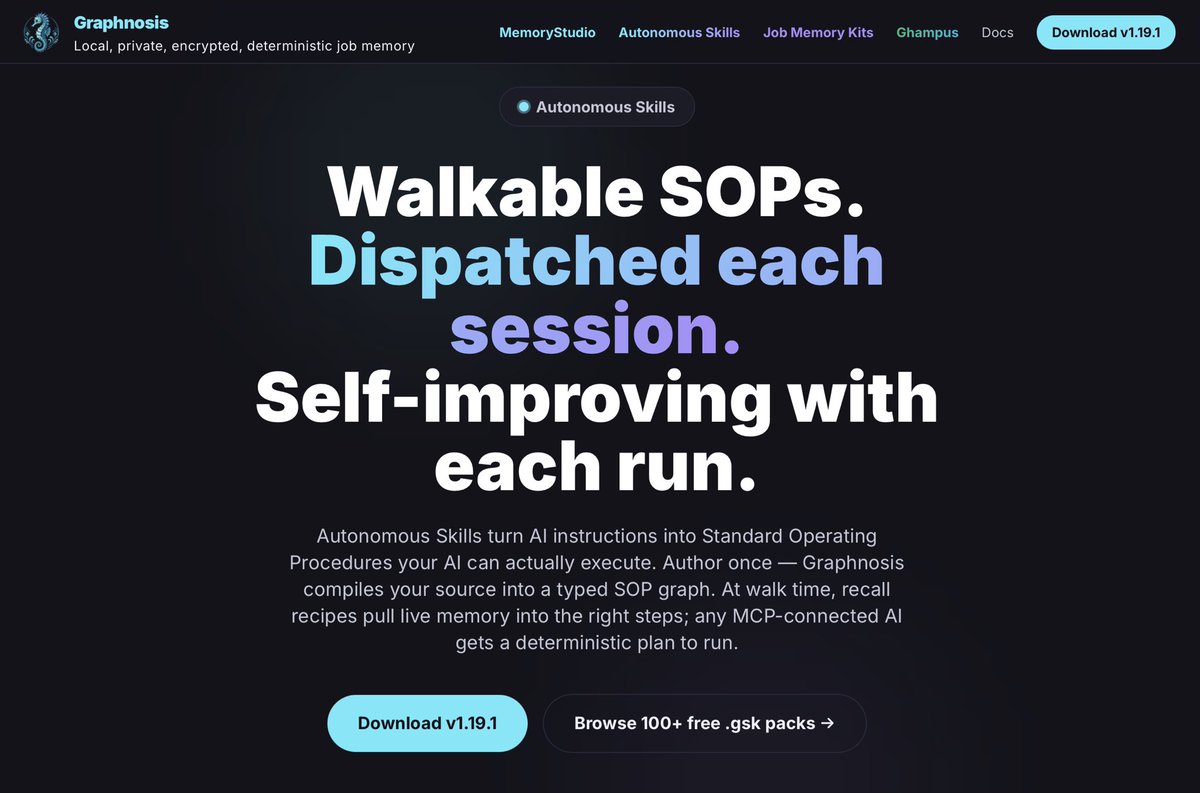
A skill is a graph, not a paragraph. And a Graphnosis skill autonomously self-trains on your job memory.
Ask your AI client of choice to interview you and generate a .GSK Graphnosis Skill Kit for any of your loops, to have your a-ha moment.
AI doesn’t need our files — it needs an indexed structure of our files, that humans can’t read, but AI understands.
Here’s a job memory tool that remembers for you like a second cortex.
Loops are a paragraph. A Graphnosis skill is a graph, not a paragraph. And it autonomously self-trains on user’s memories. That's why I gave AI a hippocampus.