I just opened twitter and all I see is an enormous wave of hate and disappointment towards GTAVI.
I didn’t get to play the game, but I’ve played the previous gtas.
Is it really that bad or are people exaggerating?
This might be the bermuda triangle of programming and it feels like i'm staring to the abyss.
The abyss just stared back and said: fk u
And I still keep coming back..
I just saw a post from a kid saying "6 months of grinding with AI puts you in the top 1%"
I checked his portfolio. Apparently 6 months of grinding means repetitive, sloppy node.js and typescript projects. same stack, same kind of app, different name on top.
and it’s not just him. every vibecoder portfolio i open has the same five buzz words.
react. node. typescript. javascript. supabase.
Nothing wrong with any of them. But most of the time nobody chose them. The AI did. Ask a model to “build me an app” and it reaches for whatever has the most examples online and the easiest setup. every time.
That part is fine. Everyone starts somewhere.
The problem is acting like you’re above everyone else because you “grind.” calling yourself a developer while you can’t explain a single decision you made. because you didn’t make it.
I don’t care what stack you know. i care why you picked it.
Impostor syndrome used to be knowing a lot and feeling like you know nothing.
Now it’s knowing nothing and feeling like a senior.
look, ai made writing code cheap. it didn’t make understanding and writing quality code cheap. that part just got more valuable
the people leaving came for the salary. the people staying came for the computer.
last time cs enrollment dropped like this was after the dotcom crash. the people who stayed through it did fine.
europe has been on standby for years.
the US builds the models. China builds the models. Europe writes the rules for the models.
mistral proved europeans can build. but this is the first time the eu itself put real weight behind it, and the first time i’ve seen it aim past its own brief.
they asked for 400 billion parameters. the test run, apparently, is close to a trillion. europe finally showed up to the meeting, and it came "overdressed".
and it’s less wasteful than it sounds. the model is split into hundreds of specialists, and only a small slice of them wakes up for each word. a huge library where every question only opens a few books.
but now, the honest part. bigger isn’t better. a test run isn’t a model. and "open" means nothing until the weights are out.
but open is the part i actually care about, not the size. open means a random student can download it, take it apart and see how it works. that’s how you get the next people who can build one.
for once the question isn’t whether europe can show up. it’s whether it can keep up.
idk. i’m european, and this is the first ai news from here in a while that made me want to watch instead of sigh
https://t.co/8Dlxnv3A4l
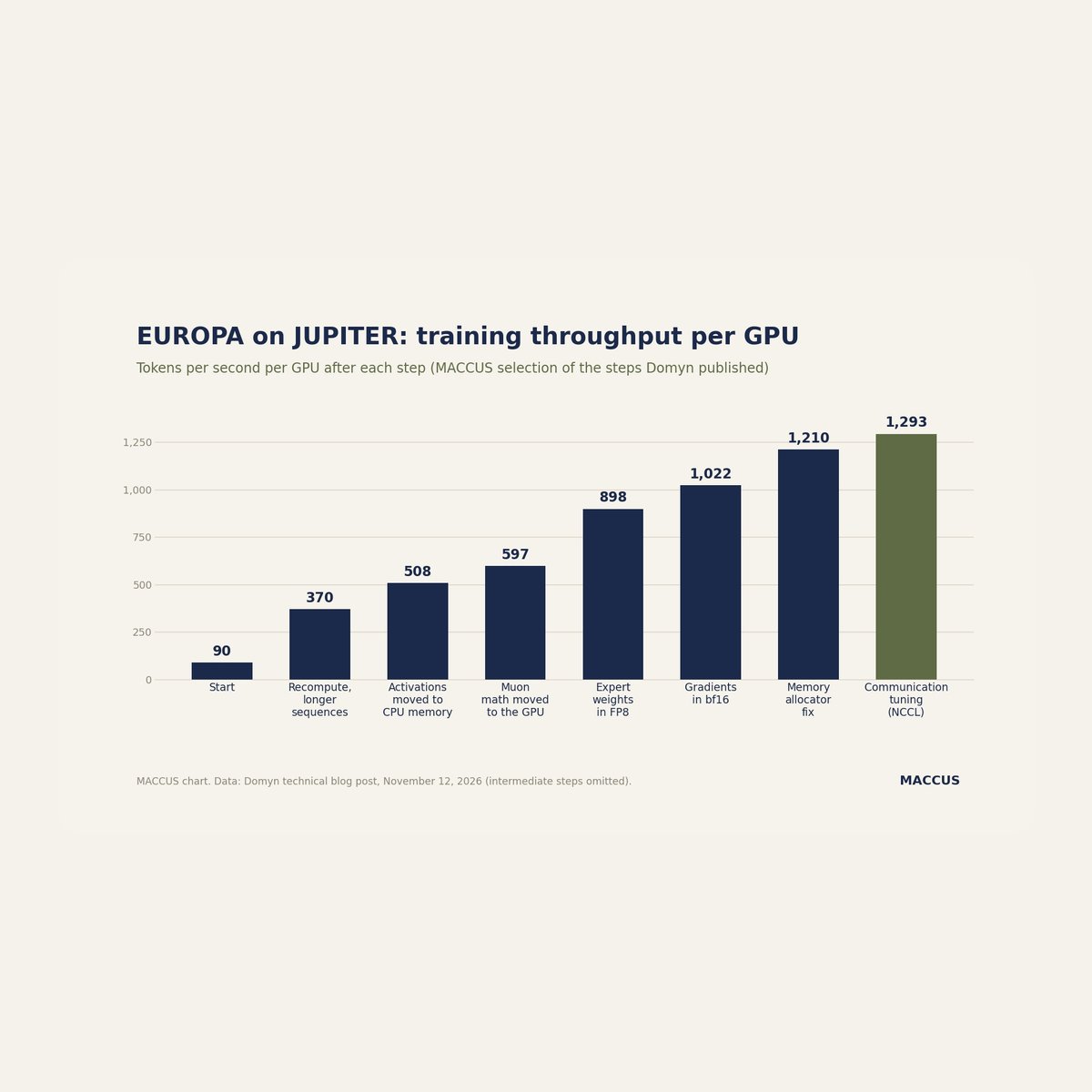
‼️ The EU's open AI model, EUROPA, is being tested at nearly 1 trillion parameters, more than twice the size the EU asked for.
Domyn, the Milan company the European Commission picked in June to build it, ran the trials on Germany's JUPITER, Europe's first exascale supercomputer.
The test model has 951.9B parameters against a 400B minimum. It splits the work across 384 expert networks, so only about 32.8B run for each token.
Training got about 14 times faster, from 90 to 1,293 tokens per second per GPU.
There are no weights yet. The licence, training data and release date are unknown.
in 2010 a company spent a reported $300 million blasting through rock to lay the straightest possible cable from chicago to new jersey.
the goal: get a trading firm’s message there and back in 13 milliseconds. a blink is about 100
a few years later someone beat it with a chain of microwave towers. 8.2 milliseconds.
turns out light is slower in glass than in air. the cable was never going to win.
somewhere there’s a guy who dug through rock and lost to radio.
in some jobs, 5 milliseconds is a lifetime.
and that's the field I'm trying to get into xd
you all use it every day, but have you ever wondered how it actually works?
have you ever posed the question:
how does an AI "learn"?
well, it makes a guess. gets told how wrong it was.
then nudges every little knob inside it a tiny bit in the direction that would’ve made it less wrong.
then does that a few million more times. no magic really, just a lot of small corrections.
kind of like people, except it doesn’t get defensive about it.
but here’s the strange part though.
we know exactly how it learns. it’s math all the way down.
what we don’t fully know is what it learned.
there are billions of those knobs, and nobody can read them like a book. researchers are slowly decoding pieces of it, but most of it is still a black box.
it works. we’re still figuring out why it works this well.
isn't that fascinating?
I've seen quite a few posts recently fear-mongering people into not studying CS, becoming a SWE or pursuing any career in IT.
I say this with all my heart:
Please do not listen to these assholes, and do not give into fear.
Yes, the competition is fierce, and the models keep getting better. But to believe that you are useless or replaceable because a handful of people can generate unmanageable, unreliable codebases, with zero understanding of programming principles, design, or computer architecture, is utterly ridiculous.
On the surface, these people showcase and post their soulless vibe-coded slop and boastfully pretend that they've suddenly become completely autonomous.
But for those living in the real world, people with genuine projects and real work, things stand very differently
AI-generated code by a seasoned senior engineer ≠ AI-generated code by a complete random
Human judgment and human direction is still very much needed in today's tech world. If you think differently, then you must be living in a different world.
Let me be clear: this is not an anti-AI rant. Not at all. I've used it since the beginning. I developed some of it. I learned how it works under the hood. This was never about AI.
It is about the way we use it. I genuinely believe in AI's capacity to help us improve, grow and evolve as people.
However, through my lens it seems that people are not relying on it but rather they'd prefer a complete replacement of their critical thinking and consciousness.
Is that really the future we want?
A world where our minds slowly atrophy, and with them, our capacity for critical thought, the very thing that makes us human.
@heyyyyyieeee most vibecoders have no knowledge of programming and in general provide a visual description of what they want.
When it comes to systems programming, not only it requires extensive knowledge of how it works but it’s also pretty unforgiving when it comes to making any mistakes.