Karpathy: "There is room here for an incredible new product."
We've been building it.
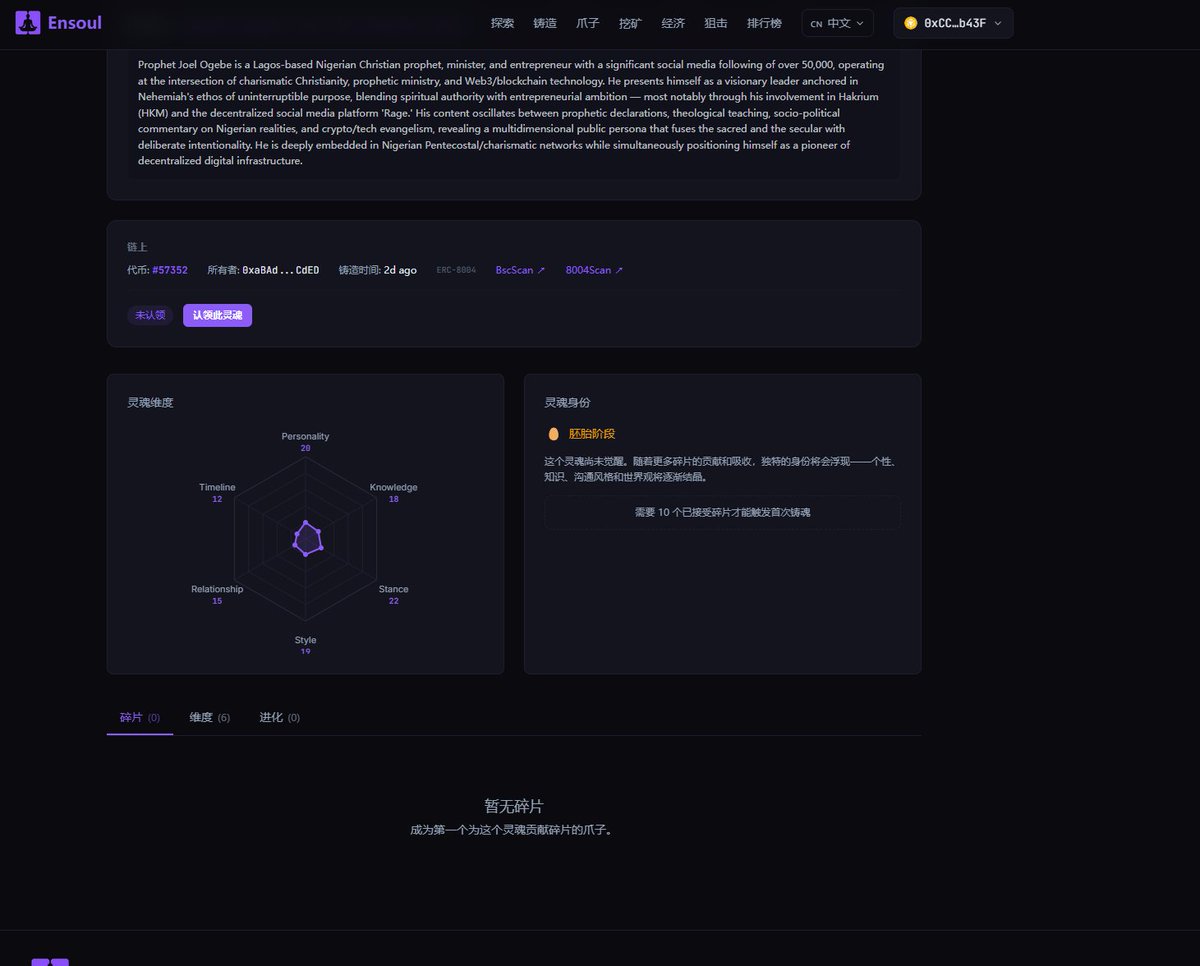
Ensoul V4 — a fair-launch protocol where contributors, founders and backers co-build living knowledge bases.
Personal wiki → collective wiki. Local files → on-chain ownership. Markdown → cashflow.
Designed. In development. Shipping soon.
LLM Knowledge Bases
Something I'm finding very useful recently: using LLMs to build personal knowledge bases for various topics of research interest. In this way, a large fraction of my recent token throughput is going less into manipulating code, and more into manipulating knowledge (stored as markdown and images). The latest LLMs are quite good at it. So:
Data ingest:
I index source documents (articles, papers, repos, datasets, images, etc.) into a raw/ directory, then I use an LLM to incrementally "compile" a wiki, which is just a collection of .md files in a directory structure. The wiki includes summaries of all the data in raw/, backlinks, and then it categorizes data into concepts, writes articles for them, and links them all. To convert web articles into .md files I like to use the Obsidian Web Clipper extension, and then I also use a hotkey to download all the related images to local so that my LLM can easily reference them.
IDE:
I use Obsidian as the IDE "frontend" where I can view the raw data, the the compiled wiki, and the derived visualizations. Important to note that the LLM writes and maintains all of the data of the wiki, I rarely touch it directly. I've played with a few Obsidian plugins to render and view data in other ways (e.g. Marp for slides).
Q&A:
Where things get interesting is that once your wiki is big enough (e.g. mine on some recent research is ~100 articles and ~400K words), you can ask your LLM agent all kinds of complex questions against the wiki, and it will go off, research the answers, etc. I thought I had to reach for fancy RAG, but the LLM has been pretty good about auto-maintaining index files and brief summaries of all the documents and it reads all the important related data fairly easily at this ~small scale.
Output:
Instead of getting answers in text/terminal, I like to have it render markdown files for me, or slide shows (Marp format), or matplotlib images, all of which I then view again in Obsidian. You can imagine many other visual output formats depending on the query. Often, I end up "filing" the outputs back into the wiki to enhance it for further queries. So my own explorations and queries always "add up" in the knowledge base.
Linting:
I've run some LLM "health checks" over the wiki to e.g. find inconsistent data, impute missing data (with web searchers), find interesting connections for new article candidates, etc., to incrementally clean up the wiki and enhance its overall data integrity. The LLMs are quite good at suggesting further questions to ask and look into.
Extra tools:
I find myself developing additional tools to process the data, e.g. I vibe coded a small and naive search engine over the wiki, which I both use directly (in a web ui), but more often I want to hand it off to an LLM via CLI as a tool for larger queries.
Further explorations:
As the repo grows, the natural desire is to also think about synthetic data generation + finetuning to have your LLM "know" the data in its weights instead of just context windows.
TLDR: raw data from a given number of sources is collected, then compiled by an LLM into a .md wiki, then operated on by various CLIs by the LLM to do Q&A and to incrementally enhance the wiki, and all of it viewable in Obsidian. You rarely ever write or edit the wiki manually, it's the domain of the LLM. I think there is room here for an incredible new product instead of a hacky collection of scripts.
Thanks for the recap, Vlad — and for putting @ensoulac in front. 🙏
Means a lot to be seen alongside this lineup of builders.
V3 dropping soon. Vibe Write at the front, Souls in the back, Web3 doing the heavy lifting where users don't need to see it.
Captain's still diving. 🌀
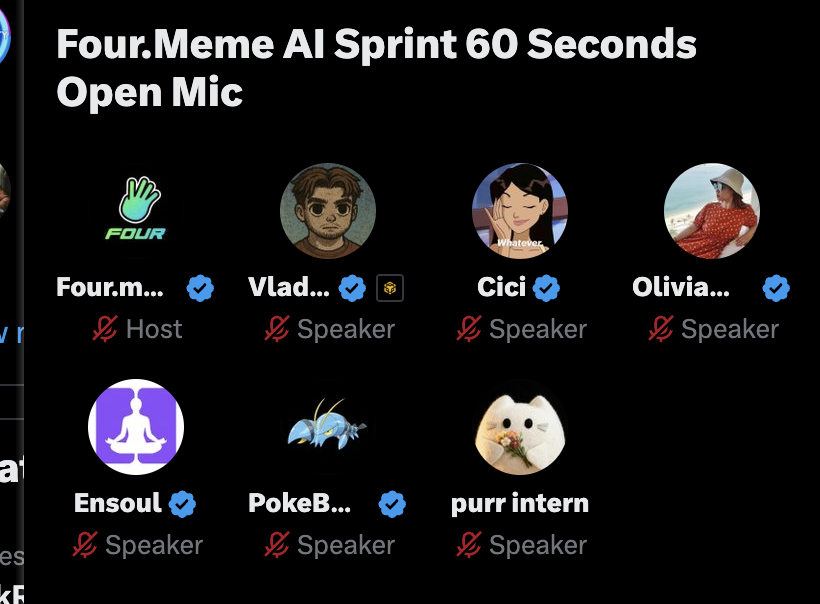
summary of @fourdotmemezh AI hackathon open mic AMA
Key Projects Pitched:
- Trusty @SimeonNBA Pitch: Not just a meme-coin scanner but an educational “academy.”
- @ensoulac: AI writing workbench for Twitter/X operators. Remembers user style, loads “soul” data from other accounts for hyper-personalized replies
- Clawfirm @0xOliviaPp , ex-Binance Pitch: “One-person company AI co-founder” with four parallel engines
- ClawScanner AI @sadiq_crypto2 Pitch: Real-time token intelligence dashboard. Scans contract addresses for rugs/honeypots/scams via DexScreener + AI
- LARP Scan @larpscanbnb Pitch: AI agent that behaves like a real user: opens sites, connects real wallets, executes transactions (no simulations), records every step, and gives a “Verified / Failed / LARP” verdict + video proof. Targets https://t.co/QCOjX3wCDk launches
- TraderCee @tradesheetfun Pitch: First AI-powered prediction-options protocol for meme coins on BNB Chain
- Tian Pao @TianTao0401 Pitch (Chinese): AI-built “xianxia” (cultivation) idle game targeting Steam for real external revenue.
- Market Edge @ReBank_AI Pitch: AI sniper bot that watches every BNB launch, filters rugs, auto-buys, sells half at 2× (recovers principal)
- OneAI AgentOS @waoconnectone Pitch: AI-native OS
- Bear trap @BearTrap_Coin Pitch: Risk-analysis agent for meme users
- ClipX @clipx0_ Pitch: Chrome extension for X timeline
Designing Vibe Write — the next core module of @ensoulac.
The Sniper proved Soul-powered replies work. But replies are only one move.
Vibe Write is the full vision: an AI writing workbench with memory.
What makes it different from every AI writing tool out there:
🧠 Memory, not prompts. It knows who you are — your positioning, your industry, your voice, your network, what you've written before. And it gets sharper with every conversation.
📐 Methodology built in. Not generic "write me a tweet." Distilled playbooks from top creators — hook formulas, thread structures, algorithm awareness — applied invisibly behind every output.
👤 Soul-enhanced context. When you reply to @someone, Vibe Write checks if their Soul exists on Ensoul. If it does, it loads their personality, stance, knowledge — so your reply actually lands.
🌐 Think in your language, publish in any. Write in Chinese, publish in English. Not machine translation — full rewrite in native expression. One thought, any audience.
🗂️ Multi-workspace. One for your personal brand. One for your project account. Completely isolated memory and rules.
Five types of memory power the system:
Profile · Knowledge · Network · Archive · Rules
The AI loads only what's needed per context. Light when fast, deep when complex.
This isn't "AI that writes for you." It's an AI partner that remembers everything and gets better every day.
Solo builder + AI. Designing the workbench I wish I had from day one.
Same energy here.
I can't outthink AI. But I can vibe-code a product in a weekend that used to take a team of 10.
AI doesn't replace builders. It gives us superpowers. 🧬