I lost $60,000+ during my first 2 years in the Market trading 0DTEs & penny stocks.
Please don't be me.
This is exactly what I do now:
- +1 month out minimum on options
- Trade leaders +90% of the time
- Bottom fish maybe ~10%
- Relative strength first, setup second
- Keep losses small
- Weekly chart = thesis
- Daily chart = timing
- 15/30min = execution
- Focus on Stage 1 → Stage 2 transitions
- Compression → expansion
- Price, Volume + 9/21/50EMAs = simplicity
- Price first, volume provides context
- Buy strength off weakness
- Wait for buyers to prove they're there
- Keep losses small
- Average up, never down
- Let winners pay for losers
- Minimize my time on X
- Build conviction through homework
- Trade themes with institutional sponsorship
- no tightness = no trade
- Protect mental capital at all cost
- Break-even means break-even
- Focus on risk before reward
- Journal everything
- Keep losses small
Turns out making money became a lot easier once I simplified my core approach... and stopped trying to turn $500 into a Lamborghini once a week.
Massive breadth expansion into the software sector. Both software-application and infrastructure benefitting from todays tape. There is not a close second place. $TEAM $MSFT $APP $HOOD $PLTR $FROG $SNOW $DDOG $OKTA $ZETA $FTNT $FIVN $NOW $CRWD $PANW some of the notables!
It's so strong even $MSTR is up 🤣
Two years. Two triple-digit returns. Zero options.
2026 YTD: +113% (mid six-figure portfolio)
2025 YTD: +160%
No options. No earnings gambles. No lotto plays. Just discipline & only shares!
Just themes, conviction, technicals, and relentless research.
Most people might think outsized returns come from taking massive risks.
In reality, a lot of it comes from:
- concentrating on the right themes
- identifying leadership early
- managing emotions
- and holding winners longer than most people can psychologically handle.
Technicals and fundamentals are my bread and butter
How I’m navigating this market:
- focusing on AI infrastructure, semis, robotics, power/grid, and software
- buying Stage 1 to Stage 2 transitions
- CANSLIM framework
- prioritizing relative strength + earnings acceleration
- adding on constructive pullbacks, not fear
Frameworks that helped me most:
- Power Earnings Gaps (PEGs)
- CANSLIM + Stage Analysis
- IPO VWAP reclaim
- AVWAP + 21EMA trend management
- sector-wide leadership confirmation
Some of the names driving performance:
$NBIS $MRVL $MU $ARM $RKLB $TSLA $TXN $TSEM $ALM $ONDS $IONQ $FPS
On average, I hold around 12 to 15 stocks across 5 to 6 major themes.
At first glance the portfolio may look diversified, but in reality it’s fairly concentrated - my top 5 positions usually make up nearly 50% of the portfolio.
The remaining positions are more rotational in nature, where I actively move capital between themes and emerging leadership.
Average holding period:
- Top 5 conviction positions: roughly 3 to 6 years
- Remaining positions: typically 1 to 3 months
Biggest lessons from 2026 so far:
- leaders rarely give easy entries
- concentration matters when conviction is high
- volatility is the price of outsized returns
- emotional control is one of the biggest edges
- real wealth is built by holding winners longer
Most people spend too much time predicting macro.
I’d rather focus on:
- earnings
- supply chains
- accumulation
- volume
- leadership
- real-world demand
Still a long way to go this year.
But I genuinely feel the process keeps improving every cycle.
Grateful for everyone following the journey.
The AI boom is not over. It has barely started.
What happened in 2023 to now was infrastructure seeding. What is coming next is full-scale deployment across every industry on the planet. The companies that own the compute, the networking, the power, the software, and the data centers are going to compound for years.
I want quality med-to-mega cap companies with real demand, and clear bottlenecks.
AI compute
NVDA: The leader in AI compute.
AMD: Earlier in the cycle, with room to gain share.
AVGO: Custom AI chips, networking, and infrastructure.
ARM: Benefits across mobile, edge, and AI architecture.
QCOM: Edge AI exposure in mobile and auto.
INTC: Turnaround and foundry optionality.
Semiconductor manufacturing
ASML: The lithography bottleneck.
TSM: The foundry backbone of AI hardware.
AMAT: Essential wafer-fab equipment.
LRCX: Etch and deposition.
KLAC: Process control and inspection.
TER: Chip testing.
AI networking
ANET: One of the most important AI networking names.
MRVL: Data-center connectivity and custom silicon.
CRDO: AI interconnect and serdes exposure.
CIEN: Optical networking demand.
CSCO: Slower growth, but still relevant.
GLW: Fiber and materials demand.
LITE: Optical components exposure.
COHR: Optical components exposure.
Servers and storage
DELL: AI servers and enterprise systems.
HPE: Enterprise infrastructure and supercomputing.
MU: Memory bottleneck exposure.
PSTG: High-performance storage.
NTAP: Hybrid cloud storage.
WDC: Cold storage at scale.
STX: Cold storage at scale.
Power and cooling
VRT: Clean AI cooling and power exposure.
ETN: Power management and electrical infrastructure.
GEV: Grid and power equipment.
CEG: Nuclear baseload power.
VST: Data-center power demand.
NEE: Grid and generation exposure.
DUK: Grid and generation exposure.
Enterprise AI
MSFT: Core AI platform and enterprise distribution.
GOOGL: Undervalued AI platform with search, cloud, and models.
ORCL: Cloud infrastructure and database leverage.
META: AI-enabled ad platform.
SNOW: Data layer for AI.
PLTR: Enterprise AI and government.
NET: Edge infrastructure and inference.
DDOG: Observability for AI-heavy systems.
MDB: Application data infrastructure.
NBIS: Higher-beta AI cloud name.
Data centers
EQIX: Premium interconnection and colocation.
DLR: Hyperscale data-center infrastructure.
AMT: Tower and data infrastructure.
IRM: Data center and records management.
APLD: AI-focused data center operator..
Defense and Space
LMT: Defense prime with AI integration.
RTX: Aerospace, defense, and autonomous systems.
NOC: Defense tech, space, and cyber.
GD: Defense platforms and systems.
AVAV: Drones and autonomous systems.
RKLB: Defense and launch systems.
RKLB: Cleanest space name with revenue and launch activity.
ASTS: High-upside, but execution-heavy.
LUNR: More speculative, but interesting.
Optics and fiber
GLW: Fiber and materials leader.
CIEN: Optical networking for AI clusters.
LITE: Optical components.
COHR: Optical components.
Solar and clean energy
FSLR: Cleanest solar name with utility-scale exposure.
ENPH: Residential solar and more cyclical.
RUN: Higher risk and financing-sensitive.
SEDG: Turnaround name.
NEE: Clean power and grid exposure.
Nuclear and uranium
CEG: Best nuclear utility-style name.
VST: Generation exposure.
NEE: Grid and baseload exposure.
DUK: Grid and baseload exposure.
CCJ: Uranium supplier exposure.
OKLO: More speculative SMR name.
Quantum
IONQ: Optionality name.
RGTI: Optionality name.
QBTS: Optionality name.
INFQ: NVIDIA-tied quantum name.
QTUM: Cleaner ETF route
Strategic materials
MP: Rare earths and strategic materials.
UUUU: Strategic materials and uranium.
USAR: Rare earth exposure.
CRML: Rare earth exposure.
What this captures is simple: the AI trade is bigger than chips. It runs through compute, networking, power, storage, data centers, software, and the adjacent sectors that support the buildout.
This is not a trading list. This is a positioning list.
You do not need to own all of these. You need to understand all of these. Pick your conviction plays, size them correctly, and hold through the volatility.
Take the long weekend to study them.
$NOK.
- adding again (first adds were @ $6, see below)
- $nvda is invested
- anduril connection
- super strong chart
I think this can go ballistic.
Target = $20+
Risk = daily close under $13
Currently @ $14.18 on $NOK.
Let me break down my $ARM trade because this has been my biggest winner of 2026 so far.
This trade perfectly explains why I care so much about RS names, Stage 2 trends & buying pullbacks in true leaders instead of trying to bottom fish garbage.
My original buy on $ARM came off the 138 pivot months ago after recognizing the Stage 1 → Stage 2 transition taking place. Then yesterday, after getting stopped earlier this week, I re-entered right at LOD off the 21EMA reclaim, and now today we’re closing around 255.
My $ARM 250c 18 Jun contracts went from 6.80 → 30.50 for +349% in basically 1 day… while still having over a month left of expiration.
But what’s important is NOT the gain itself.
It’s WHY I was watching this name so aggressively in the first place.
Let’s start with the overall market:
Monday:
market closed red → $ARM closed green.
Tuesday:
market closed red → $ARM closed green.
Today:
market closed green → $ARM closed green.
Do you see what I’m looking for there?
That’s relative strength, and that’s one of the first things my eyes immediately gravitate toward every single day. If the market is pulling back, chopping, or struggling and a stock REFUSES to break… that tells me institutions are likely still aggressively supporting price.
And this becomes even more important when you compare it against the actual semiconductor ETFs themselves.
Monday:
$SMH + $SOXX losed red → $ARM closed green.
Tuesday:
$SMH + $SOXX closed green → $ARM closed green.
Today:
Everything moved higher → $ARM continued moving higher aggressively.
That’s leadership behavior + strong stocks don’t just outperform weak markets… they often outperform their own sectors too.
That’s a huge footprint I look for.
"Relative strength first, setup second."
Once I identify a true leader, THEN I start stalking execution opportunities around the chart structure itself.
Now let’s talk positioning because this matters massively.
$ARM broke out of a massive IPO/multi-year base earlier this year. I talk constantly about Stage 1 → Stage 2 transitions because those are usually the names institutions continue accumulating for months once the trend properly develops.
Most traders wait until the stock is already massively extended and obvious before becoming interested. I’m trying to identify the shift while the stock is still transitioning...
That’s why my first major entry came near 138.
The stock was:
- tightening
- reclaiming key pivots
- showing relative strength
- healthy volume patterns
+ institutions were involved
Once a true Stage 2 trend begins, I want to buy pullbacks aggressively because healthy trends usually continue trending.
That’s where the 9/21EMA setup becomes incredibly important for my process.
Yesterday’s re-entry came from $ARM pulling back into the 21EMA after expansion... weak hands started panicking, momentum cooled slightly, then buyers immediately stepped back in and defended price intraday.
That’s the exact slingshot setup I talk about constantly.
> strong stock + strong theme + strong group
> controlled pullback + defined risk.
> momentum + reclaim confirmation
And another important thing:
I wasn’t buying weakness hoping it would reverse.
I waited for momentum to CONFIRM first!
That’s why I entered off LOD once price started reclaiming and proving buyers were stepping back in. If I’m wrong, I get stopped quickly...but if I’m right, I can know quickly and immediately begin building cushion while the trend continues working.
My process summed up is...
1) identify true leadership
2) wait for healthy pullbacks into support
3) execute once momentum turns back up
4) have the emotional ability to actually hold the winner
That’s the hard part.
Because most people either:
- chase emotional extension candles
- panic during normal pullbacks
- or take profits way too early
These Stage 2 leaders just continue grinding higher for months because institutions physically cannot build full positions in a single day. Arm’s continued expansion into AI data centers, CPUs, and energy-efficient compute infrastructure has kept institutional demand extremely strong throughout 2026.
again...
My goal is 2...
find leadership,
buy controlled weakness,
manage risk aggressively,
then let the winners run.
That’s what I repeat every single week!
Chart: $ARM.
If I had the chance to go back in time and tell myself 5 things about the market 8 years ago, this is what they would be.
Ultimately, many of you will have to learn these lessons the hard way.
1. Don't short stocks until you have $1 Million in profit
2. Don't Trade Options
3. Hold your winners, religiously and define your sell rules
4. Master One Setup, just one.
5. If it's red, it's gone. Don't hold a stock that doesn't show a profit from the get go
6. No trading when the market is below the 50SMA
7. Learn how to count
Major leaders are now testing the 21-day EMA while still showing strong relative strength.
$ALAB $TWLO $MU $MRVL $ARM $VIAV $TSEM $ADI $NXPI $SNDK $WDC $STX $NVDA $INTC $ACMR $UMC $MXL $BE
This is where strong trends usually reset before the next move higher.
Here are some leading stocks to focus on:
Stronger groups and fairly high RS charts. Quite a few others of interest too.
AAOI, AAPL, AEHR, AKAM, AMAT, AMZN, APLD, AVGO, AXTI, BE, CAT, CIEN, COHR, CRWD, DDOG, DOCN, FTNT, GLW, GOOGL, HUT, INOD, KLAC, LITE, LUNR, NBIS, NVDA, ON, PANW, PL, SNDK, STX, TSEM, TXN, WDC
I've not included names I am long:
DELL ARM MU MRVL VRT TWLO RKLB
Bull: The broader uptrend remains firmly intact, powered by massive AI tailwinds and leading stocks have been incredibly resilient, repeatedly shrugging off recent shakeouts.
Bear: Valuations are becoming stretched and participation is still too narrowly concentrated in the largest names. Additionally, treasury yields are rising on renewed inflation fears and the market is rapidly pricing out 2026 rate cuts.
Trader: Respect the uptrend, but keep an eye on yields. Stay selective and don't get shaken out of the true leaders.
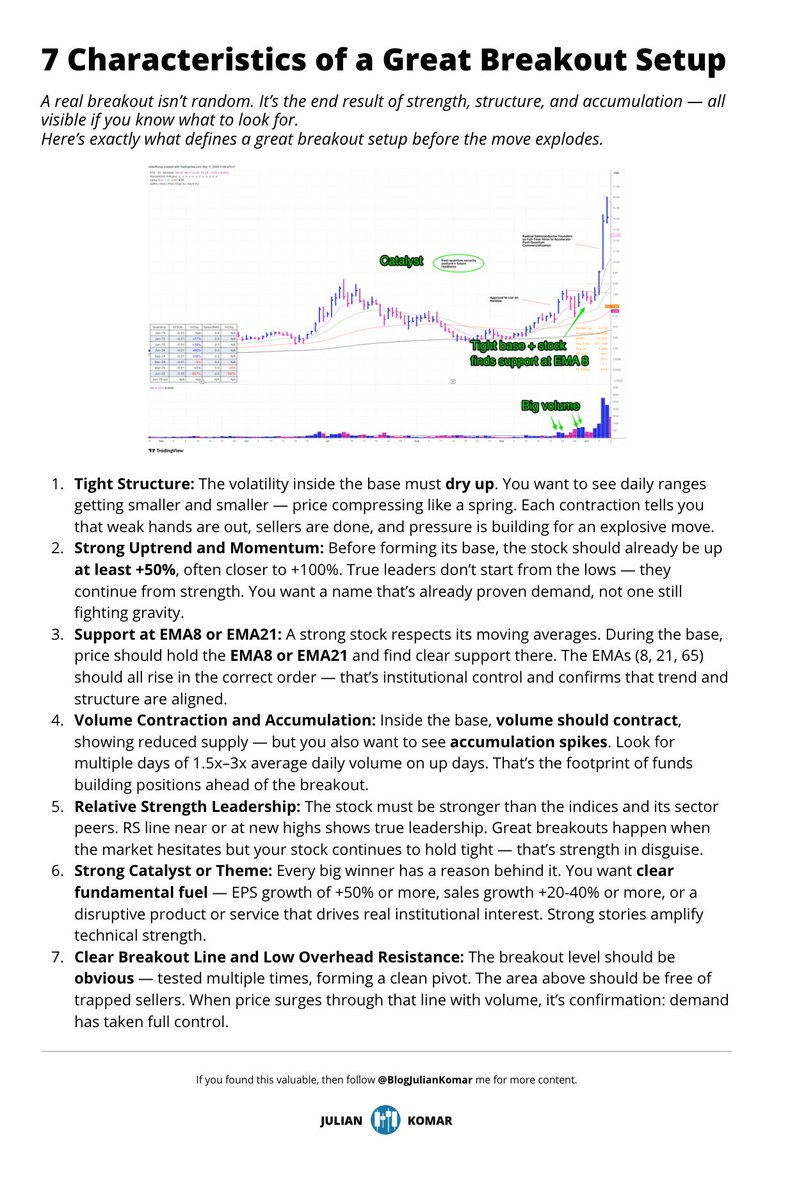
90% of my trades are #breakout#trades
Not all of them work, but the few that work make all the difference.
Selecting the right stocks & entry points is a kind of art and you want to train that.
Here are a few key characteristics of a great setup 👇
The mentality surrounding trading has a significant impact on your overall experience and success, in my opinion. It's essential to reflect on your motivations: Why are you engaging in trading? Are you in a position where you desperately need this money to meet your financial obligations, or are you driven by a desire for more wealth? Understanding the distinction between necessity and desire is crucial.
When you reach a point where you recognize that you don't critically need the money but instead derive enjoyment from performing well and participating in the trading process, you can liberate yourself from undue pressure. This shift in perspective allows you to approach trading with passion rather than desperation, ultimately enhancing your decision-making and overall performance.
Random noise becomes less influential on your decision-making, and you are not trading with fear but with confidence and poise
These are 10 timeless principles that I’ve picked up from @OliverKell_ over the years.
I’ve spent a lot of time studying these concepts, making mistakes & slowly integrating them into my personal system.
Here’s how I personally think about and apply each one in my own trading:
--
1. PUT RISK FIRST.
This completely changed my trading, because I used to be obsessed with making money. Now I’m obsessed with protecting mental/physical capital. Before entering any trade, I already know:
> where I’m wrong
> how much I can lose
> whether the reward justifies the risk
Most of my focus is honestly around avoiding disaster. One really bad trade can wipe out months of progress.
"Best losers win."
--
2. IF YOU FAIL TO PLAN, YOU ARE PLANNING TO FAIL.
Most of my work happens late at night + before the market even opens.
I’m building focus lists, marking pivots, studying leadership, identifying themes, setting alerts, reviewing earnings dates, and visualizing different scenarios beforehand. Once the bell rings, I don’t want to be “thinking,” I want to be reacting to preparation.
The traders who consistently look calm usually prepared the hardest.
--
3. DON’T TRUST YOUR STOCKS, TRUST YOUR STOPS.
The market does not care about my opinion or thesis.
This was one of the hardest lessons for me emotionally because I used to marry ideas. Now I understand that my stop is what protects me from myself. If price breaks my level and the trade loses character, I respect it and move on.
I can always re-enter later!
Don't be the big ego guy...take the hit and move on.
--
4. IT’S BETTER TO BE OUT AND WANT IN THAN IN AND WANT OUT.
There is nothing worse than being trapped emotionally in a position you know you oversized, chased, or forced. I’d much rather miss upside than sit frozen in a trade that’s completely violating my rules.
There will always be another setup.
Always.
FOMO is expensive.
--
5. LET YOUR PNL GUIDE YOUR LEVEL OF AGGRESSION.
This is something I think newer traders massively overlook.
When my system is working, leadership is acting well, and my equity curve is healthy, I naturally press harder. When conditions become choppy, or I’m in a drawdown, I intentionally reduce size and become defensive.
I trade in bursts.
You don’t need to force activity every single day. Some environments are designed to pay trend/momentum traders extremely well. Others are designed to chop you apart!
Learning the difference is a huge edge.
--
6. ONLY PRICE PAYS.
I love narratives and themes, but price always comes first.
A stock can have the greatest story in the world, but if institutions are not supporting the move through price action, volume, and relative strength, it’s irrelevant to me.
That’s why I focus so heavily on:
* leadership
* compression
* breakouts
* EMA behavior
* relative strength
* reactions to pullbacks
The chart tells me whether institutions agree with the story.
--
7. SELL INTO STRENGTH OR YOU WILL SELL INTO WEAKNESS.
Especially with Options!
Selling into strength feels uncomfortable because greed convinces you the move will never end. But when names become extremely extended from key moving averages, euphoric, or crowded, I’ve learned to start paying myself gradually.
* large extensions from the 9EMA
* emotional momentum expansions
* vertical moves
* major target levels
If you never sell strength, the market usually forces you to sell weakness later.
--
8. FROM FAILED MOVES COME FAST MOVES.
One of my favorite concepts :))
Failed breakdowns and failed moves often create violent reversals because positioning becomes trapped. Once price reclaims key levels, shorts cover, buyers step in aggressively, and momentum accelerates quickly.
That’s why I pay so much attention to:
- EMA crossbacks
- undercut & reclaim setups
- failed breakdowns
- reclaiming prior pivots
- failed gap-downs
The fastest moves in the market come from failed positioning.
--
9. DON’T GAMBLE ON EARNINGS.
I learned this lesson the hard way multiple times.
Earnings reactions are largely out of our control. You can have the right thesis and still get destroyed because guidance, margins, positioning, or expectations shifted.
Now I’m much more intentional around earnings:
> reducing size
> trimming beforehand
> avoiding oversized exposure
> planning scenarios ahead of time
The most recent example being $CRWV this last week, reduced position into ER and was stopped @ b/e.
Stop trying to hit a home run every quarter.
--
10. NEVER BUY EXTENDED STOCKS.
This principle alone probably would’ve saved me tens of thousands early on.
When stocks become massively extended from their moving averages, your risk/reward immediately worsens. Chasing usually comes from emotion, not process!!
I spend most of my time waiting for price to come into areas of interest. For ex: pullbacks into the 9/21EMAs, tight consolidations, inside days, compression areas, weekly support pivots, etc.
--
At the end of the day, all 10 of these principles really tie back into one bigger idea.
Survive long enough for my edge to compound.
Simple concepts, but very difficult to execute every single day.
Save/bookmark this post for later.
I hope this helps!
This is 1 of the main screeners I use every single week to track the strongest names in the market & exactly how I use it:
Nothing fancy, just a process that helps me consistently narrow down where institutions are already putting money to work.
The goal of this screener is simple:
Find stocks with momentum, liquidity, relative strength, and enough volatility to actually produce meaningful asymmetric opportunities.
Here’s what I’m filtering for and why it matters:
1) Price > $10
Avoids illiquid garbage and low-quality names.
2) ADR > 4%
I want names that MOVE. If a stock only moves 1–2% a day, it’s usually not worth my attention for my style.
3) Price above 52W low by 70%+
I want names already proving strength, not dead stocks trying to “bottom.”
4) Price x Volume > 10M
Liquidity is very important. I want real participation.
5) EMA 9 > EMA 21
Short-term momentum confirmation.
6) Price > 50EMA
I want names above important trend structure, not fighting underneath it.
This screener is where the research begins.
Once I have my names, I manually go through charts one by one and ask:
* Is this a leading stock in a leading group?
* Is volume confirming the move?
* Is this extended or still early?
* Is there a multi-month base forming?
* Is relative strength improving vs the market?
* Is there a narrative institutions can pile into?
That’s where names like $ARM, $MU, $DOCN, $WULF, $APLD, $INTC, etc first started grabbing my attention.
Then the watchlist process begins.
I’m usually not buying the second I find the stock. Most of the time I’m stalking it for days or weeks waiting for the right structure to appear. I’ll track:
> pullbacks into the 9/21EMA
> tight consolidations
> volume drying up
> higher lows forming
> failed breakdowns/U&Rs
> relative strength on red market days
This is where the nuance comes in.
A beginner sees “a stock going up.”
I’m trying to identify whether institutions are accumulating, whether supply is drying up, whether the stock is tightening before expansion, whether the group is strengthening, etc...
Once all those layers line up, THEN I focus on execution.
And honestly… the entry tactic matters less than most people think.
Pullback, breakout, EMA reclaim, intraday pivot reclaim… I don’t really care as long as:
1. the stock is a leader
2. the group is acting well
3. risk is tight
4. upside asymmetry is there
That’s the process.
Screen → stalk → refine → execute.
Most people overcomplicate trading because they’re trying to force random trades. I’m trying to do the opposite:
Reduce the market down to a small list of elite names, then patiently wait for opportunities where risk can be clearly defined.
The hard part isn’t finding stocks anymore.
The hard part is having the patience to wait for YOUR setup inside the right names.